
AI wardrobe personalization is defined as the use of machine learning algorithms to generate outfit recommendations tailored to an individual's style preferences, body type, occasion, and budget. The best practices for this field center on three pillars: minimizing complexity, building user trust, and confirming preferences before delivering suggestions. Platforms like Mytenue, along with research-backed systems such as PrefAnalyst, show that perceived complexity reduces purchase intent when AI explanations are unclear. Getting wardrobe AI optimization right means treating transparency as a feature, not an afterthought. These practices apply whether you are using a dedicated app or exploring AI styling recommendations for the first time.
1. What are the core AI wardrobe personalization best practices?
Trustworthy AI wardrobe personalization starts with reducing the mental effort required from you. A 2026 study of 375 shoppers found that perceived AI complexity lowers purchase intent. That finding means the best wardrobe AI tools must explain their suggestions in plain language, not just surface a result.
The foundational principles are:
- Interpretability first. Every outfit suggestion should come with a plain-language reason. "This blazer pairs with your navy trousers because both are business-casual and share a cool color tone" beats a confidence score.
- Transparent AI labeling. Any output generated or assisted by AI must be clearly marked. The 2026 EU AI Act Article 50 requires visible AI-generated content labels at the point of interaction.
- Preference confirmation steps. Before finalizing a recommendation, the system should ask you to confirm ambiguous inputs. Do you prefer fitted or relaxed? Casual Friday or client meeting?
- Explainable AI (XAI) techniques. Systems using XAI and Retrieval-Augmented Generation produce interpretable fashion recommendations that users can actually evaluate and trust.
- First-run disclosures. The app should tell you upfront that AI is powering its suggestions, in language that is easy to find and understand.
Pro Tip: If an AI styling app cannot explain why it recommended a specific outfit, treat that as a red flag. Explanation quality is the fastest signal of how well the system actually understands your style.
2. How do multi-agent AI workflows refine your style preferences?

The most accurate personalized fashion algorithms do not guess your preferences once and move on. They confirm, clarify, and refine through structured dialogue. The PrefAnalyst system, published in 2026, demonstrates this with a multi-agent preference clarification approach that separates inference from confirmation before generating any outfit suggestion.
Here is how a well-designed preference workflow operates:
- Preference inference. The system analyzes your uploaded wardrobe items, past choices, and stated style goals to form an initial profile.
- Ambiguity detection. A dedicated interaction agent flags unclear or conflicting signals. If you own both athleisure and formal wear, the system asks which context you are dressing for.
- Dialogue confirmation. You answer 2–4 targeted questions per session. These are not generic quizzes. They address specific gaps in the system's understanding of your preferences.
- Preference stabilization. The system locks in a confirmed preference set before generating outfit cards. This prevents early errors from cascading into every recommendation.
- Recommendation delivery. Only after stabilization does the AI present outfit options, each with a tailored explanation linked to your confirmed preferences.
This staged approach mirrors how a skilled personal stylist works. A good stylist does not hand you a rack of clothes without asking questions first. The same logic applies to AI.
Pro Tip: When using any AI wardrobe app, answer preference questions as specifically as possible. Vague answers like "I like casual" produce generic results. "I prefer relaxed-fit chinos over jeans for weekend errands" gives the algorithm a real signal to work with.
3. What personalization techniques prevent style echo chambers?
Overfitting is the hidden problem in wardrobe AI optimization. When an algorithm only shows you what you already own or have approved before, your style stops growing. Research recommends diversity-aware outfit recommendations as the primary fix.
The best personalization techniques in fashion address this directly:
- Diversity-aware ranking. The algorithm deliberately includes one or two suggestions outside your usual profile in each session. This keeps your style from calcifying around a narrow set of choices.
- Accept/reject feedback loops. When you reject a suggestion, the system learns why rather than simply removing that item type from future results. Granular feedback produces better refinement than binary filtering.
- Controlled exploration modes. Some platforms let you toggle a "style exploration" setting that increases the range of suggestions without abandoning your core preferences entirely.
- Out-of-profile prompts. The system periodically asks, "Would you try this?" for items that fall outside your confirmed profile. Your response trains the algorithm without forcing a change.
The goal is a wardrobe AI that grows with you. An algorithm locked to your past choices is useful for getting dressed quickly. An algorithm that also nudges you toward new combinations is useful for building a better wardrobe over time.
4. How to use AI for wardrobe: choosing the right app
Selecting the right tool matters as much as understanding the principles behind it. The best wardrobe AI tools share a specific set of features that separate genuinely useful apps from novelty products.
| Feature | Why it matters |
|---|---|
| Plain-language outfit explanations | Builds trust; lets you evaluate and learn from each suggestion |
| AI-generated content labels | Required by the 2026 EU AI Act; signals platform accountability |
| Preference confirmation dialogue | Reduces misaligned suggestions before they reach you |
| Closet upload with attribute tagging | Color, texture, and occasion tags improve recommendation accuracy |
| Diversity controls | Prevents style echo chambers and supports wardrobe growth |
Uploading high-quality data is the single most underrated factor in AI styling recommendations. Consistent item attributes and context tags matter more than the sophistication of the underlying model. A photo taken in good light with accurate color representation gives the algorithm a reliable signal. A blurry image tagged only as "shirt" gives it almost nothing.
Mytenue applies this principle directly. The platform lets you build outfits based on your style preferences, occasions, and budget, then delivers recommendations with clear reasoning attached. For occasion-specific outfit planning, Mytenue's guide to occasion-ready outfits shows how AI can match suggestions to real-life context rather than abstract style categories.
Pro Tip: Before uploading your wardrobe to any AI app, photograph items against a neutral background and tag each one with at least three attributes: color, fabric weight, and occasion. This small investment in data quality produces noticeably better recommendations within the first week.
5. What legal and ethical transparency practices should AI wardrobe apps follow?
Transparency in AI fashion apps is both a legal requirement and a trust-building tool. The 2026 EU AI Act Article 50 sets a clear standard: first-interaction disclosures must be visible and easy to understand. Apps that bury this information in terms-of-service documents fail both the law and their users.
The recommended disclosure checklist for any AI wardrobe platform includes:
- In-app labels at point of output. Every outfit card should carry a visible "AI-generated" or "AI-assisted" marker near the recommendation itself.
- First-run disclosure screen. New users should see a clear explanation of how AI powers the app before they interact with any suggestions.
- Export-safe labeling. When you save or share an outfit recommendation as a PDF or image, the AI-generated label travels with it. Transparency does not stop at the app's edge.
- Plain-language explanations of data use. The app should tell you what data it collects and how it uses that data to generate suggestions.
"Transparent, easily perceivable AI disclosures at the point of interaction reduce ambiguity and align with trust-building best practices." — EU AI Act Article 50 compliance guidance, 2026
Platforms that treat disclosure as a UX feature rather than a legal checkbox earn measurably higher user trust. A user who understands how the AI works is far more likely to engage with its suggestions and provide the feedback that makes those suggestions better over time.
6. How detailed AI explanations improve recommendation trust
Explanation quality is the clearest predictor of whether you will trust and act on an AI outfit suggestion. A 2026 user study of 211 participants found that detailed LLM-generated explanations improve trust significantly, especially when paired with diverse outfit selections.
The explanation should do three things. First, it should name the specific attributes that drove the recommendation, such as color harmony, occasion fit, or fabric compatibility. Second, it should connect those attributes to your confirmed preferences. Third, it should invite your feedback so the system can adjust.
Fashion shoppers evaluate AI outputs not just for practical accuracy but also for credibility and identity alignment. A recommendation that feels like "you" is more persuasive than one that is technically correct but feels generic. This is why explanation design is not a secondary concern. It is central to how well the personalization actually works.
Platforms advancing in this area use large language model (LLM) generated rationales that are tailored to the specific algorithm producing the recommendation. Generic explanations like "this matches your style" add no value. Specific ones like "this linen shirt fits your preference for breathable fabrics in warm-weather casual settings" build both trust and understanding.
Key takeaways
AI wardrobe personalization works best when transparency, preference confirmation, and diversity-aware recommendations operate together as a system rather than as isolated features.
| Point | Details |
|---|---|
| Transparency builds trust | Visible AI labels and plain-language explanations increase user confidence and engagement. |
| Confirm preferences before recommending | Multi-agent workflows that clarify ambiguous inputs produce more accurate outfit suggestions. |
| Data quality drives accuracy | Consistent photos with color, texture, and occasion tags improve AI personalization more than model complexity. |
| Diversity prevents style stagnation | Diversity-aware ranking and accept/reject feedback loops keep recommendations fresh and relevant. |
| Disclosure is a UX feature | First-run disclosures and export-safe labels satisfy legal requirements and strengthen user trust simultaneously. |
Where AI wardrobe personalization is actually heading
I have watched AI styling tools evolve from basic color-matching filters to multi-agent systems that hold genuine preference dialogues. The shift that matters most is not the technology. It is the design philosophy behind it.
The tools that earn lasting user trust are the ones that treat explanation as a core feature, not a footnote. Most apps still bury their reasoning in a confidence score or skip it entirely. That is a missed opportunity. When a system tells you why it paired a specific jacket with those trousers, you learn something about your own style. That learning compounds over time.
The echo chamber problem is real and underreported. I have seen users lock themselves into a narrow aesthetic within weeks of using a poorly designed AI wardrobe app, simply because the algorithm kept confirming their existing choices. Diversity-aware modes are not a luxury feature. They are what separates a useful tool from a digital mirror.
The hyper-personalized styling direction the industry is moving toward requires both better algorithms and better user education. You get more from these tools when you understand how to feed them good data and how to interpret their suggestions critically. The best AI stylist is one you can have a real conversation with, not one that just hands you an outfit card and waits.
Experiment with the tools available now. Push them with specific questions. Reject suggestions and see how the system responds. The ones worth keeping will adapt. The ones that do not will tell you everything you need to know.
— Ahmed
Mytenue: your AI stylist, built around best practices
Ready to put these principles to work?
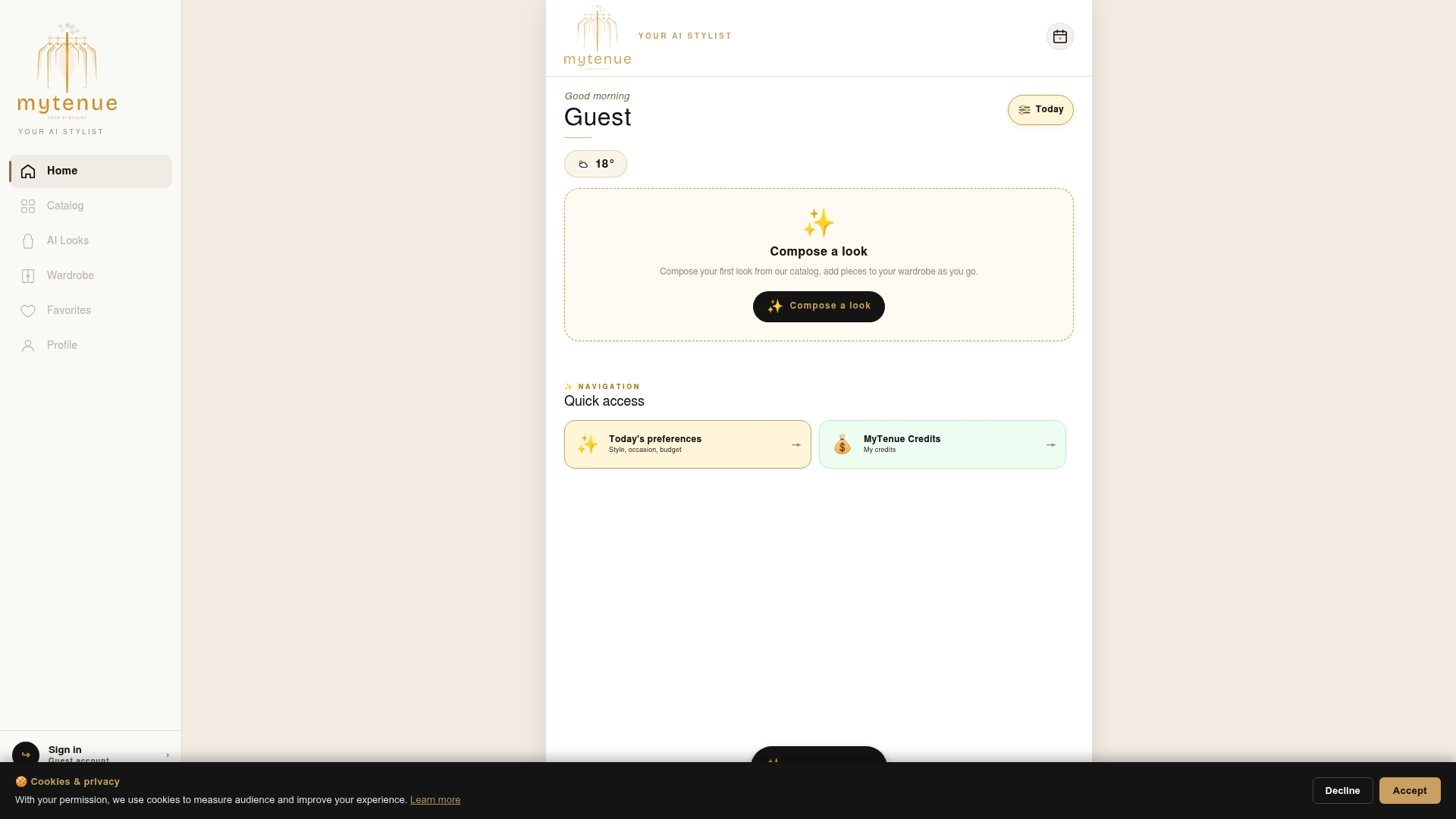
Mytenue is an AI-powered wardrobe platform built around the exact practices covered here. It delivers outfit recommendations based on your style preferences, occasions, and budget, with clear reasoning attached to every suggestion. The platform encourages you to mix existing wardrobe pieces with new finds, which supports both personal style growth and smarter shopping. Preference confirmation is built into the experience, so the AI learns what you actually want rather than guessing. Visit Mytenue to build your first AI-curated outfit and see how transparent, preference-driven personalization feels in practice.
FAQ
What is AI wardrobe personalization?
AI wardrobe personalization is the use of machine learning to generate outfit recommendations tailored to your style preferences, occasion, and budget. The best systems confirm your preferences through dialogue before delivering suggestions.
How do I get better results from AI wardrobe apps?
Upload high-quality photos with accurate color, fabric, and occasion tags. Consistent, detailed wardrobe data improves recommendation accuracy more than any other single factor.
What should AI wardrobe apps disclose to users?
The 2026 EU AI Act requires visible AI-generated content labels at the point of output and a clear first-run disclosure. Apps should also embed AI labels in any exported or shared outfit recommendations.
What is the echo chamber problem in fashion AI?
Overfitting occurs when an algorithm only recommends styles you have already approved, narrowing your wardrobe over time. Diversity-aware ranking and accept/reject feedback loops are the standard fix.
Why do AI outfit explanations matter?
A 2026 study of 211 users found that detailed, LLM-generated explanations significantly increase trust in AI fashion recommendations. Explanations that name specific attributes and connect them to your preferences outperform generic rationales every time.