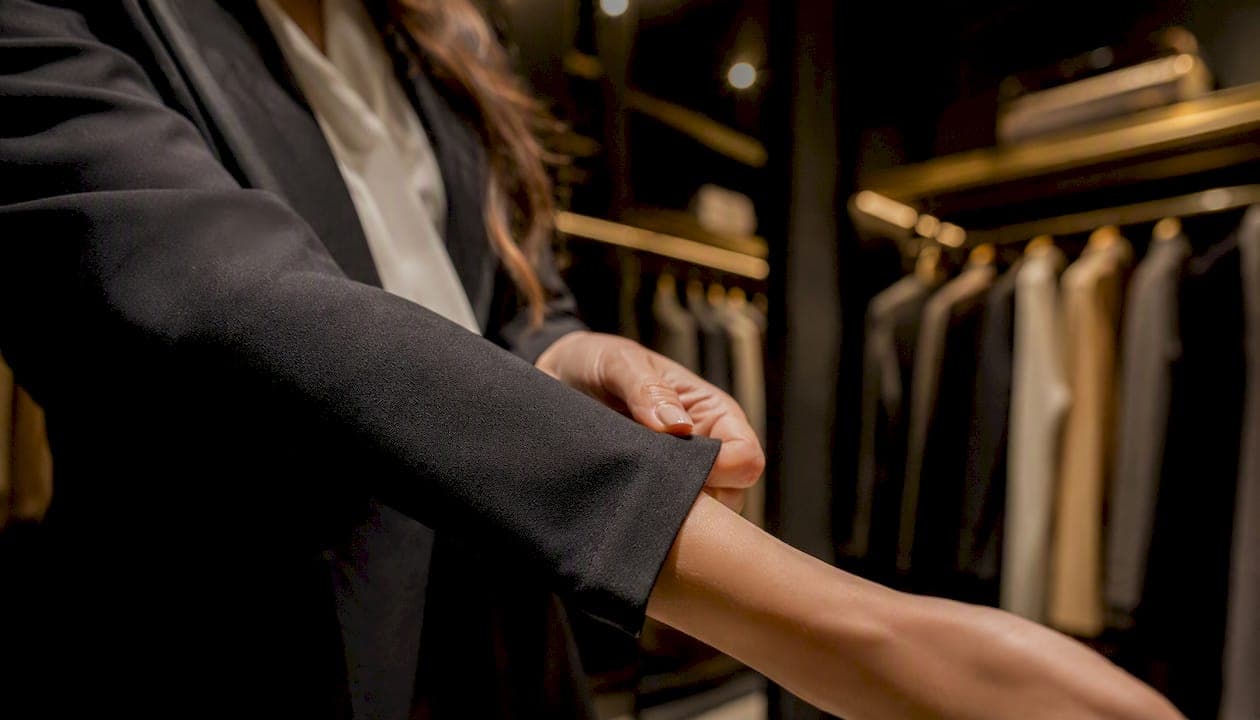
Stretch fabrics deliver three things every daily outfit needs: comfort that holds up from morning to night, a fit that contours without pinching, and freedom of movement that rigid fabrics simply can't match. Whether you're commuting, sitting through back-to-back meetings, or running errands, the right stretch piece changes how your clothes feel on your body.
- Knit vs. stretch-woven: Knit fabrics stretch by default (looped yarn structure); stretch-woven fabrics need added elastane to give. Knits are softer and more casual; stretch-wovens are more structured and durable for work and travel.
- Recovery is the number that matters most: A fabric that stretches but doesn't snap back will bag at the knees and waist within hours. Always check recovery before you buy.
- Start with one piece: A travel pant or a four-way stretch tee is the lowest-risk entry point. Wear it for a full day and notice where rigid fabrics used to restrict you.
Key Takeaways
Stretch fabrics deliver lasting comfort and fit only when you match construction type, elastane percentage, and recovery rating to the garment's actual daily demands.
| Point | Details |
|---|---|
| Recovery beats stretch percentage | A fabric with high recovery (snaps back fast) outlasts one with high stretch but poor return. |
| Match elastane to use | Everyday basics need 2–5% elastane; leggings and compression pieces need 10–25%. |
| Four-way stretch for full movement | Leggings, activewear, and fitted knits need four-way stretch for unrestricted mobility. |
| Cold water, air-dry always | Heat destroys elastane; cold wash and flat or hang drying preserve recovery and shape. |
| Test before you buy | Stretch a seam, hold ten seconds, release. Instant snap-back means good recovery. |
Table of Contents
- What gives stretch fabrics their give?
- How stretch fabrics improve your daily comfort and fit
- What are the types of stretch, and how is it measured?
- Which stretch construction works best for each garment?
- How garment construction affects stretch performance
- How to care for stretch garments and keep their shape
- How to style stretch pieces with non-stretch garments
- How to test a fabric's stretch and recovery before buying
- What research shows about stretch-woven durability and recovery
- Skin sensitivities and allergies to stretch fabric materials
- My take on building a stretch-fabric wardrobe that actually works
- Sources
What gives stretch fabrics their give?
Stretch comes from either mechanical knit structure or added elastic fibers such as elastane, and knowing which you have predicts both how the garment behaves and how you should care for it. These are two fundamentally different mechanisms, even when the end result feels similar in your hands.
Mechanical stretch happens in knit fabrics. Yarn is looped rather than woven, so the loops flex and return without any elastic fiber at all. Jersey, ponte, and French terry all stretch this way. Fiber-added stretch happens when elastane (also sold as spandex or under the brand name Lycra) is blended into woven or knit yarns. Even a small percentage changes everything about how the fabric moves.
| Construction | How stretch is created | Common fabric names | Typical use |
|---|---|---|---|
| Knit | Looped yarn structure flexes naturally | Jersey, ponte, French terry, rib | T-shirts, leggings, underwear |
| Stretch-woven | Elastane blended into warp or weft yarns | Stretch denim, stretch chino, stretch twill | Jeans, trousers, blazers |
| Bias-cut woven | Fabric cut off-grain for diagonal give | Silk charmeuse, crepe | Dresses, skirts |
- Elastane / spandex / Lycra: Three names for the same fiber. Elastane is the generic term; spandex is the American trade name; Lycra is Invista's registered brand. All three refer to a synthetic elastomeric fiber that can stretch up to five times its length and return.
- Jersey: The most common knit for everyday tees and casual dresses. Stretches primarily crosswise.
- Ponte: A denser double-knit that holds its shape better than jersey. Popular for work trousers and structured dresses.
- Stretch denim: Woven denim with 1–3% elastane. Looks like traditional denim but moves with you.
How stretch fabrics improve your daily comfort and fit
Stretch fabrics improve everyday comfort and fit by allowing garments to move with the body, and their reach has expanded well beyond activewear into jeans, chinos, and dresses. The practical difference shows up in moments you'd otherwise barely notice: bending to pick something up, sitting for two hours, or packing a bag for a weekend trip.
Here's what stretch clothing actually solves for everyday wear:
- Unrestricted movement: No pulling at the shoulders when you reach, no tightness across the back when you sit.
- Better fit across body shapes: Stretch accommodates the natural variation between waist and hip measurements that rigid fabrics can't.
- Reduced chafing: Fabric that moves with you creates less friction at inner thighs, underarms, and waistbands.
- Silhouette retention: A well-constructed stretch piece holds its shape through a full day of wear.
- Travel efficiency: Stretch fabrics resist wrinkles better than many rigid wovens, and they pack flat.
Breathability depends on the base fiber, not the elastane content. A cotton-elastane blend breathes well; a polyester-elastane blend manages moisture better but feels warmer. For hot-weather everyday wear, look for cotton or modal as the dominant fiber. For travel or high-activity days, polyester or nylon blends wick sweat more effectively.
When the choice is between stretch and non-stretch, the right answer depends on use: stretch for mobility and comfort, non-stretch for structure and formal tailoring. A stretch ponte blazer works for a business-casual meeting; a fully canvassed wool suit jacket does not need to stretch at all.
What are the types of stretch, and how is it measured?
Stretch is classified by direction, and the direction determines which garments a fabric suits.
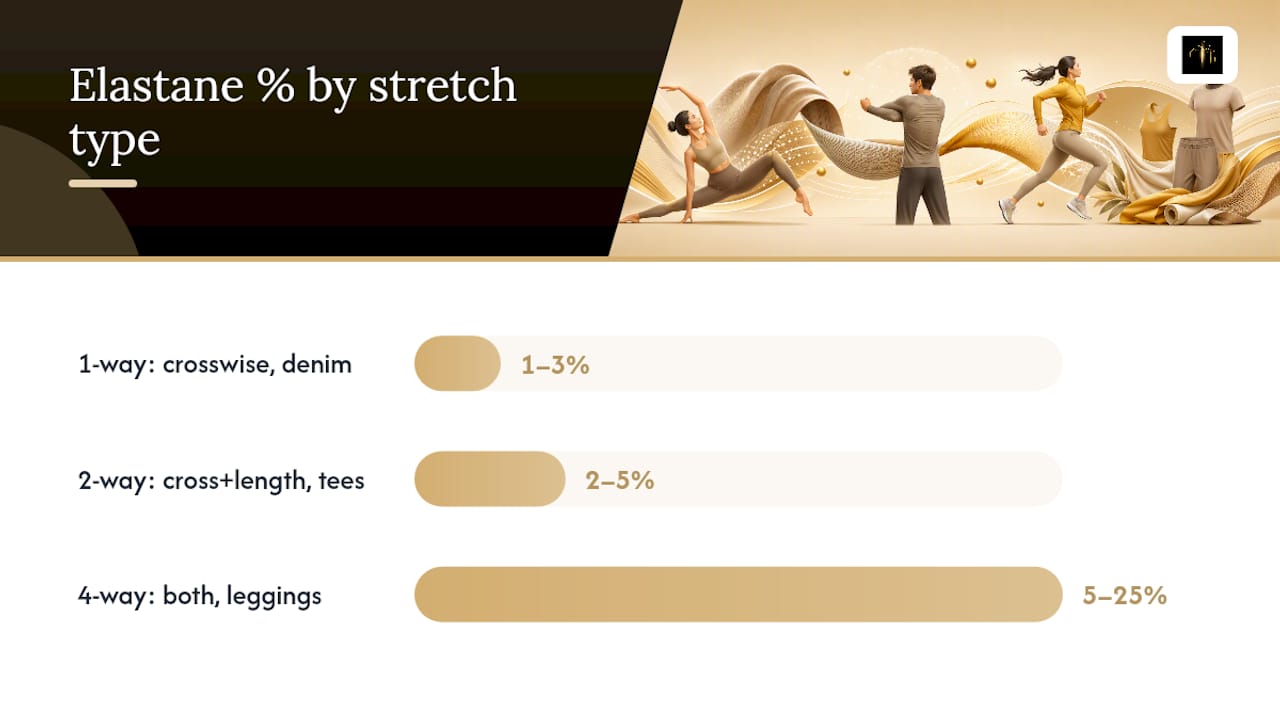
| Stretch type | Direction of give | Typical elastane % | Best for |
|---|---|---|---|
| 1-way | Crosswise only | 1–3% | Stretch denim, woven trousers |
| 2-way | Crosswise and lengthwise | 2–5% | Jersey tees, casual dresses |
| 4-way | Both directions equally | 5–25% | Leggings, activewear, swimwear |
Recovery is the metric that separates a garment that looks good at 9 AM from one that bags by noon. It measures how completely a fabric returns to its original dimensions after stretching. Recovery is the critical metric for garment longevity and the key factor shoppers should check to avoid bagging. Industry testing uses standards such as ASTM D3107 (stretch and recovery for woven fabrics) to quantify this. In practical terms: stretch a hem two inches, hold for ten seconds, release. A fabric with good recovery snaps back almost immediately. One with poor recovery stays stretched.
Manufacturers commonly add 2–5% elastane to everyday garments; higher elastane content of 10% or more is used for compression or high-performance items. For shopping, use these ranges as a guide:
- 2–5% elastane: Everyday basics, stretch jeans, work trousers, casual dresses.
- 5–10% elastane: Fitted ponte pieces, structured knit dresses, performance-casual wear.
- 10–25% elastane: Leggings, compression shorts, swimwear, shapewear.
Check the fiber content label. If elastane isn't listed, the stretch is mechanical (knit structure only), which means recovery depends entirely on yarn quality and knit density.
Which stretch construction works best for each garment?
Matching stretch type to garment type is the fastest way to avoid a purchase you'll regret.
- Leggings: Four-way stretch is the standard for garments that require full range of motion. Look for 5–25% elastane in a nylon or polyester blend. The waistband should sit flat without rolling; the fabric should recover fully after a squat.
- Jeans: 1–3% elastane in a stretch denim. Slim and skinny fits need it; straight and relaxed fits can work without it. Size as you normally would, but expect slight growth at the knees and waist by end of day. A good recovery rating prevents that from becoming permanent.
- Work trousers: Stretch-woven twill or ponte with 2–5% elastane. Ponte holds a crease better than jersey and reads as more formal. Stretch-woven chinos give a tailored look with enough give to sit comfortably.
- Casual tops and tees: 2-way jersey with 2–5% elastane. Cotton-elastane blends breathe well and hold their shape through repeated washing better than 100% cotton.
- Underwear and base layers: High elastane content (10–20%) in a soft knit. Flatlock seams reduce bulk and chafing.
- Travel pieces: Stretch-woven fabrics offer a high strength-to-weight ratio, making them well suited to travel trousers where durability and range of motion matter without added bulk. A stretch-woven pant in a nylon or polyester blend resists wrinkles, dries fast, and moves freely.
Pro Tip: When sizing stretch-woven trousers, try your usual size first. If the fabric has good recovery, it will conform to your shape without needing to size down. Sizing down in a low-recovery fabric just means tighter fit that bags faster.
How garment construction affects stretch performance
The fabric is only half the story. How a garment is cut and sewn determines whether that stretch actually works for you.
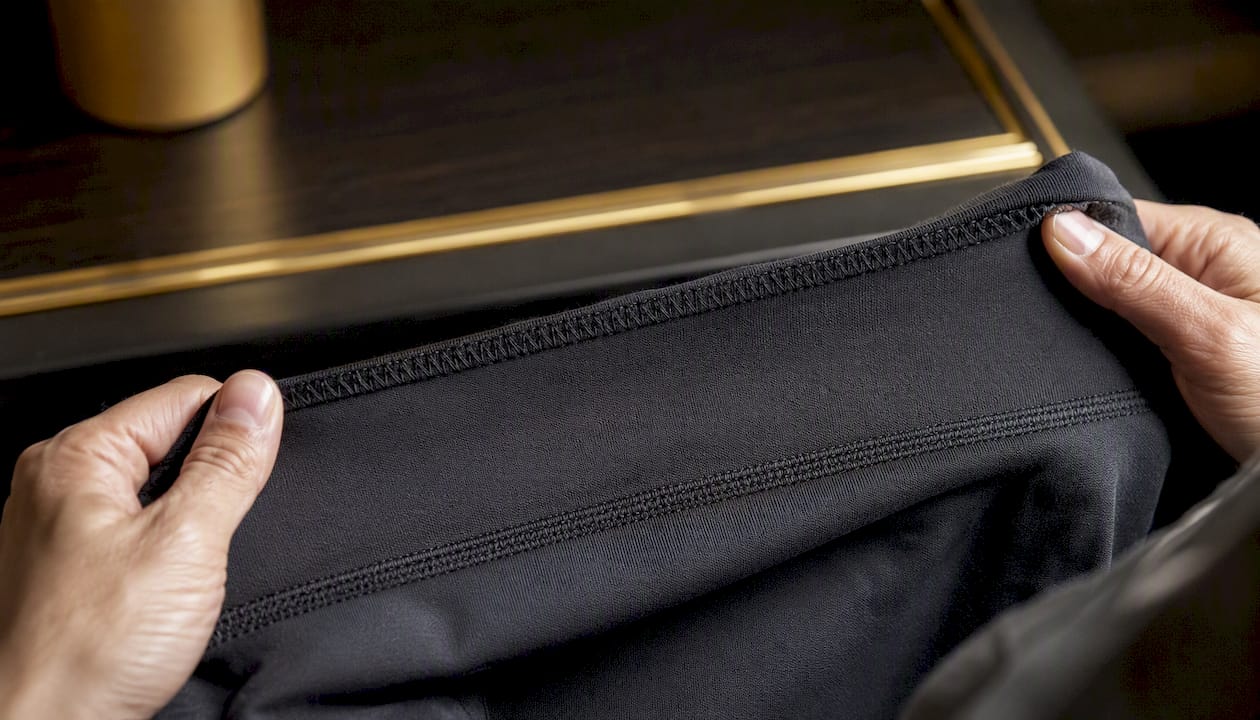
Seam and stitch type matter more in stretch garments than in wovens. A standard lockstitch breaks when the fabric stretches because the thread can't extend with it. Overlock stitching (serging) and flatlock stitching both allow the seam to flex. Flatlock seams lie flat against the skin, which is why they're standard in leggings and base layers. Overlock seams are more common in casual knits and everyday tees.
Pattern ease works differently for stretch. A pattern designed for woven fabric builds in extra room (ease) so you can move. A pattern for stretch fabric can be cut closer to body measurements because the fabric itself provides the ease. Cutting a stretch pattern in a low-stretch fabric produces a garment that fits like a tourniquet. Always match the pattern's stretch requirement to the fabric's actual stretch percentage.
Grainline affects how stretch behaves on the body. Cutting on the straight grain maximizes the fabric's designed stretch direction. Off-grain cutting can produce twisting seams and uneven recovery after washing.
Pro Tip: If you sew your own stretch garments, use a ballpoint or stretch needle (size 75/11 or 90/14). A standard sharp needle pierces knit loops and causes skipped stitches or runs. A ballpoint needle pushes between loops rather than cutting them.
How to care for stretch garments and keep their shape
Elastane degrades with heat, chlorine, and mechanical stress. The care routine below keeps stretch garments performing longer.
- Wash in cold water. Hot water breaks down elastane fibers faster than anything else. Cold water (below 86°F / 30°C) preserves both the fiber and the dye.
- Use a gentle or delicate cycle. High-agitation cycles stress seams and stretch fibers. A mesh laundry bag adds another layer of protection for leggings and fine knits.
- Skip fabric softener. Softeners coat elastane fibers and reduce their ability to recover. Use a gentle, pH-neutral detergent instead.
- Never use chlorine bleach. Chlorine degrades elastane rapidly. Oxygen-based bleach is safer if you need to treat stains.
- Air-dry flat or hang. Tumble drying on high heat is the fastest way to destroy stretch recovery. Lay knits flat to dry so gravity doesn't stretch them out of shape. Hang stretch-wovens on a hanger.
- Iron on low heat, if at all. High-heat ironing melts elastane. If you need to smooth a stretch-woven piece, use a steamer or a low iron setting with a pressing cloth.
- Store folded, not crammed. Compression in a packed drawer stresses elastane. Fold leggings and knit pieces; hang structured stretch-woven trousers.
For stressed areas like knee panels, crotch seams, and waistbands, reinforce with a small piece of fusible interfacing on the inside before the seam gives out entirely. It's a five-minute fix that extends garment life significantly.
How to style stretch pieces with non-stretch garments
Stretch pieces look intentional when you balance their fitted silhouette with something structured. The key is proportion.
For work: Ponte trousers with a tailored blazer. The ponte reads as formal because of its weight and surface; the blazer adds structure. The stretch is invisible but you'll feel it in every meeting. Pair with a non-stretch silk or cotton blouse to vary fabric hand.
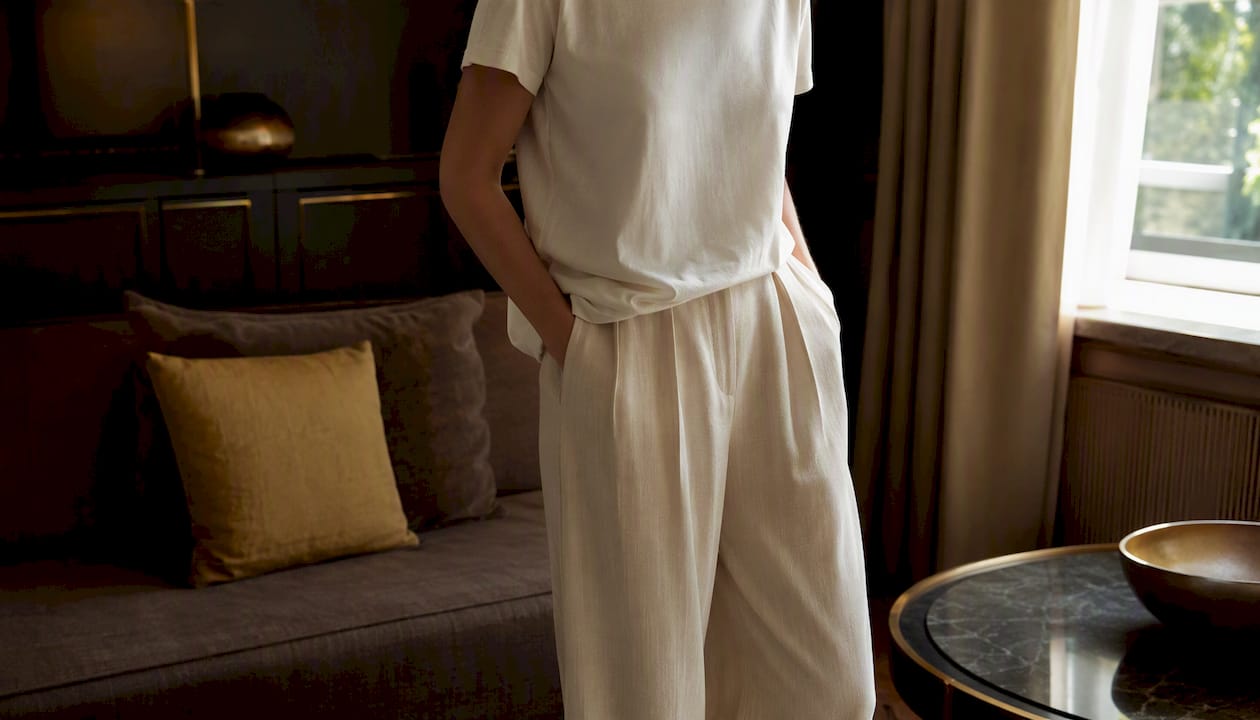
For casual wear: A fitted jersey tee tucked into wide-leg non-stretch linen trousers. The stretch tee conforms to your torso; the linen trousers add volume and drape. This contrast in silhouette is what makes the outfit look considered rather than thrown together. For more ideas on styling one stretch piece multiple ways, a single jersey tee can anchor five different looks depending on what you pair it with.
For travel: A stretch-woven pant with a non-stretch woven shirt. Both pieces pack flat and resist wrinkles. The stretch pant handles the physical demands of transit; the woven shirt keeps the look polished on arrival.
Fabric-hand pairing: Cotton-elastane blends pair naturally with other natural-fiber pieces (linen, cotton, wool). Polyester-elastane blends work better with other synthetics or with structured wovens. Mixing a shiny polyester knit with a matte cotton woven can look mismatched in texture even when the colors work.
Low-effort everyday dressing gets easier when you build around one or two stretch basics that pair with everything else you own.
How to test a fabric's stretch and recovery before buying
In-store test (takes 30 seconds):
- Grip the fabric at a seam with both hands, about two inches apart.
- Pull firmly crosswise, then lengthwise. Note how far it gives.
- Hold the stretch for ten seconds.
- Release and watch. Good recovery: snaps back in under two seconds with no visible distortion. Poor recovery: stays stretched or returns slowly with a slight ripple.
- Check the hem. Stretch it gently and release. A hem that puckers or stays stretched signals low elastane content or poor construction.
Shoppers can evaluate stretch and likely longevity by testing recovery in-store and by checking percent-elastane on product specs for online purchases.
Online checklist:
- Zoom into the product photo to check knit density. Loose, visible loops mean lower recovery.
- Find the fiber content in the product specs. No elastane listed means mechanical stretch only.
- Look for terms like "4-way stretch," "recovery tested," or a specific elastane percentage. Vague descriptions like "stretchy feel" or "comfortable fit" tell you nothing technical.
- Read reviews specifically for comments on bagging, growth at knees, or waistband rollover after a few washes.
Red flags at retail:
- No fiber content listed anywhere on the label or product page.
- Elastane percentage listed as a range ("2–8%") with no further detail.
- Visible loose loops on close inspection of a knit that's supposed to hold structure.
What research shows about stretch-woven durability and recovery
The technical case for stretch-woven fabrics in everyday wear comes down to two properties: strength-to-weight ratio and recovery. Industry analysis highlights stretch-woven fabrics as offering a favorable strength-to-weight ratio for travel and everyday garments, providing durability and full range of motion without bulky weight. For anyone who wants a trouser that survives daily commuting, frequent washing, and occasional travel without losing its shape, stretch-woven outperforms a pure knit on all three counts.
Recovery remains the single most predictive metric for how a garment ages. Experts emphasize that good recovery prevents garments from bagging and preserves the intended silhouette after repeated wear and washing. Loose, open knits with low elastane content look fine on the hanger and bag within a week of wear.
Pro Tip: *When reading product specs, look for recovery percentage alongside stretch percentage.
For outfit recycling and garment longevity, choosing high-recovery stretch pieces is the single most effective move. A ponte trouser or stretch-woven chino that recovers well can be worn three times a week for two years without bagging. That's a better return than a cheaper knit that looks tired after a season.
Skin sensitivities and allergies to stretch fabric materials
Elastane itself is rarely the allergen. Most reactions to stretch clothing trace back to the dyes, finishing chemicals, or residual processing agents used during manufacturing, not the elastane fiber itself. Formaldehyde-based finishes (used to prevent wrinkles and shrinkage) and azo dyes are the most common culprits in contact dermatitis cases linked to synthetic clothing.
That said, some people do react to synthetic fibers in general, particularly polyester-elastane blends, because synthetics trap heat and moisture against the skin more than natural fibers do. The result is irritation from friction and sweat rather than a true allergic response.
If you experience redness, itching, or rash from a stretch garment, try these steps before assuming you're allergic to elastane:
- Wash the garment twice before first wear to remove surface finishing chemicals.
- Switch to a cotton-elastane or modal-elastane blend, which sits closer to natural fiber behavior.
- Look for OEKO-TEX Standard 100 certified fabrics, which are tested for harmful substances including formaldehyde and restricted azo dyes.
- If symptoms persist with natural-fiber blends, consult a dermatologist. True elastane allergy exists but is uncommon; a patch test will confirm it.
Nickel in metal components (zippers, snaps, waistband hardware) causes more contact dermatitis in everyday clothing than elastane does. If your reaction is localized to a waistband or zipper area, the hardware is the more likely cause.
My take on building a stretch-fabric wardrobe that actually works
The conventional advice on stretch fabrics focuses almost entirely on activewear, which misses where most people actually need it: the hours between 8 AM and 6 PM in work clothes, commuter pants, and the tee you wear to run three errands before noon.
These two pieces cover more daily scenarios than any five rigid-fabric equivalents. Wear each one three times before washing, air-dry both, and you'll notice within a month that they hold their shape better than anything you've been replacing every season.
For outfit planning, a simple rotation works better than a large wardrobe of mediocre pieces. Pair your stretch trouser with a structured non-stretch jacket on Monday, a relaxed linen shirt on Wednesday, and a fitted knit on Friday. Three looks, one trouser, no decision fatigue. Mytenue's wardrobe management and outfit-stretching tools make this kind of rotation easy to plan and track, so you're not reinventing your wardrobe every morning.
The laundering cadence matters too. Washing stretch pieces less frequently (spot-clean when possible, full wash every two to three wears) preserves elastane longer than daily machine washing. When you do wash, cold water and air-drying are non-negotiable.
The gap most people miss is recovery. They buy stretch for comfort and never check whether the fabric will still look good in six months. Prioritize recovery percentage on the label, test it in-store before you buy, and you'll stop replacing the same pair of pants every season.
Sources
These are the core references behind this guide, organized by what each one answers best.
- The advantages of stretch woven fabrics - MMI Textiles
- Why fabric stretch matters - ProTextile
- Types & properties of stretch fabrics - Moda Material
- Types of Stretch Fabric: Best Options Explained - MFG Merch
- The Why and How of Stretch Fabrics — Refiber Designs
- The Complete Guide To Stretchy Fabrics - Clothing Digest