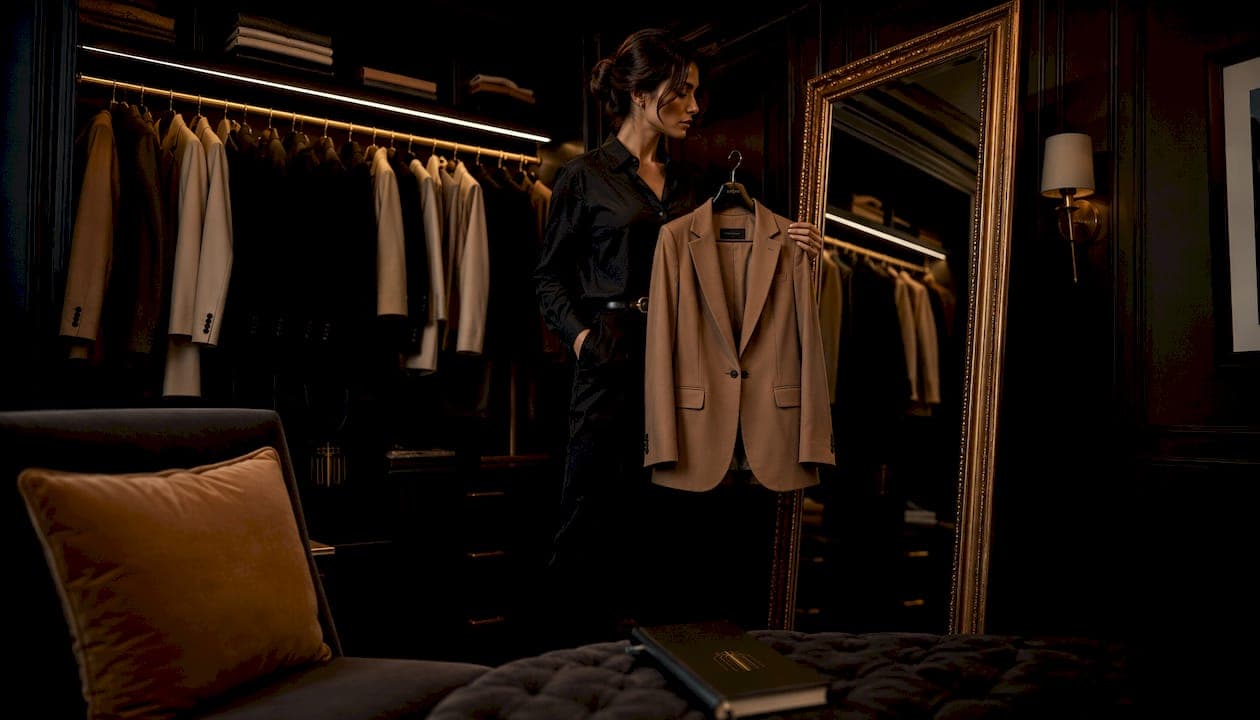
A compact capsule of 10–12 core pieces plus a handful of seasonal swaps covers most lives, most occasions, and most weather. That's the whole idea.
Here's your starter checklist — pieces that earn their place year-round:
- White crew-neck tee (100% cotton or cotton-modal)
- Black tee (same fit, moodier edge)
- Crisp white button-down shirt
- Fine-gauge neutral knit
- Dark-wash straight or slim jeans
- Tailored trousers (black or charcoal)
- Midi skirt (neutral shade)
- Blazer (black, camel, or oatmeal)
- Trench coat (classic beige, knee-length)
- Wool-blend overcoat
- White leather sneakers
- Loafers or pointed-toe flats
- Minimal gold or silver studs
- Classic sunglasses
The 80/20 rule for capsules keeps this manageable: roughly 80% of your closet should be all-season core items, 20% seasonal swaps. Stylists also recommend the 10-wear audit rule — if you haven't worn a piece at least ten times, it doesn't earn its spot. Mytenue's AI outfit builder helps you track exactly that.
Table of Contents
- Why a season-proof capsule works better than a full closet
- What are the core wardrobe essentials by category?
- What should you add or swap each season?
- How do you build and maintain a seasonal capsule?
- How do you care for and store pieces between seasons?
- 12 outfit formulas for every occasion
- Key Takeaways
- The case for fewer, better choices
- Mytenue makes outfit planning effortless
- Useful sources and further reading
Why a season-proof capsule works better than a full closet
Versatility beats volume. A smaller, well-chosen wardrobe solves more outfit decisions than a closet stuffed with trend pieces that only work one season.
"A trench is a wardrobe hero, working with brights or neutrals, and so is a leather jacket to add some toughness to t-shirts or dresses. A great pair of straight-leg jeans, a selection of t-shirts in various colors, and a blazer in a shade that will work with the most in your wardrobe — whether it's black, cream, or grey — are also easy pieces to add." — Real Simple
The 80/20 balance means your core does the heavy lifting every day, and seasonal pieces rotate in without disrupting anything. Tailoring amplifies this: a blazer or pair of trousers that fits perfectly elevates cheaper pieces around it, so you spend less overall. Adopting a uniform approach — standardized outfit building blocks you reach for automatically — cuts daily decision fatigue without making you look like you wore the same thing twice.
Pro Tip: Get your blazer and tailored trousers professionally fitted first. Those two pieces anchor more outfits than anything else in the closet, and a $20 tailor visit does more than a $200 new purchase.
What are the core wardrobe essentials by category?
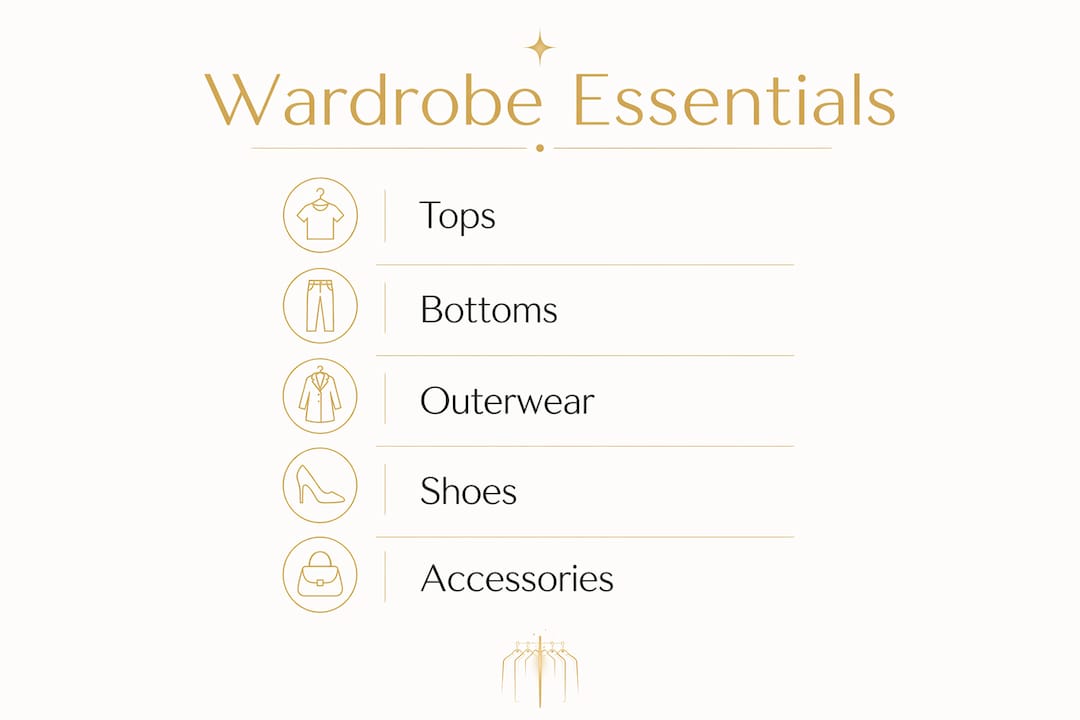
Five categories cover everything: tops, bottoms, outerwear, shoes, and accessories. Each one has a short list of high-impact pieces that carry the highest percentage of your outfits.
| Category | Core Items | Fabric/Weight Guidance |
|---|---|---|
| Tops | White tee, black tee, white button-down, fine knit | Cotton or cotton-modal for tees; merino or cashmere for knits |
| Bottoms | Dark-wash jeans, tailored trousers, midi skirt | Stretch denim (max 2% Lycra); tropical wool or viscose for trousers |
| Outerwear | Blazer, trench coat, wool-blend overcoat | Lightweight cotton/wool blend for blazer; heavy wool for overcoat |
| Shoes | White sneakers, loafers or flats, Chelsea boots | Leather or faux-leather sneakers; low-to-medium heel on boots |
| Accessories | Structured bag, leather belt, studs, sunglasses | Neutral leather (black, tan, cognac); classic oval or rectangular frames |
A blazer works in summer draped over a white tee with linen trousers, and in winter layered over a merino knit. Dark-wash denim in a mid-weight fabric transitions from September through May; swap to linen or lightweight cotton in June and July. A structured outer layer — trench in spring and fall, wool overcoat in winter — changes the functionality of everything underneath it more than any single trend item.
Pro Tip: Build your palette around two or three neutrals (black, white, camel or navy) plus one accent color. Every piece then mixes with every other piece — no dead-end combinations. For fresh ideas on mixing accent pieces with foundational staples, streetwear-meets-tailoring styling is worth exploring.
What should you add or swap each season?
Keep the core, swap 10–20% for the season. That's it. Seasonal additions are high-impact and low-volume.
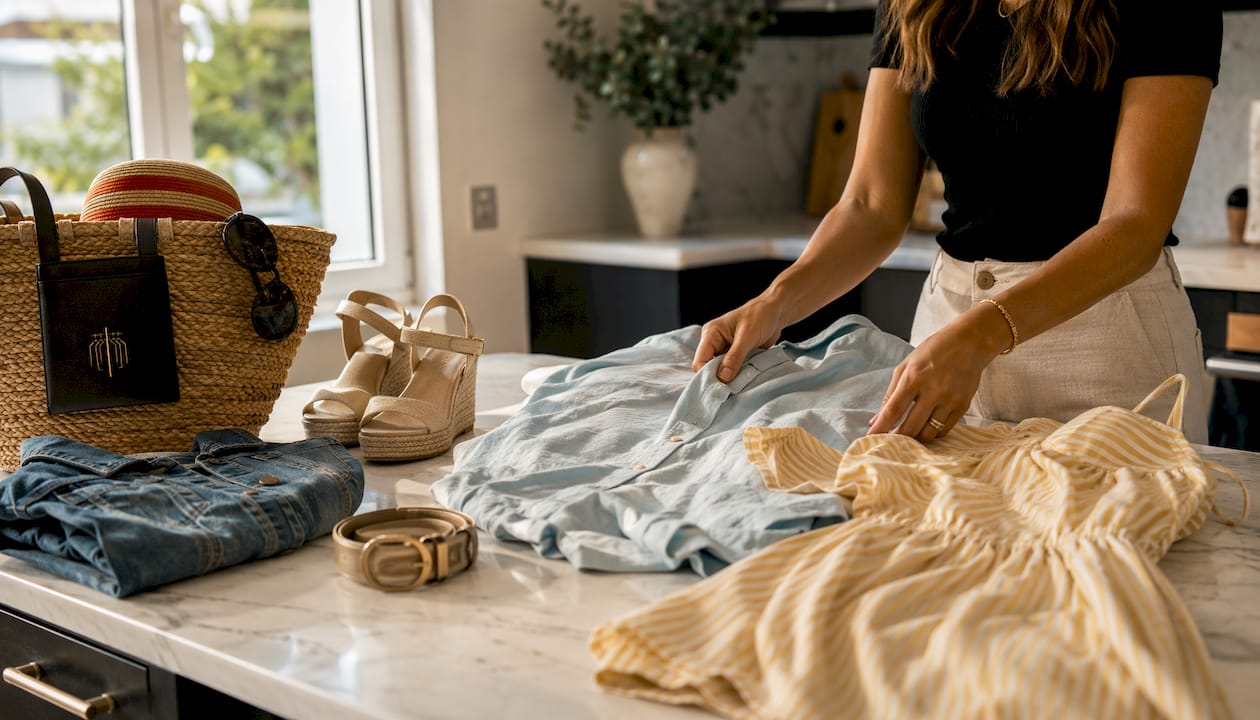
Spring: Light trench coat, linen or cotton blouse, lightweight zip-up cardigan, flat leather sandals, baseball cap for casual days.
Summer: Linen separates (trousers or a co-ord), breathable midi dress, flat leather sandals, basket bag, classic sunglasses. Summer fabrics — linen, lightweight cotton, silk, Tencel — keep comfort high without sacrificing polish.
Fall: Mid-weight knit, leather jacket, loafers, a scarf that doubles as a belt. Layering is the move: base (tee) + mid (knit) + outer (leather jacket or blazer).
Winter: Wool or cashmere layers, insulated ankle or knee boots, beanie, heavyweight overcoat. Cashmere and merino give more warmth with less bulk — worth the investment.
Five-step transition checklist:
- Pull out the season's core pieces and check fit before you need them.
- Swap one fabric weight (linen out, merino in — or vice versa).
- Change your shoe anchor (sandals ↔ ankle boots).
- Add one outerwear layer appropriate to the temperature.
- Rotate one accent accessory (scarf, belt, or statement earring) to refresh the look.
How do you build and maintain a seasonal capsule?
Follow a six-step cycle and you'll never start from scratch again.
- Audit. Turn all hangers backward at the start of each season. After 3–6 months, items still reversed are candidates for removal.
- Identify gaps. List what's missing by category. One pair of dark jeans? No structured bag? Write it down.
- Phased buying. Start with foundational pieces — white tee, dark jeans, blazer — then add seasonal items as budget allows. Never buy a full capsule at once.
- Tailor. Before buying new, ask: could a tailor fix this? A hem, a taken-in waist, or a shortened sleeve often costs less than a replacement.
- Track wears. Apply the 10-wear rule. If a piece hasn't hit ten wears in a season, decide: keep, repair, donate, or replace.
- Seasonal storage. Pack off-season items clean and dry. Heavy coats go in breathable garment bags; knitwear folds flat in bins.
For each item you're on the fence about, run this quick check:
- Does it fit well right now (not "after I alter it someday")?
- Does it pair with at least three other pieces you already own?
- Have you worn it ten times or more?
A "no" on any two of those is a clear signal to let it go. Mytenue's outfit tracking makes the 10-wear threshold easy to monitor without keeping a spreadsheet. You can also explore the 10-item wardrobe concept for a more minimalist take on the same method.
How do you care for and store pieces between seasons?
Fabric-appropriate care extends the life of every piece significantly. Wash less, air more.
- Wool and cashmere: Hand-wash in cold water or dry-clean; never tumble dry. Store folded flat, never on a hanger.
- Denim: Wash inside-out in cold water; air-dry to preserve color and shape.
- Linen: Machine-wash on gentle; iron while slightly damp for a crisp finish.
- Blazers and structured outerwear: Dry-clean once per season; steam between wears to refresh.
- Leather shoes and bags: Wipe clean after each wear; condition leather twice a year.
For storage, pack heavy coats in breathable garment bags (never plastic). Fold knitwear flat in labeled bins. Restart the hanger test at every season change. An annual audit cadence prevents closet stagnation and keeps the capsule honest. For more on reworking what you already own, outfit recycling strategies are a practical next step.
Pro Tip: Stuff leather boots with cedar shoe trees between seasons. It holds the shape, absorbs moisture, and adds years to the life of the leather.
12 outfit formulas for every occasion
One formula equals one repeatable outfit solution. Mix and match from your core pieces.
- Casual day: White tee + dark jeans + white sneakers + structured tote.
- Smart-casual work: Fine knit + tailored trousers + loafers + leather belt.
- Business: White button-down + blazer + tailored trousers + ankle boots.
- Weekend errands: Black tee + straight jeans + white sneakers + crossbody bag.
- Travel: Linen trousers + oversized shirt + flat sandals + basket bag.
- Evening out: Midi skirt + fine knit tucked in + ankle boots + minimal studs.
- Spring transition: White button-down + dark jeans + trench coat + loafers.
- Summer day: Midi dress + flat leather sandals + classic sunglasses.
- Fall layering: Tee + mid-weight knit + leather jacket + ankle boots.
- Winter polish: Merino turtleneck + tailored trousers + wool overcoat + Chelsea boots.
- Casual Friday: Blazer draped over white tee + dark jeans + white sneakers.
- Weekend evening: Midi skirt + crisp white blouse + block-heel mule + structured clutch.
The blazer alone anchors formulas 3, 7, and 11 — three completely different occasions, zero new purchases. That's the one-item, many-looks principle in action.
Key Takeaways
A season-proof wardrobe works because 80% all-season core pieces plus 20% seasonal swaps, maintained with the 10-wear rule and the hanger test, cover most occasions without buying more than you need.
| Point | Details |
|---|---|
| Start with neutrals | Build around black, white, and camel so every piece pairs with every other. |
| Invest in fit | Tailor your blazer and trousers first — it multiplies the value of cheaper pieces around them. |
| Use the hanger test | Turn hangers backward each season; items still reversed after 3–6 months are candidates to remove. |
| Phase your purchases | Buy foundational pieces first, then add seasonal items one at a time as budget allows. |
| Mytenue tracks it all | Use Mytenue's AI outfit builder to log wears, hit the 10-wear threshold, and get personalized outfit suggestions. |
The case for fewer, better choices
The conventional wisdom says a bigger wardrobe gives you more options. It doesn't. It gives you more decisions, more clutter, and more pieces you never actually wear.
The capsule approach works because it forces a different question: not "what do I own?" but "what do I actually reach for?" The hanger test makes that behavioral — you're not guessing, you're tracking. The 10-wear rule makes it quantifiable. And the phased investment strategy means you're never buying out of panic or trend pressure.
What most people underestimate is how much tailoring changes the equation. A $30 tailor visit on a $60 blazer produces a result that looks like a $300 blazer. That's not a style tip — it's math. The pieces that fit perfectly are the ones you reach for automatically, which is exactly how staples become staples.
The yin-yang balance between staples and statement pieces matters too. Statements without staples look chaotic. Staples without statements look boring. The ratio is roughly 80/20, and it works in every season.
Mytenue makes outfit planning effortless
You've got the framework. Now let Mytenue do the daily work. Mytenue's AI stylist takes your existing pieces, your occasion, and your style preferences and builds complete outfits in seconds — no more standing in front of the closet at 7 AM.
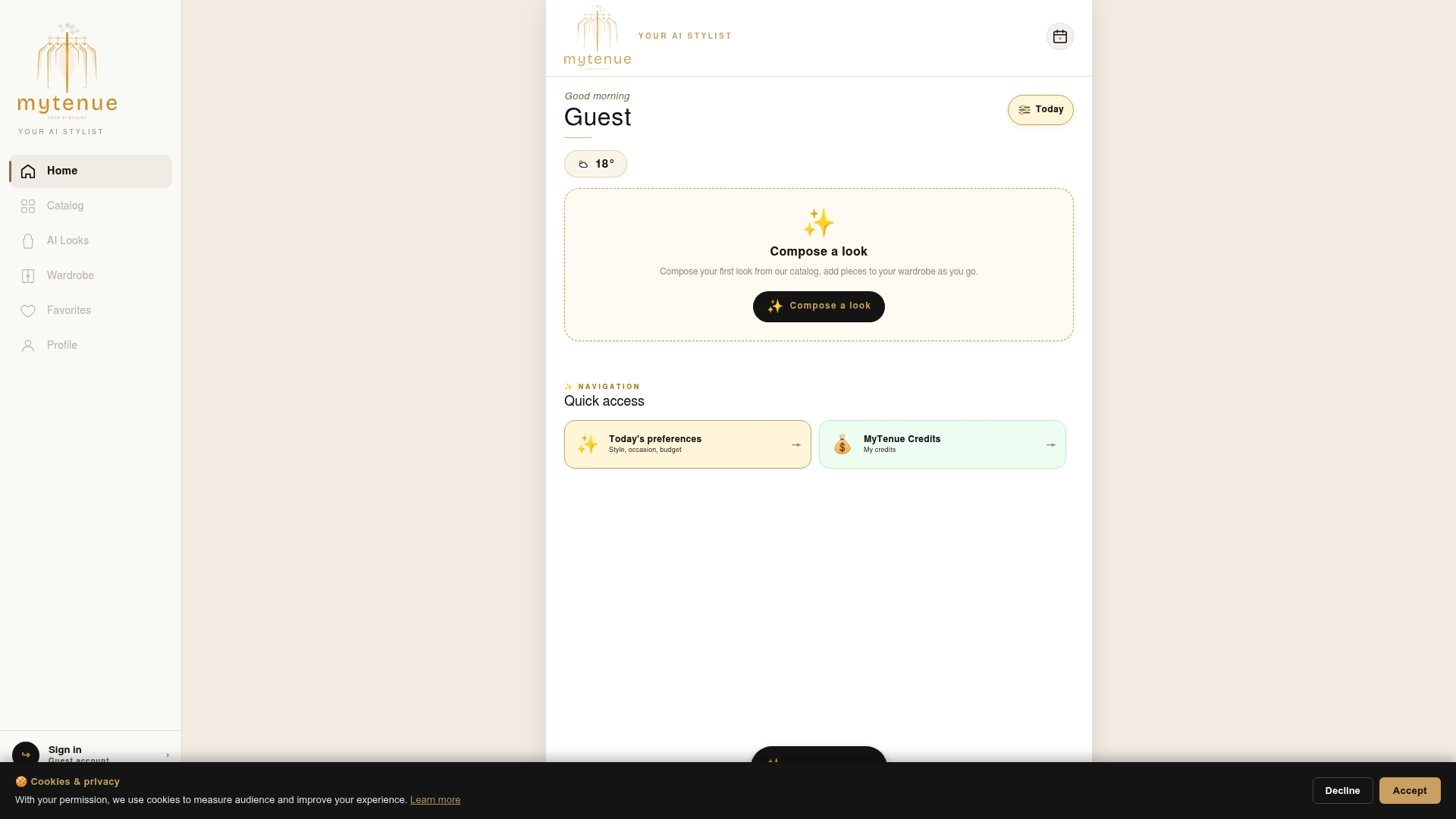
Here's what Mytenue does for you directly:
- Generates personalized outfit combinations from pieces you already own
- Tracks wear counts so you hit the 10-wear audit threshold automatically
- Flags wardrobe gaps and suggests targeted additions by season
- Builds seasonal packing lists so transitions take minutes, not hours
Skip the guesswork. Start building your capsule with Mytenue today and get outfit suggestions tailored to your style, your season, and your life.
Useful sources and further reading
These sources cover the styling rules, capsule checklists, audit methods, and phased investment strategies referenced throughout this guide.
- Our Complete Capsule Wardrobe Basics Checklist for Every Season — Real Simple's full season-by-season checklist with stylist quotes on transitional pieces.
- Capsule Wardrobe Essentials (2026): 12 Pieces Worth Buying — Minimalist 12-piece starter list with repeat-wear rationale.
- How to Build a Timeless Capsule Wardrobe for Every Season — Covers the 80/20 rule and seasonal fabric guidance in detail.
- Capsule Wardrobe Essentials: 30 Pieces for Every Season — The 10-wear rule, phased investment strategy, and annual audit cadence.
- A Stylist's Guide to Building a Capsule Wardrobe for Every Season — The hanger test method explained by a working stylist.
- Vogue Wardrobe Essentials Guide — Tailoring as a multiplier and the yin-yang balance between staples and statements.
- How to Build a Chic Summer Capsule Wardrobe in Just 8 Pieces — Practical summer-specific capsule with linen separates and accessory guidance.