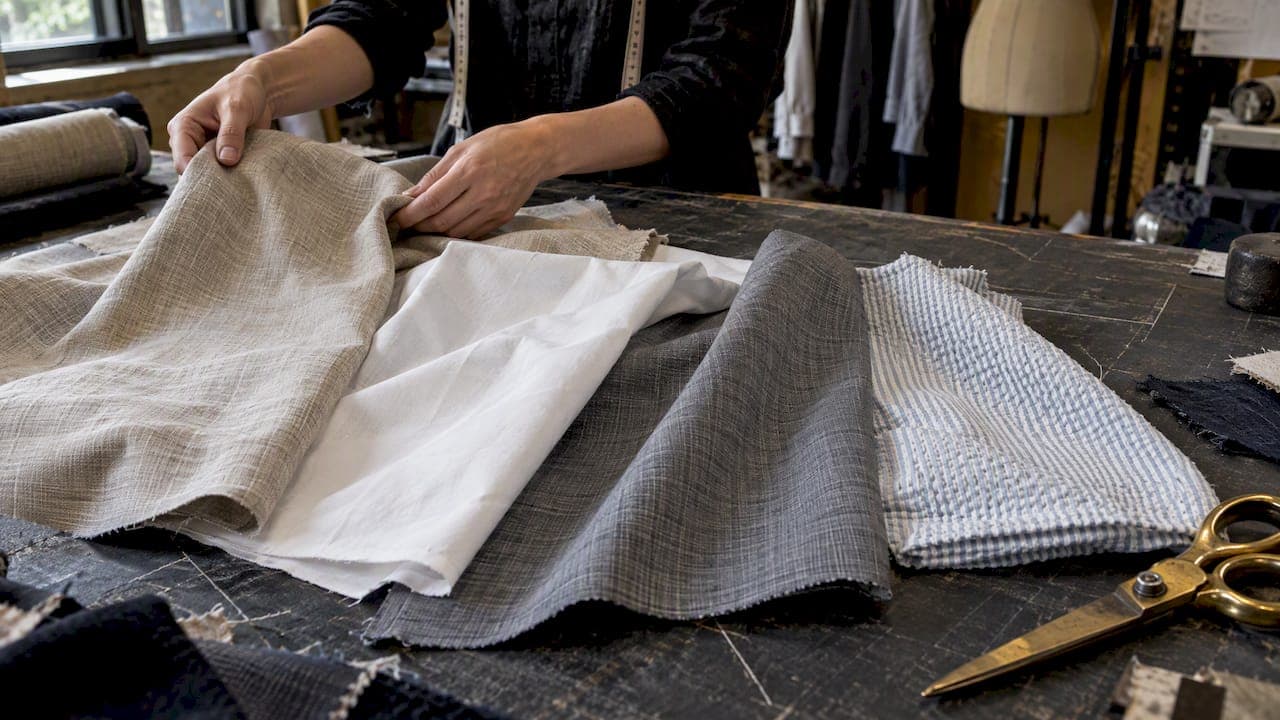
The best summer workwear fabrics are open-woven natural ones: linen, lightweight cotton, fresco (tropical-weight) wool, seersucker, plus Tencel and viscose twill for softer drape. Skip ordinary polyester, nylon and acrylic. Then look at weave, lining and cut, because they often matter as much as the fiber on the label.
This guide goes fiber by fiber, then garment by garment. It covers suiting, shirts and trousers, and it includes a section for tall men, who get little help from most fabric guides.
TL;DR
- Best all-rounders: linen for extreme heat, fresco wool for formal offices, cotton-linen blends for a balance of cool and crease-resistant.
- Avoid: standard polyester, nylon, acrylic, raw denim and very tight cuts.
- Check the weave first. An open weave breathes better than a dense one of the same fiber.
- Construction counts: half lining or no lining, an unstructured jacket and a little room under the arms.
- Tall men: buy length in the sleeve and body first, then use mid-rise trousers to balance proportions.
Table of Contents
- What makes a fabric work in summer
- The fibers worth wearing
- Fabrics to avoid in the heat
- Quick comparison
- Weave, lining and cut: where polish comes from
- Outfit formulas that work
- Workwear for tall men
- A quick in-store test
- Our perspective
- Let your AI stylist pick the fabric for you
- Common questions
- Sources
What makes a fabric work in summer
Breathability is not a fiber label. It is the sum of construction, weight, how a fabric handles moisture, and fit. REI's textile guide makes the same point: looser weaves generally breathe better than tight ones, and thinner materials let more air through. Fit should leave room without turning billowy.
Four questions sort most fabrics fast:
- Can air pass through it? Hold it to the light. If you see tiny gaps in the weave, air moves.
- What does it do with sweat? Natural fibers absorb it. Standard synthetics tend to hold it against the skin.
- Does it survive a commute? A fabric that looks like a crumpled napkin by 9 a.m. is no good in a client meeting.
- Does it suit the dress code? Linen reads relaxed. Fresco reads formal.
The fibers worth wearing
Linen: the coolest, the most wrinkled
Linen is the classic choice for great heat. A French tailoring guide to summer suit fabrics presents linen as suited to high temperatures but prone to creasing. La Provence also lists it among its picks for summer work in a heatwave.
The trade-off is simple. You get the best airflow and a relaxed look. You also get wrinkles by lunch. Accept them as part of the charm, or choose a blend.
Cotton: comfortable, but not the coolest
Cotton is soft and easy to care for. It holds water thanks to its fiber structure and gives a smoother look. Its cooling performance is slightly lower than other natural options. It also dries slowly, which matters on a packed train. Gala recommends 100% cotton for hot offices, and the tailor's guide above sees cotton as best in moderate warmth.
Good cotton formats for work: poplin or voile shirts, seersucker jackets and chinos in a light weave. For the sustainability side, ADEME notes that cotton needs roughly 1,000 to 2,000 liters of water for the amount in one T-shirt, and recommends organic or recycled cotton when you can. Want the cotton-versus-wool trade-off in more depth? Our piece on merino wool vs cotton covers it.
Fresco and tropical-weight wool: the formal office pick
Wool in summer sounds wrong. It works. The same tailoring guide describes cold wool, or fresco, as breathable, polished and crease-resistant, and recommends fresco or lightweight wool for formal offices. La Provence also lists tropical wool and merino among its summer workwear fabrics.
The key is the weave. Atelier Mesure advises looking at the weave before the weight: an open fresco breathes better than a fine, closed wool. That is why a 250 g fresco can feel cooler than a tight 200 g worsted.
Seersucker: the puckered cool one
Seersucker's crinkled texture lifts the cloth off your skin so air circulates. It needs no ironing, since the pucker is the look. HUGO BOSS lists it, with lightweight cotton, among its recommendations for summer suits. It suits creative offices and warm climates better than a conservative boardroom.

Tencel, viscose and silk: soft drape
These are the smooth, flowing options. Gala names Tencel and silk for hot offices, and La Provence lists Tencel and viscose twill. They suit blouses, shirt-dresses, unlined trousers and drapey tops. Silk and viscose can mark with sweat and need gentle washing, so check the care label before you buy.
Blends: the practical middle
A blend can be the smartest buy for a working week. A cotton-linen mix pairs linen's breathability with cotton's resistance to creasing, according to one shirt maker's product notes. The tailor's guide describes blends as a way to combine freshness, structure and easier wear.
Fabrics to avoid in the heat
La Provence's heatwave advice is clear: avoid non-technical polyester and nylon, acrylic, raw denim, overly tight cuts and dark colors. Gala adds that nylon and polyester can encourage perspiration and odors.
There is nuance. A textile expert quoted by Pourquoidocteur says ordinary polyester absorbs moisture very poorly and should be avoided in strong heat. Technical polyesters such as Dri-FIT, built to spread moisture, can feel fine during summer physical activity. So the verdict depends on construction, not just the word "polyester".
Cotton or polyester for an office?
For a desk job, cotton usually wins on comfort. A workwear supplier's comparison notes that polyester wears better, dries fast and creases little, while cotton absorbs moisture but dries slowly and can shrink or crease. It sees a poly-cotton blend as a compromise when comfort and easy care both matter. Our rule: choose natural for hot days and long hours, and keep a blend for the days when you cannot iron.
Quick comparison
| Fabric | Heat performance | Wrinkles | Best for |
|---|---|---|---|
| Linen | Excellent | High | Relaxed offices, very hot days |
| Cotton (poplin, voile) | Good | Medium | Shirts, chinos, daily wear |
| Fresco / tropical wool | Very good | Low | Formal offices, suits |
| Seersucker | Very good | Low (by design) | Casual or creative workplaces |
| Tencel / viscose twill | Good | Low to medium | Drapey trousers, blouses |
| Cotton-linen blend | Very good | Medium | Shirts, soft jackets |
| Standard polyester / nylon | Poor | Low | Avoid on hot days |
Weave, lining and cut: where polish comes from
Two jackets in the same fiber can feel very different. Here is what changes the result.
- Weave over weight. Open weaves let air move. Dense ones trap heat.
- Lining. HUGO BOSS treats a perforated, partial or absent lining as a direct airflow solution. Atelier Mesure recommends half lining, unstructured construction, open-weave cotton shirts and a little underarm room. Its view: lining and construction often matter more than shaving a small amount of weight off the cloth.
- Cut. A slightly roomier cut helps air circulate. The shirt maker above gives a boxy cut and a 150 g/m² cotton-linen as an example of balanced weight. Avoid anything body-hugging, as Gala also advises.
- Color. La Provence suggests beige, white, sand, light olive and sky blue. Gala adds pastels and bright summer shades. A tailor's guide to dressing for the office in heat suggests a linen or linen-cotton suit with a white or light-blue straight-cut shirt and neutral suit colors, usually without a tie.
Outfit formulas that work
Formal office: fresco wool trousers, a half-lined unstructured jacket in a light neutral, a white poplin shirt, leather loafers.
Smart casual: cotton-linen shirt, light chinos, a seersucker jacket on cooler mornings.
Creative or hybrid: Tencel trousers, an open-weave cotton tee or knit polo, clean leather sneakers. Need ideas? Our guide to sneaker-friendly office outfits shows what passes at work.
Heatwave day: one layer less, lighter color, looser cut. Our three rules for heatwave outfits give you a fast daily routine.

Workwear for tall men
Most summer fabric advice ignores height. Tall men face three issues: sleeves and hems that run short, shirts that pull out of the waistband, and proportions that look stretched.
- Buy length first. Look for tall or long-cut sizes in shirts and jackets. Linen and cotton-linen shrink a little when washed, so allow a margin in the sleeve.
- Use mid-rise trousers. One style guide for tall men recommends the rule of thirds: upper body visually one third of your height, lower body two thirds, rather than a 50/50 split. Mid or high-rise trousers help, because low rise makes the torso look longer.
- Get the roomier cut, not the baggy one. A little extra ventilation is good. Too much fabric on a long frame looks sloppy.
- Prefer longer hems on summer trousers. Unlined, open-weave trousers hang better with a full break or clean hem. Check length after washing.
- Choose fabrics with some body. Fresco and cotton-linen drape cleanly on a tall frame. Very thin viscose can cling and show every movement.
This is general styling guidance, not a sizing promise. Try garments on, and ask a tailor to adjust sleeve and hem length.
A quick in-store test
Three moves take less than a minute:
- Hold the fabric to a light. Gaps mean airflow.
- Scrunch it in your fist for five seconds. Deep creases mean a hard day at the desk.
- Check the label and the lining. Half lined, unlined or perforated lining is what you want inside a jacket.
Our perspective
We see the same pattern again and again: people own good summer pieces and still dress badly in the heat. The fabrics are not the issue. The mix is. A linen shirt with heavy, fully lined trousers cancels itself out.
So we think in outfits, not items. Weight, color, cut and occasion have to agree. That is the job of an AI stylist: it looks at what you already own, checks the fabric, color and style compatibility of pieces together, and flags the combination that will leave you sweating in a 2 p.m. meeting. It also helps you buy less. Wearing what you have, mixed with a few smart additions, is more sustainable than a new wardrobe every season. If you want to plan the week ahead, try our workweek outfit planning checklist.
— Ahmed
Let your AI stylist pick the fabric for you
Mytenue is your AI stylist, built on your own wardrobe. Scan your pieces. Get weather-adapted outfit suggestions each morning. Try looks on with virtual try-on on your personal avatar. Plan your week in the calendar.
The app is on iOS and Android, with a bilingual French and English interface. A free version is available. Paid plans are Basic at €5.99 per month, Premium at €9.99 per month and Gold at €16.99 per month. See the plans and download the app.
Common questions
What is the coolest fabric for a summer office?
Linen is the coolest for extreme heat, but it wrinkles. For a formal dress code, fresco (tropical-weight) wool breathes well and holds its shape. A cotton-linen blend sits between the two.
Is cotton or polyester better for summer?
Cotton is usually more comfortable on hot days because it absorbs moisture and feels softer, though it dries slowly. Standard polyester holds moisture against the skin and can encourage odors. Technical polyesters designed to spread moisture can work for active use.
Is wool really okay in summer?
Yes, if it is a lightweight, open weave such as fresco, or fine merino. A closed, dense wool will feel hot. Half lining and an unstructured cut improve comfort further.
What colors are best for summer workwear?
Light, neutral shades: white, beige, sand, light olive and sky blue. They reflect heat better than dark colors and pair easily.
How do tall men avoid short sleeves and awkward proportions?
Buy tall or long-cut sizes and allow for slight shrinkage in linen and cotton. Wear mid-rise trousers so your legs look about two thirds of your height. Then have a tailor check the hems and sleeve length.
Sources
- Matière costume été homme : lin, laine… (Sartore Tailoring)
- Canicule : comment s'habiller au travail (La Provence)
- Comment s'habiller pour aller au bureau quand il fait chaud (Gala)
- Quelles matières privilégier pour ses vêtements ? (ADEME)
- Été : quel est le meilleur tissu pour survivre à la chaleur (Pourquoidocteur)
- Polyester ou coton : quel textile professionnel choisir ? (Good Fabric)
- Suits in real heat: what genuinely changes (Atelier Mesure)
- Comment choisir son costume pour l'été (HUGO BOSS)
- How to Pick the Most Breathable Fabrics (REI Expert Advice)
- La chemise manches courtes en lin (Loom)
- Comment s'habiller au bureau quand il fait chaud ? (Hockerty)
- How To Dress Well As A Tall Man: 10 Proportion Rules