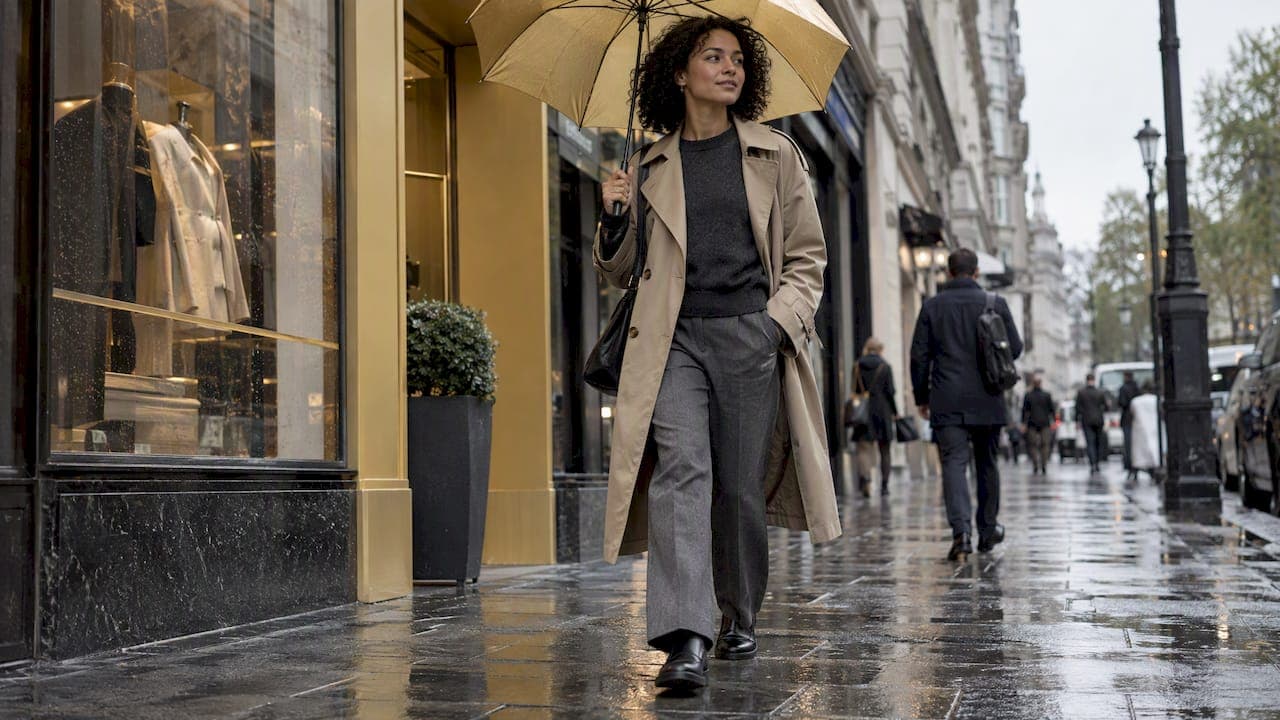
The best outfit for the weather starts with the feels-like temperature, not the number on the forecast. Add layers you can remove, one piece that handles rain or wind, and shoes that suit the ground. Below you will find outfit formulas by temperature band, ideas for rain, wind, cold and heat, and a two-minute routine to build looks from clothes you already own.
TL;DR
- Check the feels-like temperature, then the wind, rain and the gap between morning and afternoon.
- Build in three layers: a breathable base, an insulating middle, a protective outer.
- Change one layer per temperature band, not the whole outfit. Your wardrobe goes much further.
- Heat waves and orange or red alerts call for light clothing, water and cooler outing hours.
- Settle the outfit the night before. A planner or an app makes it a one-minute job.
Table of Contents
- Start with the feels-like temperature
- What to wear by temperature: six bands
- The three-layer formula
- Cold weather outfit ideas
- Mid-season: the hardest weather to dress for
- Rain and wind
- Heat and sun
- Alerts: when the weather is not just weather
- Your region matters
- Quick daily outfits from clothes you already own
- Our perspective
- Let your AI stylist handle the forecast
- FAQ
- Sources
Start with the feels-like temperature
Two days at 8 °C can feel nothing alike. Météo-France explains that perceived temperature depends on weather conditions, clothing, activity and acclimatization, and that wind, humidity and sun exposure change how hot or cold you feel.
So read the forecast in four steps:
- The feels-like figure. It beats the raw temperature every time.
- The range. A 5 °C morning and a 17 °C afternoon need removable layers, not one heavy coat.
- Wind and rain. These decide your outer layer.
- Your day. A 40-minute walk to the metro is not the same as a desk-to-taxi commute.
That last point matters. If you walk fast, you warm up and can dress lighter. If you stand at a bus stop or a school gate, dress warmer than the number suggests.
What to wear by temperature: six bands
These are practical rules of thumb, not lab values. Everyone runs warmer or colder, so adjust by one layer. Our own guide to six temperature bands and copyable outfit formulas goes deeper on each one.
| Feels-like temperature | Core idea | Example outfit |
|---|---|---|
| Below 0 °C | Three full layers, covered extremities | Thermal base, wool sweater, insulated coat, hat, scarf, gloves, lined boots |
| 0 to 8 °C | Warm coat, one insulating middle layer | Long-sleeve tee, knit, wool coat, scarf, closed shoes |
| 8 to 14 °C | Light jacket plus a knit | Shirt, light sweater, trench or denim jacket, straight trousers |
| 14 to 19 °C | Mid-season, easy to peel | Tee, overshirt or cardigan, chinos, sneakers |
| 19 to 25 °C | Single layer, light fabrics | Linen shirt or tee, midi skirt or light trousers, a thin layer for the evening |
| Above 25 °C | Airy, light-colored, sun-aware | Cotton or linen top, shorts or flowing dress, hat, sunglasses |
Notice the pattern. Moving from one band to the next changes one or two pieces. The base stays, the middle layer thickens or disappears, the outer layer swaps.
The three-layer formula
Every cold-to-mild outfit rests on the same logic. A breathable base layer, a middle layer such as fleece or merino wool, and an outer layer that holds heat, breathes and blocks wind and water is the standard recipe.
- Base: touches the skin. Cotton for mild days, merino or a technical knit for cold ones.
- Middle: your warmth. Sweater, fleece, thick cardigan, quilted vest.
- Outer: your shield. Coat, parka, trench, windbreaker.
The outer layer does not have to be bulky. A thin shell works if the middle layer insulates well, and materials like boiled wool, oiled cotton or leather hold up well. That is good news for style: a sharp, slim coat over a good knit looks better than a puffy one over nothing.
Want to see it applied? One three-layer formula yields six outfits at 10 °C, which shows how little you need to vary.
Extremities count
Hats, scarves and gloves do real work. The same source recommends fleece-lined hats, scarves and gloves, and notes that up to 30% of heat can be lost through the scalp. For gloves, a thin silk pair under a fleece pair gives flexibility and warmth.

Cold weather outfit ideas
Cold is where layering pays off most. Three looks to copy:
- The office commuter. Merino base, fine-gauge sweater, tailored wool trousers, long coat, leather gloves, ankle boots with grip.
- The weekend walker. Thermal tee, fleece or chunky knit, windproof parka, jeans with a thermal layer underneath, beanie.
- The standing-still outfit. School gate, market, outdoor event: add an extra insulating layer, thick socks and lined footwear. Standing still is colder than walking.
For deeper freezes, see four layered outfits for freezing temperatures. If you want volume from a small closet, dozens of cold weather outfits from nine pieces shows how to rotate a tiny capsule.
On health, Dr. Gérald Kierzek, writing for Doctissimo, advises modular daily layering to stay comfortable through temperature changes. He adds that poor clothing choices do not directly cause illness, but dry cold combined with poor layering can weaken respiratory mucous membranes. If you have a circulation condition or a chronic illness, ask your doctor about winter clothing for your case.
Heading to the mountains? Specialized winter equipment such as tires or chains is mandatory in certain mountain areas from 1 November to 31 March, and the same page recommends warm, waterproof clothing and suitable footwear for snow and ice. Check local rules before you travel.
Mid-season: the hardest weather to dress for
Spring and autumn mornings start cold and end warm. This is where most people overdress or freeze. The fix is simple: wear pieces you can take off and carry.
- Tee or thin knit as the base.
- Overshirt, cardigan or light jacket as the removable middle.
- A scarf in a light fabric. It adds warmth in the morning and folds into a bag by noon.
- Shoes that handle a wet pavement and a long afternoon.
Five ready-made combinations are in our guide to mid-season outfit formulas that work.
Rain and wind
Rain asks for a short list of decisions:
- Outer layer: a water-resistant trench, a rain jacket or a hooded parka. Pick a color that works with most of your closet.
- Bottoms: darker trousers hide splashes. Avoid long hems that soak up water.
- Shoes: leather boots, waxed sneakers or rubber soles. Cobblestones get slippery fast.
- Bag: closed, ideally water-resistant.
Wind is different. It makes the air feel colder, so a windproof outer matters more than thickness. Skip loose, light skirts and scarves that fly. Choose tighter weaves and a collar that closes.
For city rain, our Paris weather outfits for rain and cobblestones shows four copyable looks. For the full wet-day approach, read about rain outfits that look good and stay dry.
Heat and sun
In hot weather, fabric matters more than style category. Linen, light cotton and airy weaves breathe. Light colors reflect the sun. A hat and sunglasses are part of the outfit, not extras.

During heat waves, France.fr recommends wearing light clothing, drinking water regularly, limiting physical activity and planning outings for cooler hours. If you are elderly, pregnant, or have a heart or respiratory condition, follow your doctor's advice on top of that.
For a quick routine, see three rules for heat wave outfits and a fast daily workflow.
Alerts: when the weather is not just weather
In France, Météo-France's Vigilance system uses four colors, green, yellow, orange and red, to signal the danger level of phenomena such as wind, storms, rain and flooding, snow and ice, and heat waves, as described by France.fr. A yellow alert might just change your shoes. Orange or red changes your plans.
It also helps your wallet. Many impulse buys happen after a surprise cold snap or a rainy day with no jacket. Our piece on four Météo-France signals to plan outfits and avoid impulse buys explains how to plan ahead instead.
Your region matters
France has five distinct climate zones. Western areas like Brittany and Normandy have an oceanic climate with frequent rain and mild winters, while the east has a semi-continental climate with bigger seasonal swings. In practice:
- West coast: a good rain jacket matters more than a heavy coat. Layers handle the rest.
- East and mountains: invest in real insulation and warm footwear.
- Paris: the same source describes autumn with more rain and cooler evenings, and cloudy, colder winters that call for thick coats and sweaters.
- South: sun protection and light fabrics for most of the year, plus a jacket for evenings.
A wardrobe built for Rennes is not the same as one for Strasbourg. Buy for your own climate.
Quick daily outfits from clothes you already own
Most people wear a small fraction of their closet. The weather-first method fixes that, because the forecast narrows your choices before style does.
- Sort by function. Group pieces by role: bases, middle layers, outers, bottoms, shoes.
- Pick the outer first. The weather decides it. Everything else adapts.
- Add the middle layer. Match it to the temperature band.
- Choose a base and bottoms that fit the occasion.
- Check colors. Two neutrals plus one accent is a safe rule.
- Decide the night before. Look at tomorrow's feels-like temperature, lay out the outfit, and the morning is done.
This is also the sustainable route. Mixing what you own with the odd new piece beats buying a full set each season. Photographing your pieces makes the job faster, because you can see your options at once instead of digging through drawers.
Three examples
- Rainy 12 °C, office day: thin merino base, navy sweater, straight trousers, trench, waxed sneakers.
- Dry 6 °C morning, 15 °C afternoon: tee, overshirt, wool coat you can carry, scarf in your bag.
- Sunny 27 °C, weekend: linen shirt, light shorts, hat, sandals with a good sole.
In each case, one layer changes and the rest stays. That is the whole trick.
Our perspective
We built Mytenue because we saw the same morning scene over and over: a full closet, a quick glance at the forecast, and nothing to wear. The problem is rarely a lack of clothes. It is the lack of a fast way to match what you own with what the day demands.
We think the weather should be the first filter, and your wardrobe the second. When the forecast picks the layers, you stop second-guessing. When your own pieces make the outfit, you spend less and waste less. New items then fill real gaps instead of piling up.
That is why our AI stylist starts from your digitized wardrobe, adapts suggestions to the day's weather, and lets you see the result on your own avatar before you leave the house. Good dressing should feel light.
— Ahmed
Let your AI stylist handle the forecast
Mytenue turns this whole routine into a few taps. Digitize your wardrobe, get daily weather-adapted outfit suggestions, check color, fabric, style and occasion compatibility, try looks on your personal mannequin, and plan the week in a calendar. You can also generate editorial flat-lay images of your outfits.
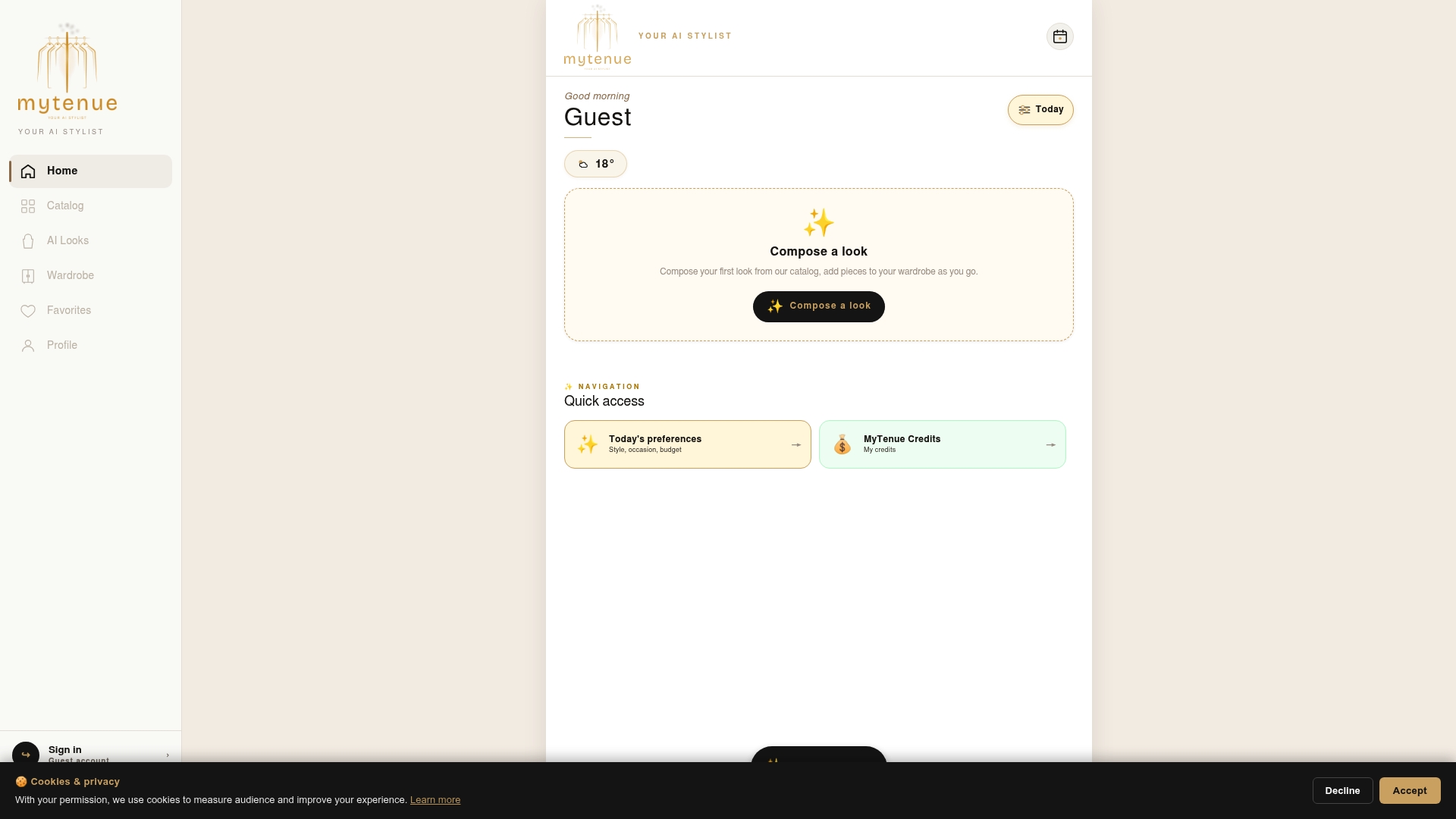
The app is available on iOS and Android, in French and English. You can start free, then move up if you want more: Basic is €5.99 per month, Premium €9.99 per month and Gold €16.99 per month. See the plans and download the app. For a step-by-step walkthrough, read our six-step routine for weather-based outfit suggestions.
FAQ
What should I wear when the weather is unpredictable?
Dress in removable layers: a light base, a middle layer you can tie or carry, and a packable outer. Check the morning and afternoon feels-like temperatures, not just the daily average. A scarf and a compact rain layer in your bag cover most surprises.
How do I know how many layers I need?
Start with the feels-like temperature, then add or remove a layer for wind, rain and how active you will be. Below about 8 °C, think three layers. Between 14 and 19 °C, two are usually enough. Your own sensitivity to cold changes the numbers by a layer either way.
Is there an app for daily outfit ideas based on weather?
Yes. Mytenue suggests outfits from your own wardrobe, adapted to the day's weather, and lets you preview them on a personal avatar. There is a free version, and paid plans start at €5.99 per month. It works on iOS, Android and the web.
Does dressing warmly prevent colds?
Not directly. Dr. Kierzek notes that clothing choices do not cause illness by themselves, though dry cold and poor layering can weaken respiratory mucous membranes. Layering helps you stay comfortable, but if symptoms persist, see your doctor.
What is the 3-3-3 rule for a wardrobe?
It is a popular capsule idea: pick three tops, three bottoms and three pairs of shoes, then mix them. It pairs well with weather-first dressing, because each piece has a clear role and the forecast tells you which to pick.
Sources
- Qu'est-ce que la température ressentie ? Météo-France
- Risques naturels en France : les bons réflexes, France.fr
- Le climat en France, France.fr
- Hiver et sclérodermie, FAI2R
- Comment s'habiller le matin quand la météo est incertaine, Doctissimo
- Comment s'habiller en hiver, Yvo et Moi