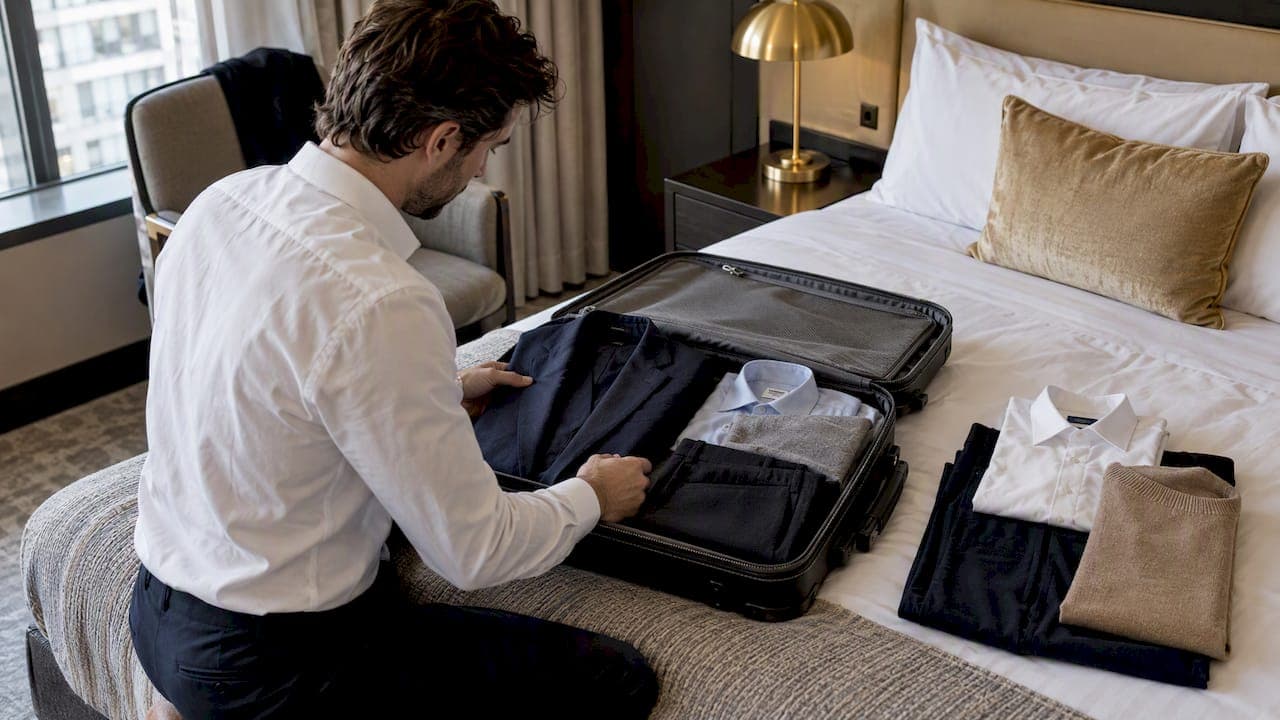
A business trip capsule wardrobe is a small set of 7 to 11 pieces, chosen around your agenda, that mix into every outfit the trip needs. One blazer, a few shirts, two bottoms, versatile shoes, and a tight color palette. Start from the calendar, not the closet. Below: the planning method, the pieces, the numbers, and a worked four-day example for a trip to France.
TL;DR
- Plan by calendar slot. Give every meeting, dinner and travel day one complete outfit before you pack anything.
- Aim for 7 pieces on a short, consistent trip, 9 for more variety, 11 for longer or multi-city trips. Each piece should work in at least two outfits.
- Stick to one neutral palette (navy, slate, bone, soft olive) anchored by a single blazer, and choose wrinkle-resistant fabrics.
- In France, dress slightly more formally than you think. Add layers for the region and season, and take comfortable shoes with grip.
- Wear the bulkiest items on the plane and keep the rest in a carry-on.
Table of Contents
- Start with the agenda, not the suitcase
- How many pieces do you really need?
- Pieces that earn their place
- Colors and fabrics: the quiet engine of a capsule
- Turning nine pieces into outfits
- Weather and region: France is not one climate
- Packing it all in a carry-on
- Our perspective: plan the outfit, then pack the clothes
- Let your AI stylist build the capsule
- Your pre-trip checklist
- FAQ
- Sources
Start with the agenda, not the suitcase
Most overpacking comes from packing by instinct. "Just in case" adds a third blazer and a fifth shirt. Reverse it.
Open your calendar. List every slot where someone will see you:
- Travel day, outbound
- Each meeting, workshop or presentation
- Each dinner or client drink
- Any event with its own dress code
- Travel day, return
Next to each slot, write the dress level: casual, business casual, business formal, cocktail. This is how event organizers think too. A Paris conference programme can specify casual attire for registration, casual business attire for appointments and cocktail attire for the opening event. One trip, three dress codes. Your capsule has to cover all three with the fewest pieces possible.
Then assign a full outfit to each slot, lay out candidate pieces, and keep a garment only if it works with several others. Anything that works in one outfit only stays home.
Read the dress code in France
France leans formal. The Swiss-French chamber guide to doing business in France notes that French business dress is rather conservative and advises a suit even for an informal meeting, while noting that start-ups, entrepreneurs and tech jobs trend toward modern, comfortable, casual clothing. The U.S. International Trade Administration says in its France business travel guide that professional attire is expected and that French business behavior emphasizes courtesy and a certain formality.
What that means for your packing:
- Banking, law, consulting, luxury, public sector: pack a blazer and tailored trousers or skirt as your baseline.
- Start-up or tech meeting: the same blazer worn open over a knit or clean tee works, with dark, plain trousers.
- Unsure: ask your host the day before. "Tenue de ville ou plus décontractée?" is a perfectly normal question.
When in doubt, the safer error is slightly too sharp. You can remove a blazer. You cannot add one you did not pack.
How many pieces do you really need?
There is no single magic number, but a few well-known rules give you a range.
| Trip type | Pieces in the capsule | Rule of thumb |
|---|---|---|
| 1 to 2 nights, one city | 7 | Short, consistent trip |
| 3 to 4 days, a mix of meetings and dinners | 9 | More variety |
| 5+ days, several cities or big temperature swings | 11 | Longer trips |
The 7, 9 and 11 piece tiers come from a 12-piece work trip capsule guide. They are a starting point. Your agenda decides.
Another popular shortcut is the 3-3-3 method: three tops, three bottoms and three pairs of shoes, which can be mixed into up to 27 looks on paper. In real life, a business trip needs fewer shoes and more layers, so treat 3-3-3 as a ceiling.

A 2-3 day starter kit
For a short trip, a typical kit is one blazer or suit, two dress shirts, one or two pairs of pants, dress shoes and one casual pair. That is six or seven items. It covers two days of meetings and a dinner if you rotate shirts and add a knit.
Pieces that earn their place
The goal is versatility. Every item should pass one test: can I wear it at a meeting and at dinner?
Tops
- Two shirts in wrinkle-resistant fabric. Travel editors recommend wrinkle-resistant poplin shirts for this reason.
- One fine-gauge knit or a plain, high-quality tee for layering under the blazer.
- One "swing" top: a silk-feel blouse or a different-color shirt for the evening.
Bottoms
- One pair of tailored trousers in a stretchy, versatile blend.
- One second bottom: dark chinos, a straight skirt, or a second trouser in a different shade.
Outer layer
- One travel blazer. This is the anchor of the whole capsule. Pick the color first, then buy the rest around it.
Shoes
Business-trip advice is consistent: choose shoes that walk well and look sharp, and never go beyond three pairs. Two is better. Wear the heaviest pair on the plane.
Accessories
- A belt or a scarf that changes the look of a repeated outfit.
- A structured tote or work bag. Structured totes blend form and function, and a tech organizer keeps chargers separate.
- One piece of jewelry or a watch. Keep it simple.
Colors and fabrics: the quiet engine of a capsule
Color is what makes nine pieces behave like twenty. Pick a base palette: navy, slate, bone or soft olive are the classic travel neutrals. A consistent base of neutrals anchored by a single blazer makes pairing effortless and helps repeated outfits feel intentional.
A simple formula:
- Two base colors (for example navy and bone).
- One accent (olive, burgundy, or a soft blue).
- One pattern at most: a fine stripe or a subtle check.
On fabrics, the checklist is short:
- Wrinkle-resistant: poplin, tightly woven blends, fine merino.
- Breathable: you will sit in planes, trains and heated offices.
- A little stretch: for long days and tight seats.
- No fabrics that need ironing the moment they leave the bag.
Test at home. Sit in the outfit for 20 minutes, then check the creases.
Turning nine pieces into outfits
Here is the rule that makes a capsule work: choose items that each work with at least two outfits. If a piece only goes with one other thing, drop it.
Parisian style gives you a useful mindset. Designer Jeanne Damas describes it, in a Condé Nast Traveler piece on dressing in Paris, as built on simplicity and a rejection of distinct "occasion dressing", with timeless, multifunctional pieces that move from professional tasks to social settings. That is exactly what a capsule is.
Here is a 9-piece capsule and what it can do:
| Piece | Role |
|---|---|
| Navy blazer | Anchor, worn at meetings and dinners |
| Slate trousers | Main bottom |
| Bone or olive second bottom | Variety, dinners, travel day |
| White poplin shirt | Meetings, under the blazer |
| Pale blue shirt | Second meeting shirt |
| Fine knit in slate or bone | Layering, travel day, casual meeting |
| Silk-feel top | Evening |
| Leather derby or loafer | Meetings, walking |
| Clean minimal sneaker or flat | Travel day, casual dinner |
What a four-day trip looks like
| Slot | Outfit |
|---|---|
| Day 1, travel | Knit, olive bottom, minimal sneakers, blazer in the bag or on |
| Day 1, dinner | Silk-feel top, slate trousers, loafers |
| Day 2, meetings | White shirt, navy blazer, slate trousers, derbies |
| Day 2, dinner | Same trousers, knit instead of shirt, scarf |
| Day 3, workshop | Pale blue shirt, olive bottom, no blazer |
| Day 3, client dinner | Navy blazer, silk-feel top, slate trousers |
| Day 4, presentation | White shirt, blazer, slate trousers |
| Day 4, travel home | Knit, olive bottom, sneakers |
Eight slots, nine pieces, no outfit that has to be worn twice in the same context. If you want a deeper method for building the underlying wardrobe at home, our professional capsule wardrobe plan walks through 15+ looks.
Weather and region: France is not one climate
France has five distinct climate zones. Paris needs seasonal layers. Mountain areas such as the Alps have cold, snowy winters and cooler summers. The Mediterranean coast calls for lighter layers.
The capsule method handles this with layers, not extra outfits. Intentional layering replaces packing for every possible weather scenario.
- Winter in Paris: thin knit, blazer, a warm coat worn on the plane.
- Summer in Paris or on the Riviera: breathable shirts, unlined blazer, a light layer for air-conditioned rooms.
- Rain: a compact, neat raincoat or trench rather than a sports jacket.
Primary advice for Paris: keep layers neat and muted, and leave athletic wear and flip-flops at home.
Shoes matter most in the city. Paris cobblestones reward comfortable shoes with grip, and water-resistant shoes help when it rains. Our guide to Paris weather outfits shows four looks for rain and cobblestones. For a week of forecasts across several regions, the 9 to 12 piece travel outfit plan shows how to match your capsule to Météo-France forecasts.

Packing it all in a carry-on
A carry-on forces good choices. A few habits make the difference.
- Wear the bulkiest pieces in transit. Coat, blazer, heaviest shoes.
- Shoes at the bottom, toes toward the wheels, socks and small items tucked inside.
- Trousers and blazer flat in the middle, folded once along the seams.
- Shirts and knits on top, or rolled in a packing cube so they come out ready to wear.
- Keep a small "arrival" pouch: chargers, a stain pen, a travel steamer or a lint roller.
One packing cube in a standard carry-on is usually enough to organize a short trip. Wearing your dress shoes on the plane saves space and means you arrive meeting-ready.
For a week away, a two-color palette and a mid-trip laundry plan keep you in the cabin bag. Book a hotel with laundry service, or wash one knit and one shirt overnight.
Clothes are only part of the bag. If you want the toiletries to fit the same carry-on, pack a travel hair routine with the same discipline: only what you will use.
Our perspective: plan the outfit, then pack the clothes
We build Mytenue around one idea: you already own most of what you need. The problem is not a lack of clothes. It is a lack of combinations you can see in advance.
For business travel, that matters even more. You are away from your closet, you cannot try things on at the last minute, and a missed outfit means a wrong impression in a meeting. So we believe in three habits.
- See the outfit before it is in the bag. A flat-lay or a virtual try-on on your own avatar shows whether the blazer works with the olive trousers before you commit.
- Score your combinations. Color, fabric, style and occasion all interact. A capsule is a set of compatible pieces, and compatibility can be checked.
- Mix what you own with a few well-chosen additions. That is better for your budget and for the planet than buying a whole new work-trip wardrobe.
A good capsule feels invisible. Nobody notices that you wore the same blazer three times. They notice that you looked composed.
— Ahmed
Let your AI stylist build the capsule
Mytenue is your AI stylist for iOS and Android. Digitize your wardrobe, and the app generates outfits from the pieces you already own. Check them with virtual try-on on your personal avatar. See editorial flat-lays. Get weather-adapted suggestions and plan each trip day in the calendar.
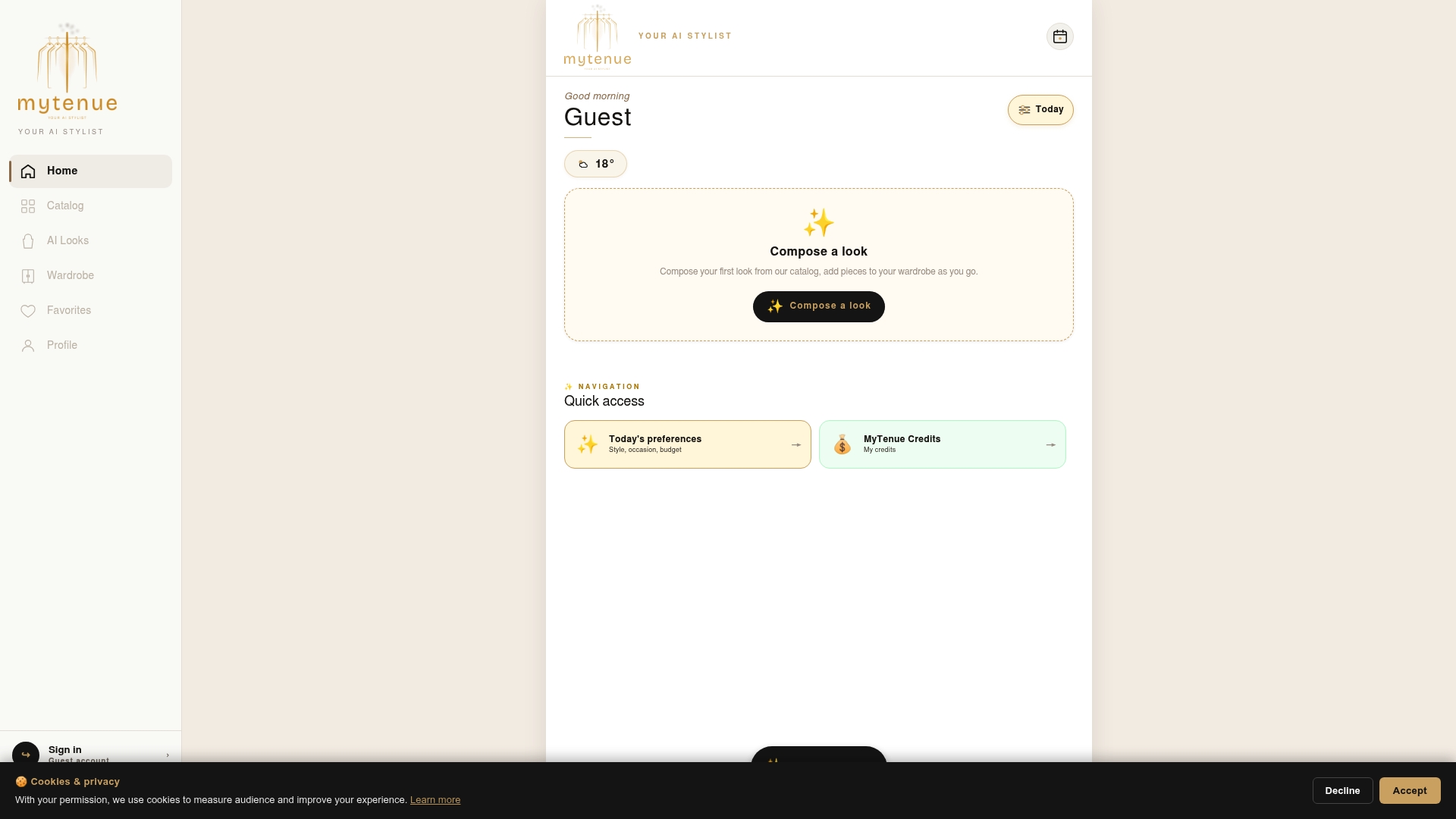
Plans: Free, Basic at €5.99 per month, Premium at €9.99 per month and Gold at €16.99 per month. The interface is available in French and English. Download the app and compare the plans, or discover Mytenue.
Still preparing the meeting itself? See how to get a meeting outfit in 10 minutes from your own closet.
Your pre-trip checklist
- List every calendar slot and its dress level.
- Check the forecast for each city, a few days before.
- Assign one full outfit per slot.
- Pick the anchor blazer and the palette.
- Keep only pieces that work in two or more outfits.
- Try the outfits on, or preview them, and fix gaps.
- Choose two pairs of shoes you can walk in.
- Pack in order: shoes, trousers and blazer, tops.
- Photograph each outfit so you can recreate it in the hotel.
For the week before and after the trip, use the workweek outfit planning checklist to keep the routine going. If your work wardrobe is mostly business casual, our business casual essentials is the place to start.
FAQ
How many outfits should I pack for a 3-day business trip?
Plan one complete outfit per calendar slot: travel, each meeting, each dinner. For three days that is often 6 to 8 outfits, built from about 7 to 9 pieces. Pieces that work in at least two outfits make that possible.
What colors are best for a business travel capsule?
Stay with neutrals such as navy, slate, bone or soft olive, anchored by one blazer. Add a single accent color and at most one subtle pattern. This makes every top and bottom combine.
What should I wear for a business meeting in France?
Expect a more formal standard than in many countries. Official guidance describes French business dress as rather conservative, with a suit advised even for informal meetings, although start-ups and tech companies are more relaxed. If you are unsure, ask your host and bring a blazer.
Can I fit a week of business outfits in a carry-on?
Yes, if you use a mix-and-match capsule in a two-color palette and plan a mid-trip wash. Wear the bulkiest items on the plane, pack shoes at the bottom and use a packing cube for shirts and knits.
Sources
- Business Travel Guide France (Swiss-French chamber guide)
- France - Business Travel (International Trade Administration)
- Event Program, DUCO France 2025
- 12-Piece Work Trip Capsule Wardrobe
- The 333 Method Fits 6 Outfits In a Carry-on (Travel + Leisure)
- Business Trip Packing List: 2-3 Day & Week-Long Kits
- A Business Trip Packing List for Traveling Professionals (Condé Nast Traveler)
- How to Pack for a Business Trip
- What to Wear in Paris (Condé Nast Traveler)
- Le climat en France (France.fr)
- What to Wear in Paris in 2026: A Month-by-Month Guide
- What to Wear in France
- Business Travel Packing List, Carry-On Only
- How to Pack a Hair Routine for Travel