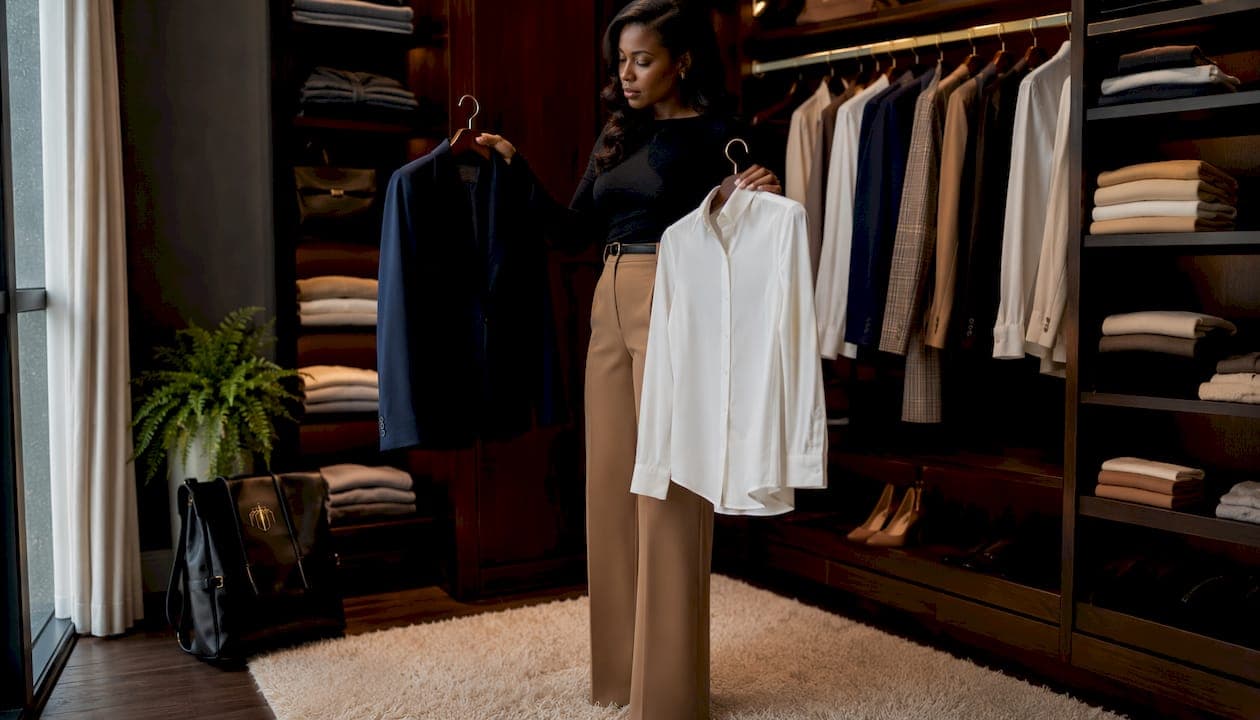
A practical business casual capsule lets most professionals create numerous work-ready outfits without repeating a look. That's the whole premise. You don't need a packed closet. You need the right pieces, in the right colors, working together. Mytenue's AI stylist is built exactly for this: digitize your capsule, and it generates outfit plans, weather-adapted suggestions, and a full outfit calendar in minutes.
Your capsule covers five gender-neutral categories:
- Tops: several blouses, button-ups, or knit tops
- Bottoms: a few pieces such as tailored trousers, dark denim, a skirt or midi
- Third layers: several blazers, cardigans, or structured jackets
- Shoes: a selection of pairs like loafers, low pumps or flats, ankle boots
- Accessories: a few items such as a belt, tote, scarf or watch
Start here. Everything else is a refinement.
Table of Contents
- What are the business casual wardrobe essentials you actually need?
- How do you mix and match 30+ outfits from 18 pieces?
- Which fits and fabrics make basics read business casual?
- Why does the third-layer rule change everything?
- What shoes and accessories finish business-casual looks?
- Where should you invest vs. save in your capsule?
- How do you care for capsule pieces to make them last?
- How does Mytenue's AI turn your capsule into 30+ outfit plans?
- Key Takeaways
- The capsule mindset most people get wrong
- Mytenue puts your capsule to work immediately
- Useful sources and further reading
What are the business casual wardrobe essentials you actually need?
The capsule framework commonly recommended includes several tops, bottoms, third layers, shoes, and accessories. Minimalists can work with fewer pieces on a hybrid schedule, while full-time office workers may prefer a larger collection.
Tops (3–4 pieces):
- White cotton-poplin button-up
- Silk or silk-blend camisole (tucks under blazers)
- Knit top in a core neutral
- One statement blouse in an accent color
Bottoms (3 pieces):
- Tailored dark trousers
- Dark straight or wide-leg denim
- Pencil skirt or midi skirt
Third layers (3 pieces):
- Black structured blazer
- Camel or neutral blazer
- Knit cardigan for colder or air-conditioned offices
Shoes (2 pairs):
- Loafers or kitten-heel pumps
- Ballet flats or low block heels
Accessories (2–3 items):
- Structured leather tote
- Quality leather belt
- Silk scarf or a simple watch
This allocation matches the commonly recommended 15–18-piece capsule that generates 30+ unique business casual outfits.
Seasonal swaps: In hot climates, swap the cardigan for a linen-blend blazer and choose cotton poplin or crepe over wool. In cold climates, a wool-blend blazer and ponte trousers carry you through winter without adding bulk. For seasonal wardrobe transitions, fabric weight is the lever, not the silhouette.
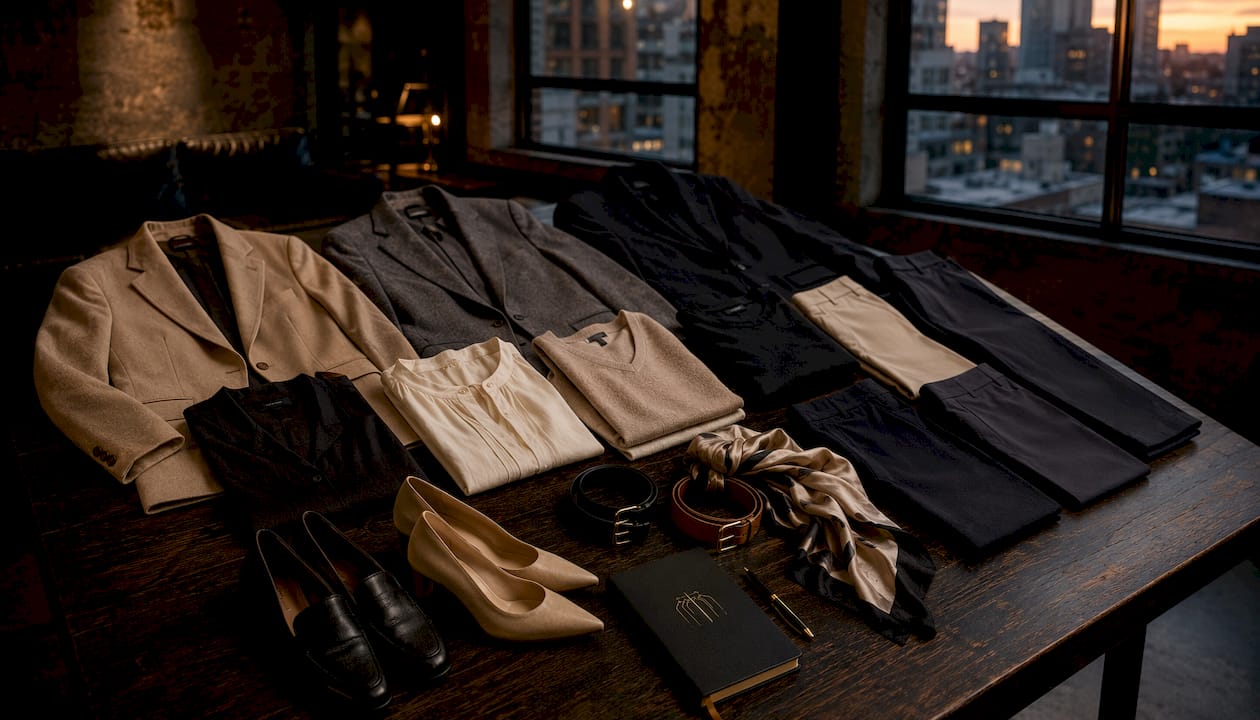
Color rule: Choose two base neutrals (black + camel, navy + gray) for bottoms, layers, and shoes. Reserve your accent color (burgundy, forest green, warm white) for tops and accessories. This keeps replacements cheap and mixing effortless.
How do you mix and match 30+ outfits from 18 pieces?
The math works because every top pairs with every bottom, and every third layer multiplies those combinations again. Here are eight repeatable formulas:
- Power/formal: White button-up + black trousers + black blazer + loafers
- Soft/creative: Knit top + midi skirt + camel blazer + ballet flats
- Hybrid: Silk camisole + dark denim + black blazer + ankle boots
- Desk-to-dinner: Statement blouse + tailored trousers + no layer + low pumps
- Client-ready: White button-up + pencil skirt + camel blazer + kitten heels
- Tonal column: Camel knit top + camel trousers + camel blazer + brown loafers
- Casual Friday: Knit top + dark denim + cardigan + clean leather sneakers
- Zoom-friendly: Statement blouse + wide-leg trousers + no layer (camera-ready from the waist up)
The fastest multiplier? Swap shoes. The same top-and-trouser combo reads differently in loafers versus ankle boots. Add the third layer and you've got a third look. A single item can generate multiple distinct outfits when you treat it as a variable, not a fixed pairing.
Pro Tip: Try the column of color technique: wear a top and bottom in the same base neutral, then break it with a contrasting third layer or accessory. It creates an instant visual anchor that makes even a relaxed layer read polished.
Which fits and fabrics make basics read business casual?
Fit is the difference between "office-ready" and "almost there." Four rules cover most situations:
- Shoulders: seams sit at the edge of your shoulder, not drooping onto your arm
- Waist: trousers and skirts skim without pulling; blazers show a slight waist definition
- Sleeve length: blazer sleeves end at the wrist bone; shirt cuffs peek out by half an inch
- Hem: trousers graze the top of the shoe; midi skirts hit mid-calf
Fabric matters as much as cut. The prep revival trend favors breathable natural fibers and clean silhouettes over stiff suiting. Wool blends, silk, cotton poplin, crepe, and ponte are your workhorses. They hold their shape, travel well, and photograph cleanly on video calls.
Pro Tip: A high-quality white T-shirt tucked into tailored trousers outperforms three lower-quality blouses. Focus on fabric weight and shoulder/neck finishing. That's where longevity lives.
Why does the third-layer rule change everything?
The fastest way to make a casual basic office-appropriate is to add a structured third layer. Professional stylists consistently name this as the single most effective elevation tactic. A blazer, a structured field jacket, or a refined cardigan signals intentionality. Without it, the same outfit reads weekend.
Your third-layer options:
- Structured blazer: the most versatile; works over dresses, trousers, and denim
- Field jacket (denim-wool blend): less formal than a blazer, still polished indoors and out
- Knit cardigan: softer, better for creative or hybrid offices
- Trench coat: outerwear that doubles as a layer on mild days
Alternative anchors when you skip the layer: a leather belt at the waist, a silk scarf at the neck, a structured tote, or pointed flats. One polished anchor is enough to shift the read from casual to considered.
Pro Tip: Choose a blazer in a mid-weight fabric (wool-cotton blend) over a stiff canvas. It drapes better, travels without wrinkling, and works across three seasons.
What shoes and accessories finish business-casual looks?
Three to four shoe categories cover every office scenario:
- Loafers: the most versatile; pair with trousers, denim, and skirts
- Ballet flats or low pumps: feminine, comfortable, and always appropriate
- Ankle boots: fall and winter go-to; add edge to midi skirts and wide-leg trousers
- Clean leather sneakers: only appropriate when exceptionally clean and paired with a structured layer; otherwise they skew casual
For bags, a structured leather tote handles most days. A slim laptop bag works for client meetings. A polished crossbody is useful for after-hours transitions. One quality bag beats three mediocre ones.
Accessories: keep jewelry minimal and intentional. A quality watch, a leather belt, and one visible refined detail (silk scarf, simple gold hoops) outperform a pile of small pieces. Mix metals freely as long as the scale is consistent.
Where should you invest vs. save in your capsule?
Spend more on pieces that touch every outfit. Save on items that rotate seasonally or trend quickly.
| Tier | Budget Range | Best For |
|---|---|---|
| Budget | — | First capsule, hybrid schedule, minimalist 15–18 pieces |
| Mid-range | — | Full-time office, better fabrics, longer wear |
| Investment | — | Client-facing roles, durable construction, fewer replacements |
Invest in: blazer, tailored trousers, and shoes. These appear in the most outfit combinations and show wear fastest when quality is low.
Save on: seasonal tops, trend pieces, and accessories. A $30 silk-look camisole performs nearly as well as a $150 version under a blazer.
Shopping checklist: check fabric content (aim for natural or structured blends), verify the return policy before buying online, confirm tailoring allowance in the seams, and match new pieces to your existing base neutrals before checkout. A $20 alteration on mid-range trousers can make them perform like investment pieces. For more wardrobe upgrade strategies that stretch your budget, the approach is always the same: fewer, better, tailored.
How do you care for capsule pieces to make them last?
Good care extends garment life and keeps cost-per-wear low.
- Wool blends: hand wash or dry clean; store folded, never hung (hanging stretches the shoulder)
- Silk: hand wash in cold water with gentle detergent; lay flat to dry; never wring
- Cotton poplin: machine wash cold, hang to dry, iron while slightly damp
- Knits: wash inside-out on a delicate cycle; reshape and dry flat
Rotate shoes: rest each pair at least one day between wears. Cedar shoe trees maintain shape and absorb moisture. Resole leather shoes before the heel wears through — a $30 resole extends a $200 shoe by years.
For small repairs, replace loose buttons immediately (a loose button becomes a lost button). Reinforce seams at stress points before they split. DIY fixes work for buttons and hems; take structural repairs to a tailor.
Sustainability note: mix existing items into new outfit combinations before buying anything new. A handcrafted luxury wardrobe approach prioritizes durable construction and fewer, better pieces over constant acquisition.
How does Mytenue's AI turn your capsule into 30+ outfit plans?
Digitizing your capsule in Mytenue takes the outfit-formula work off your plate entirely. Here's the workflow:
- Digitize: photograph your 15–18 pieces (3–4 tops, 3 bottoms, 3 layers, 2 shoes, 2–3 accessories) and upload them to Mytenue's wardrobe organizer
- Tag: assign categories (top, bottom, layer), colors, and occasions to each item
- Generate: ask Mytenue's AI to build 30+ outfit plans from your existing pieces
- Schedule: use the outfit calendar to plan your full workweek in advance
- Adapt: Mytenue's weather-based suggestions adjust daily recommendations to your local forecast
The AI analyzes color compatibility, fabric pairing, and occasion fit simultaneously. Virtual try-on with your personal avatar lets you test combinations before you wear them. The editorial flat-lay images Mytenue generates are useful for planning transitions from business casual to more formal or casual events using the same capsule pieces. For busy morning outfit planning, having your week pre-scheduled in the app cuts daily decision time to near zero.
Pro Tip: Use Mytenue's flat-lay feature to test a new purchase virtually before it arrives. Upload the item, drop it into your existing capsule, and see how many outfit combinations it actually creates. If it doesn't add at least three new looks, reconsider the buy.
Key Takeaways
A business casual capsule, built on base neutrals and an accent color, can produce many distinct work outfits when paired with Mytenue's AI outfit planning.
| Point | Details |
|---|---|
| Capsule size benchmark | Aim for 15–18 pieces: 3–4 tops, 3 bottoms, 3 layers, 2 shoes, 2–3 accessories. |
| Third-layer rule | Adding a structured blazer or field jacket is the fastest way to make casual basics office-appropriate. |
| Color strategy | Two base neutrals for bottoms and layers, one accent for tops and accessories, minimizes purchase needs. |
| Budget priorities | Invest in blazer, trousers, and shoes; save on seasonal tops and trend pieces across three budget tiers ($300–—). |
| Mytenue workflow | Digitize your 15–18 pieces in Mytenue, tag by category and color, and generate a 30+ outfit calendar instantly. |
The capsule mindset most people get wrong
Business casual dressing is not about owning the right list of items. It's about intentionality. The same white button-up reads sloppy or sharp depending entirely on fit, tuck, and what you put over it. That's the insight most capsule guides bury in a footnote.
The third-layer rule matters not because blazers are magic, but because they signal that you made a choice. A structured layer tells a room you dressed with purpose. That perception shift is real and it happens fast.
What I'd push back on: the idea that a capsule has to be boring. Two base neutrals don't mean two boring colors. Charcoal and camel together are rich. Navy and ivory are crisp. The accent piece, whether it's a forest-green blouse or a burgundy scarf, is where personality lives. Keep the foundation quiet and let one thing speak.
The sustainability angle is also underused. Most people buy new before they've exhausted what they already own. Mytenue's mix-and-match engine is genuinely useful here: it surfaces combinations you haven't tried yet from pieces already in your closet. That's not a feature. That's a habit shift.
Mytenue puts your capsule to work immediately
Your capsule checklist is only as useful as your ability to execute it every morning. Mytenue closes that gap. Upload your 15–18 pieces, and the AI generates a full outfit calendar, adapts suggestions to the day's weather, and lets you virtually try on combinations using your personal avatar before you ever open your closet.
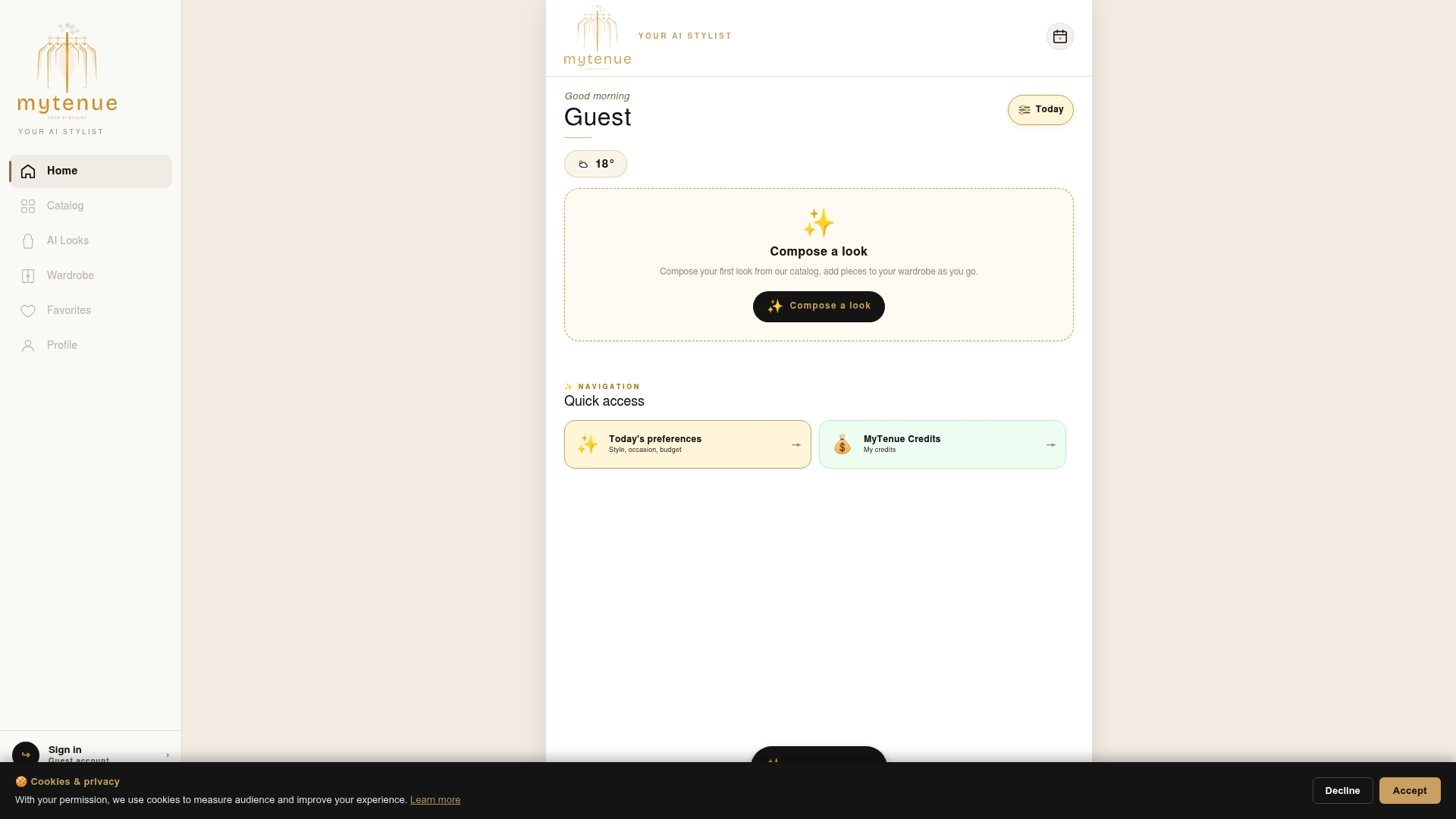
No more standing in front of your wardrobe at 7 AM. No more repeating the same three outfits because the others feel like too much effort to figure out. Mytenue's outfit scheduling and flat-lay images make your capsule feel larger than it is, and its color and fabric analysis catches combinations you'd never think to try yourself.
Ready to digitize your 15–18-piece capsule (3–4 tops, 3 bottoms, 3 layers, 2 shoes, 2–3 accessories) and generate your first 30 outfits? Start with Mytenue — the free tier lets you upload your wardrobe and explore outfit suggestions right away.
Useful sources and further reading
- Business Casual Capsule Wardrobe: 18 Pieces, 30+ Outfits — Capsulee Wardrobe: detailed capsule framework with outfit count breakdowns
- Business Casual for Women: Stylist Guide — AC Styles: third-layer rule and intentionality-first styling philosophy
- What Is Business Casual: The 5 Pieces to Wear — Who What Wear: prep revival trend and fabric guidance
- Guide to Business Casual for Women — Corporette: column of color technique and tonal dressing
- Work Capsule Wardrobe Outfit Ideas — Elle: fabric quality over quantity and investment basics
- Sustainable luxury fashion practices — Jeeyodee: care and longevity guidance for capsule pieces