
AI curates complete looks by identifying a hero item, extracting its style attributes, and assembling compatible pieces from the catalog — then ranking and visualizing the result as a shoppable outfit. For shoppers, that means ready-to-wear inspiration with zero decision fatigue. For retailers, it means higher average order value (AOV) and more cross-sell opportunities per session. Mytenue is built around exactly this pipeline, turning a single product page into a full styled moment.
Here is how the process works at a glance:
- Anchor detection: The AI identifies the hero (seed) item and its category
- Attribute extraction: Color family, silhouette, material, occasion, and vibe are tagged
- Slot mapping: The system determines which outfit slots (top, bottom, footwear, accessories) need filling
- Compatibility filtering: Candidate items are scored for color harmony, price proximity, and style fit
- Visualization and ranking: The best combinations are rendered and ranked for the shopper
Table of Contents
- What "AI styling" and "complete look" generation actually mean
- How AI assembles a complete outfit, step by step
- How the AI visualizes looks: embeddings, computer vision, and generative pipelines
- Why shoppers and retailers care: KPIs and commercial impact
- How to try or implement AI-curated looks
- What AI styling still gets wrong and the risks to watch
- Key Takeaways
- AI styling done right: a perspective worth sharing
- Mytenue brings AI-curated looks to life for you
- Useful sources and further reading
What "AI styling" and "complete look" generation actually mean
AI styling is the automated process of assembling a multi-item outfit from a product catalog, guided by compatibility logic rather than a human editor. A "Complete the Look" feature is the shopper-facing output: a curated set of items displayed alongside a hero product so you can buy the whole outfit in one session.
These two concepts overlap but are not identical. Virtual try-on focuses on visual fit — placing a garment on your body or a model image to show how it looks on you. AI styling, by contrast, is catalog-driven outfit assembly: it selects which items belong together, regardless of whether you see them draped on a body. Many platforms now combine both, but they solve different problems.
Style presets give the system a direction. Common examples include casual-chic, business-casual, evening glam, Y2K, streetwear, and resort. Each preset shifts the weighting on attributes like formality, color palette, and silhouette type, so the same hero blazer might anchor a polished office look in one preset and a relaxed weekend outfit in another.
The hero (anchor) item is whatever product the shopper is viewing. The remaining slots are the outfit categories the system needs to fill: typically top, bottom, outerwear, footwear, and one or more accessories. Not every slot is required for every look — a dress hero collapses the top and bottom slots into one, and the system adapts accordingly.
How AI assembles a complete outfit, step by step
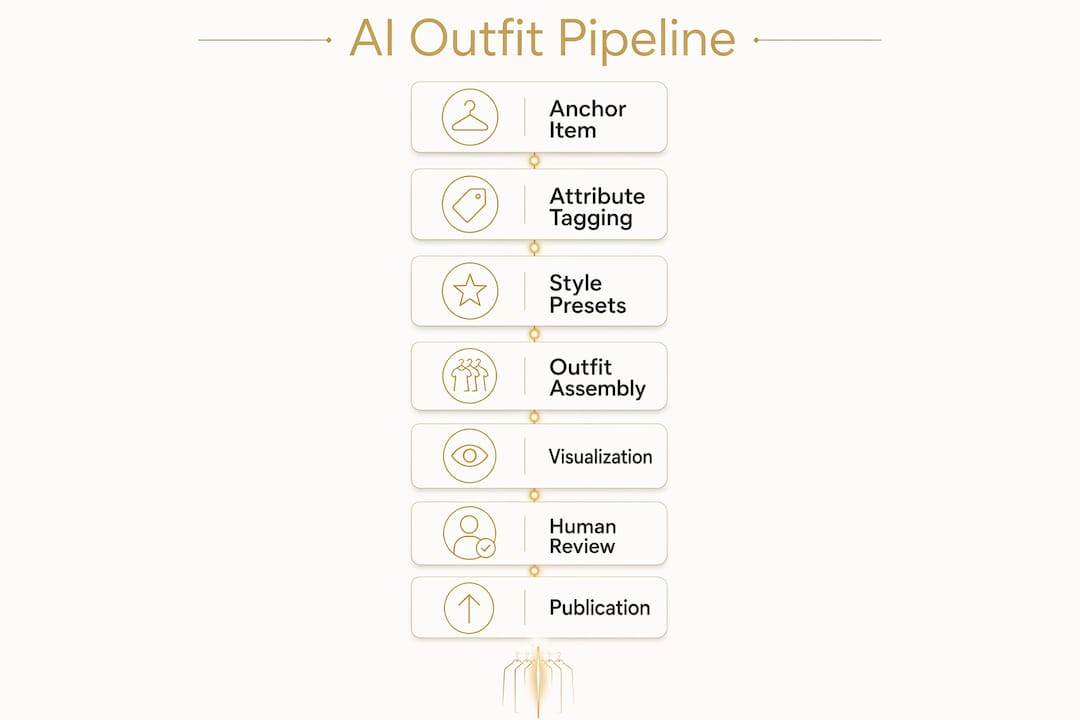
The pipeline from anchor item to ranked, shoppable look follows a consistent sequence across platforms.
- Anchor detection: The system identifies the hero product and confirms its primary category (e.g., a midi skirt vs. a blazer vs. a sneaker).
- Attribute extraction: Image tagging and metadata parsing pull color family, material, silhouette, occasion tags, and trend signals. Quality tagging here determines everything downstream.
- Slot mapping: Based on the anchor's category, the engine maps which outfit slots remain open and sets constraints (e.g., a dress fills top + bottom, so only footwear and accessories are needed).
- Compatibility filtering: Candidate items from the catalog are scored. Ranking scores are typically calculated through a weighted combination of price proximity, brand affinity, and color compatibility.
- Candidate ranking: The top-scoring combinations are ordered. Inventory availability, trend signals, and personalization weights (from past clicks and purchases) refine the final order.
- Visualization: The selected items are rendered together — either as a flat-lay grid or a lifestyle image using generative pipelines.
- Human review and live learning: Merchandising teams audit and approve looks before they go live. Shopper interactions — clicks, add-to-carts, purchases — then feed back into the model as continuous training signals.
A single SKU can yield five or more unique outfit variations based on different styling directions, which means one well-tagged product page can serve multiple shopper personas simultaneously.
| Attribute | Human stylist | Rule-based engine | Modern AI styling |
|---|---|---|---|
| Scalability | Low | High | Very high |
| Personalization | High | Low | High |
| Speed | Slow | Fast | Fast |
| Editorial control | Full | Limited | Configurable |
| Trend sensitivity | High (manual) | None | Continuous (via retraining) |
| Cost per look | High | Low | Low–medium |

Pro Tip: Merchandising edits — when your team approves or rejects AI-generated looks — are among the highest-quality training signals the model receives. Seeding the system with curated editorial outfits before launch accelerates accuracy far faster than letting the AI publish blindly and learn from cold-start data.
How the AI visualizes looks: embeddings, computer vision, and generative pipelines
The visual layer is where AI styling becomes genuinely impressive — and where it still has real limits.
Attribute extraction and image tagging are the foundation. Every garment image passes through a computer vision model that assigns tags: category, color family, material, occasion, and aesthetic vibe. The richer and more consistent these tags are, the better the compatibility search performs. Poorly tagged inventory is the single most common reason AI outfit curation underperforms.
Multimodal embeddings and vector search power the retrieval step. Systems convert garment images and metadata into high-dimensional vectors, then use approximate nearest neighbor search (via libraries like FAISS or ScaNN) to find compatible items in milliseconds — even across catalogs with millions of SKUs. Style embeddings trained with triplet learning go further, teaching the model complementary relationships beyond simple co-purchase signals. CLIP-style image embeddings fed into a triplet-loss network are a common architecture for this.
Generative visualization is the most technically demanding step. The pipeline separates the hero product from its background using bounding box APIs, maps anchor points for coordinate alignment, applies digital draping physics, and then passes the composite through an iterative diffusion prompt-engineering loop to match lighting and fabric physics. The AI also scores and selects the cleanest product image automatically — flagging shots with faces or hands and preferring isolated product images for recommendation tiles.
The most realistic visual outcomes separate the hero product using bounding boxes and anchor points, apply digital draping, and then pass the composite through an iterative diffusion prompt-engineering loop to match lighting and fabric physics — avoiding the flat, artificial look that undermines shopper trust.
Where current pipelines still struggle:
- Fine fabric textures (silk, chiffon, velvet) often render with a plastic or waxy quality
- Extreme body poses cause draping artifacts where garments intersect unnaturally
- Layered outfits (a jacket over a shirt over a turtleneck) frequently produce inaccurate layer intersections
- Cultural styling nuances and body diversity remain underrepresented in most training datasets
Why shoppers and retailers care: KPIs and commercial impact
The business case for AI outfit curation is straightforward. When a shopper sees a complete look rather than a single product, they have a reason to add multiple items to their cart. That directly lifts AOV. Conversion rate rises because the outfit answers an unstated question — "what else works with this?" — before the shopper has to go looking. Session time increases as shoppers browse outfit variations, and return rates can fall when purchases are made as coordinated looks rather than isolated impulse buys.
More than 65% of shoppers interact most with outfit and style recommendation features on product pages — a signal that the feature drives real engagement, not just passive impressions. You can explore the personal style benefits of AI curation in more depth, including how reduced decision fatigue translates to higher satisfaction scores.
Common pricing and licensing models for AI styling modules include SaaS fees per SKU in the catalog, revenue-share arrangements tied to attributed sales, and commission structures on items recommended by the engine. Implementation scope varies, but a typical pilot requires:
- Clean, consistent product images (ideally on white or neutral backgrounds)
- Complete metadata: category, color, material, occasion, size range
- Real-time or near-real-time inventory sync so out-of-stock items never appear in looks
- Editorial rules defining which item combinations are off-limits (e.g., no competing brand pairings)
- Analytics hooks to capture clicks per outfit, add-to-cart rate, and AOV lift by look
How to try or implement AI-curated looks
For shoppers, the workflow is fast:
- Open a product page and find the "Complete the Look" or outfit module
- Select a style direction or vibe (casual, evening, workwear)
- Swap individual items within the look if something does not suit you
- Save the full outfit or add all items to your cart
Platforms like Mytenue let you upload wardrobe items and build looks around pieces you already own, which adds a sustainability angle: mix existing pieces with new ones rather than buying a full outfit from scratch.
For e-commerce teams, a pilot follows a different sequence:
- Data audit: Confirm image quality and metadata completeness across your catalog subset
- Tag enrichment: Fill gaps in color, material, and occasion attributes before training
- Pilot on a subset of SKUs: Start with your top 200–500 hero products to limit scope
- Human review console: Build or configure an approval workflow so merchandisers can accept, reject, or edit AI-generated looks before they go live
- A/B test: Run the outfit module against a control (no outfit feature) and measure results
What to track during a pilot:
- AOV lift in sessions where the outfit module was shown vs. not shown
- Conversion rate delta between the two groups
- Clicks per outfit (how many items in a look get clicked)
- Time on product detail page
- Return rate change for items purchased as part of a look vs. standalone
Pro Tip: Test presentation format before testing content. A carousel of outfit variations and a single hero look image produce very different engagement patterns. Settle on the format that wins, then optimize the looks themselves. For short pilots (under 30 days), prioritize AOV lift and add-to-cart rate — conversion and return-rate signals need more time to stabilize.
What AI styling still gets wrong and the risks to watch
No pipeline is perfect. Knowing the failure modes protects both shoppers and the brands deploying these tools.
Known limitations:
- Dataset bias: Models trained on limited body types, skin tones, or Western style conventions produce recommendations that feel irrelevant or exclusionary to large shopper segments
- Cultural insensitivity: Styling rules that work in one market can be inappropriate or tone-deaf in another; global catalogs need region-aware filtering
- Under-tagged inventory: Missing or inconsistent metadata causes the engine to surface incompatible items with high confidence scores
- Unrealistic visual output: Generative images still struggle with fine textures, layering, and extreme poses — a look that renders beautifully may not reflect how the garment actually fits
- Poor fit and fabric realism: Digital draping physics are improving but remain imperfect, especially for structured garments and knitwear
Privacy and ownership checklist for platforms accepting user uploads:
- Obtain explicit consent before storing wardrobe photos
- State clearly how long images are retained and whether they are used for model training
- Clarify IP ownership of any AI-generated imagery that incorporates user-uploaded content
Red flags for merchants evaluating AI styling vendors:
- Systems that auto-publish looks without a human review step
- No editorial override capability for merchandising teams
- Ranking logic that surfaces high-margin items regardless of style compatibility
- No mechanism to exclude culturally sensitive or seasonally inappropriate combinations
Responsible AI styling, as Mytenue practices it, keeps a human in the loop at every publication step.
Key Takeaways
AI curates complete looks through a seven-step pipeline — from anchor detection to ranked visualization — and the quality of that output depends directly on catalog tagging, human review, and continuous retraining from real shopper signals.
| Point | Details |
|---|---|
| The pipeline is seven steps | Anchor detection through human review; every step affects final look quality. |
| Tagging quality drives everything | Incomplete metadata is the most common reason AI outfit curation underperforms. |
| — | More than 65% of shoppers interact most with outfit and style recommendation features on product pages. |
| Human-in-the-loop is non-negotiable | Fully unsupervised pipelines produce brand-misaligned or seasonally wrong looks; merchandiser edits are also high-value training data. |
| Mytenue for shoppers and brands | Mytenue combines AI outfit assembly, human editorial review, and wardrobe personalization in one platform. |
AI styling done right: a perspective worth sharing
The conversation around AI fashion styling tends to split into two camps: breathless enthusiasm about generative imagery, and skepticism about whether any algorithm can replace a trained eye. Both miss the more interesting truth.
The real value of AI outfit curation is not that it replaces stylists. It is that it scales the decisions stylists already make — which items belong together, which combinations serve a specific occasion, which looks will resonate with a specific shopper. A human stylist working a catalog of 50,000 SKUs cannot produce a curated look for every product. An AI pipeline can, and it gets sharper every time a shopper clicks, saves, or buys.
What most implementations get wrong is treating the AI as a finished product rather than a starting point. The platforms that produce the best results — the ones where outfit recommendations feel genuinely curated rather than algorithmically assembled — are the ones where merchandising teams stay actively involved. Their edits are not just quality control; they are the highest-signal training data the model receives.
The sustainability angle also deserves more attention than it typically gets. An AI that helps shoppers build looks around items they already own, rather than defaulting to full new-outfit purchases, is a genuinely different value proposition. It is also a harder engineering problem, because it requires the system to reason about a user's existing wardrobe rather than just the brand's catalog. That is where the next generation of AI wardrobe personalization is heading, and it is the direction Mytenue finds most worth building toward.
Mytenue brings AI-curated looks to life for you
Mytenue is your personal AI stylist — built for shoppers who want complete, confidence-inspiring looks without the guesswork, and for brands that want to turn single product views into multi-item sessions.
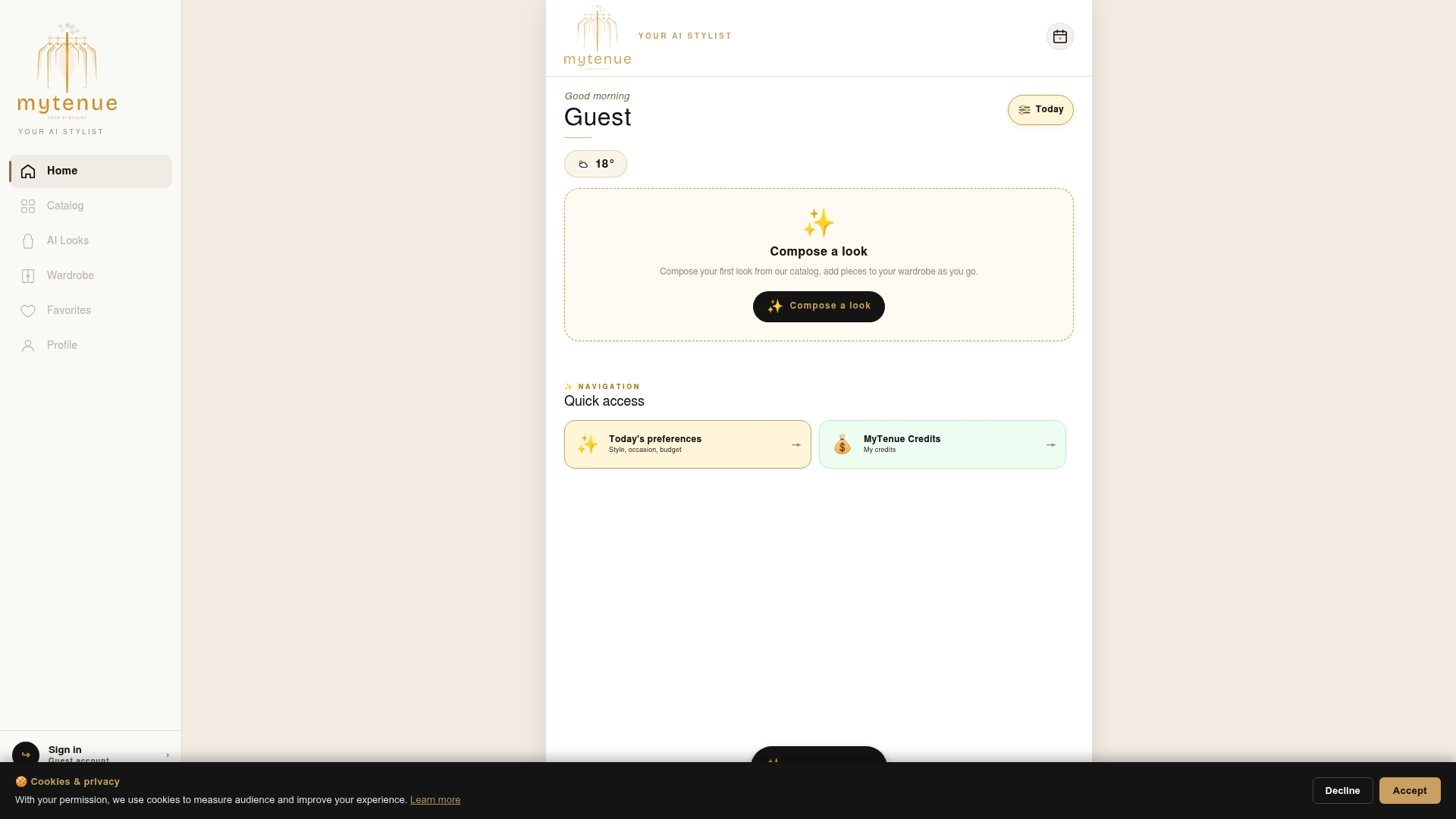
The platform combines catalog-level attribute tagging, a Complete the Look engine, a human editorial review console, and generative visualization — all in one place. You pick a hero item, choose your vibe, and Mytenue assembles a full outfit from pieces that actually work together. Swap anything, save the look, or add it all to your cart. For brands, the same engine runs as a configurable module with real-time inventory sync and A/B testing built in. Ready to see it in action? Try Mytenue and get your first AI-curated look today.

Useful sources and further reading
Key sources used in this article, with notes on what each covers:
- Personalized 'Complete the Look' model — Walmart Global Tech Blog: Covers ranking signal architecture (price proximity, brand affinity, color compatibility) and triplet-loss style embedding training. Best for process_overview and technical_mechanisms sections.
- Complete the Look: How AI styling drives multi-item orders — YesPlz: Covers shopper engagement statistics, image selection automation, and the business case for outfit features. Best for business_and_consumer_value and technical_mechanisms.
- How AI curates an outfit, step by step — YesPlz: Explains the human-in-the-loop workflow and continuous retraining from shopper signals. Best for process_overview and limitations_and_ethics.
- From products to inspiration: Inside the engine of occasion-based outfit visualiser — Myntra Engineering: Deep technical coverage of vector embeddings, bounding box pipelines, diffusion-based visualization, and fashion intelligence vs. rule-based systems. Best for technical_mechanisms.
- How to Build a Custom Outfit AI Generator — Vegavid: Practical engineering guide covering graph-based compatibility, vector databases (FAISS, Pinecone, Milvus), feature stores, and future wardrobe reasoning systems. Best for technical_mechanisms and how_to_use.
- Text2Outfit: Controllable Outfit Generation with Multimodal Language Models — ICCV 2025: Academic paper on text-driven and seed-to-outfit generation using LLM frameworks and LoRA fine-tuning. Best for technical_mechanisms and definition sections.
- How I built an AI stylist that curates and visualizes outfits — Algolia: Engineering walkthrough of a hybrid retrieval and generative pipeline, including cost considerations and UX challenges. Best for how_to_use and limitations_and_ethics.
- Fora Leonara: The Digital Atelier of Enduring Style: Editorial perspective on curated ready-to-wear collections and craftsmanship — a useful real-world example of editorial-led curation alongside AI-driven approaches.