
Algorithmic outfit curation is the process of using AI to assemble coordinated clothing combinations by analyzing personal data, occasion context, and style preferences simultaneously. The role of algorithms in outfit curation goes far beyond simple product matching. Modern systems apply computer vision, natural language processing (NLP), and machine learning to generate complete looks, not just individual items. Platforms like Mytenue use these techniques to deliver personalized outfit recommendations that account for your body type, budget, and the specific moment you are dressing for. The result is a faster, more confident approach to getting dressed every day.
How do algorithms generate personalized outfit recommendations?
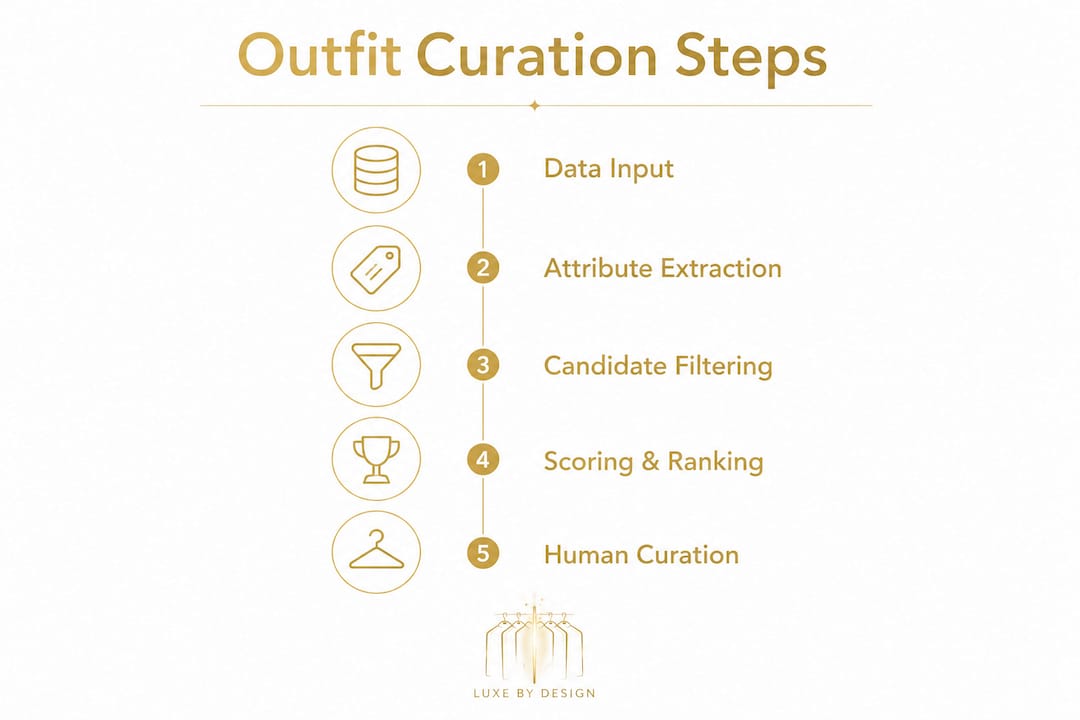
Outfit recommendation algorithms work through a multi-stage pipeline that processes several types of data at once. Each stage filters and scores clothing combinations before a final suggestion reaches you.
The pipeline typically follows this sequence:
-
Data collection. The system gathers your body measurements, style history, stated preferences, and behavioral signals like clicks and skips. State-of-the-art systems also pull in environmental data such as temperature, wind, and precipitation to match outfits to real conditions.
-
Feature extraction with computer vision. Each garment image gets analyzed for color, texture, silhouette, and material weight. NLP processes product descriptions and tags to extract occasion suitability and style category.
-
Scoring and compatibility matching. A scoring function evaluates each potential outfit combination across three dimensions: color harmony, occasion coherence, and style compatibility. Integrating occasion-aware priors into this scoring step improves outfit quality scores by 3.3 times and reduces style violations by 42% compared to random selection. That improvement means you see coordinated looks instead of mismatched suggestions.
-
Inventory and trend filtering. The algorithm checks which items are actually available and cross-references current trend data to keep suggestions fresh and shoppable.
-
Output generation. The system presents a complete outfit, not a single product. Systems like the Loom architecture generate three distinct outfit options in under 5 seconds on standard hardware. Speed at that level makes real-time personalization practical for everyday use.
Pro Tip: When you rate or skip a suggestion, you are feeding the algorithm direct signal. The more you interact, the faster the system learns your actual preferences rather than your stated ones.
The practical takeaway is that AI trend forecasting and scoring functions work together to make each suggestion more relevant than the last.
What hybrid human-AI models ensure quality in outfit curation?
Purely automated styling has a real weakness: algorithms can match attributes correctly while still producing outfits that feel off. A navy blazer and olive trousers may score well on color theory but look wrong for a specific brand aesthetic or cultural moment. Human expertise closes that gap.
The most effective fashion AI platforms use a hybrid human-in-the-loop model where AI handles data volume and attribute tagging while human stylists define the creative boundaries. This division of labor produces suggestions that are both technically sound and genuinely styled.
Here is how the collaboration works in practice:
- AI handles scale. The algorithm processes thousands of garment combinations per second, extracting attributes and filtering candidates by compatibility scores.
- Human stylists set aesthetic rules. Merchandising teams define which combinations cross a brand's style logic, flagging outputs that feel generic or off-brand.
- Feedback loops refine the model. Human reviewers mark rejected outfits, and those corrections train the algorithm to avoid similar errors in future runs.
- Creative boundaries evolve. As trends shift, stylists update the rules, and the AI adapts its scoring accordingly.
Hybrid approaches are most effective when AI performs attribute extraction and candidate filtering while human stylists maintain creative boundaries and high aesthetic appeal. Human review ensures that the algorithm's technically correct matches also feel genuinely styled to the person wearing them.
Pro Tip: When evaluating any AI styling platform, ask whether human curation is part of the process. Platforms that combine both consistently outperform fully automated systems on style quality.
The visual styling tools that perform best in 2026 all share this hybrid structure. Neither AI alone nor human stylists alone can match the output quality of the two working together.
How do modern AI systems continuously learn and improve outfit recommendations?
An outfit recommendation algorithm is not static. It learns from every interaction you have with it, and that learning accelerates the more you use the platform.
The core mechanism is closed-loop learning. Closed-loop feedback systems use both explicit rejections and implicit interaction patterns to accelerate personalization and align recommendations closely with your evolving style preferences. A skip is as informative as a purchase.
The most advanced systems go further with hierarchical negative feedback:
- Standard negative feedback records that you disliked an outfit.
- Hierarchical negative feedback breaks that dislike down by attribute. Did you reject the color? The silhouette? The occasion match? Next-generation systems apply this granular signal to generate counter-examples that better align future recommendations with your actual taste.
- Implicit behavioral signals such as time spent viewing an item, zoom interactions, and repeat visits add another layer of preference data without requiring you to rate anything explicitly.
The underlying architectures driving this learning include transformer models, reinforcement learning, and graph neural networks. Multi-technique architectures combining these three approaches optimize real-time outfit recommendations by balancing your style trajectory against the need to introduce new pieces you have not considered before. That balance between familiarity and discovery is what keeps recommendations feeling personal rather than repetitive.
AI wardrobe personalization improves measurably over time precisely because these feedback loops compound. The system you use in month three knows you far better than the one you started with.
What practical benefits do algorithmic outfit curation offer fashion-conscious consumers?
The most immediate benefit is the reduction of decision fatigue. Choosing what to wear involves more cognitive load than most people realize. AI reduces outfit decision fatigue by presenting a curated shortlist rather than an open wardrobe of possibilities. You make one choice instead of dozens.
Beyond convenience, algorithmic curation changes how you discover style. Traditional retail shows you products in isolation. AI systems show you complete looks in context, which is a fundamentally different experience.
| Benefit | What it means for you |
|---|---|
| Decision fatigue reduction | You receive a curated shortlist, not an open-ended choice |
| Occasion accuracy | Suggestions match the specific event, weather, and dress code |
| Style discovery | You see coordinated looks featuring pieces you would not have paired yourself |
| Wardrobe efficiency | Existing items get surfaced alongside new acquisitions |
| Lifestyle inspiration | Outfits appear in styled contexts that reflect real situations |
AI technologies have shifted apparel recommendation from selling individual products to selling lifestyle contexts. Personalized lifestyle images, created by manipulating lighting, model poses, and backgrounds with generative AI, increase engagement compared to static product catalogs. You are not just seeing a jacket. You are seeing yourself in a situation.
Pro Tip: Use the occasion filter actively when exploring AI styling platforms. Specifying "job interview" versus "weekend brunch" produces dramatically different and more useful results than browsing without context.
The confidence benefit is harder to quantify but just as real. Seeing a complete, coordinated outfit removes the uncertainty of mixing and matching on your own. You leave the house knowing the look works, not hoping it does.
Key Takeaways
Algorithms in outfit curation work best when they combine computer vision, NLP, occasion-aware scoring, and human creative oversight to generate complete, personalized looks at speed.
| Point | Details |
|---|---|
| Multi-stage pipelines drive accuracy | Algorithms process body data, occasion context, and trend signals before scoring any outfit combination. |
| Occasion-aware scoring matters most | Integrating occasion priors improves outfit quality scores by 3.3 times and cuts style violations by 42%. |
| Human oversight is non-negotiable | Hybrid human-AI models produce suggestions that are technically correct and genuinely styled. |
| Feedback loops accelerate personalization | Hierarchical negative feedback teaches the system your dislikes, not just your preferences. |
| Context shifts the experience | AI moves fashion from product browsing to lifestyle inspiration by presenting complete, styled looks. |
Why the hybrid model is the only honest answer
I have spent years watching fashion technology make promises it could not keep. Fully automated styling engines looked impressive in demos and fell apart in practice. The outfits were technically compatible but felt assembled by someone who had never actually gotten dressed.
The hybrid human-AI model is not a compromise. It is the correct architecture. AI is genuinely better than humans at processing thousands of garment combinations, tracking behavioral signals, and updating in real time. Humans are genuinely better at knowing when something crosses a line aesthetically, culturally, or contextually. Neither can replace the other.
What I find most underappreciated is the role of negative feedback. Most people think about AI learning from what they like. The real personalization gains come from what they reject and why. A system that understands you dislike oversized silhouettes in formal contexts, but love them for weekend wear, is a system that actually knows your style. That granularity only comes from hierarchical feedback, and most consumers do not realize they are training the model every time they skip a suggestion.
The next frontier is real-time contextual adaptation. Imagine an algorithm that adjusts your morning outfit suggestion based on your calendar, the weather forecast, and the last three outfits you wore. That level of context awareness is technically achievable today. The platforms that build it thoughtfully, with user transparency and control at the center, will define what AI styling looks like in the next five years.
My honest observation on consumer attitudes: people are more comfortable with AI curation than they admit publicly. When the suggestions are good, they follow them without hesitation. The resistance disappears the moment the algorithm proves it understands your taste.
— Ahmed
How Mytenue brings algorithmic outfit curation to life
Mytenue combines AI-driven outfit scoring with human curation to deliver personalized looks built around your style preferences, occasion, and budget.
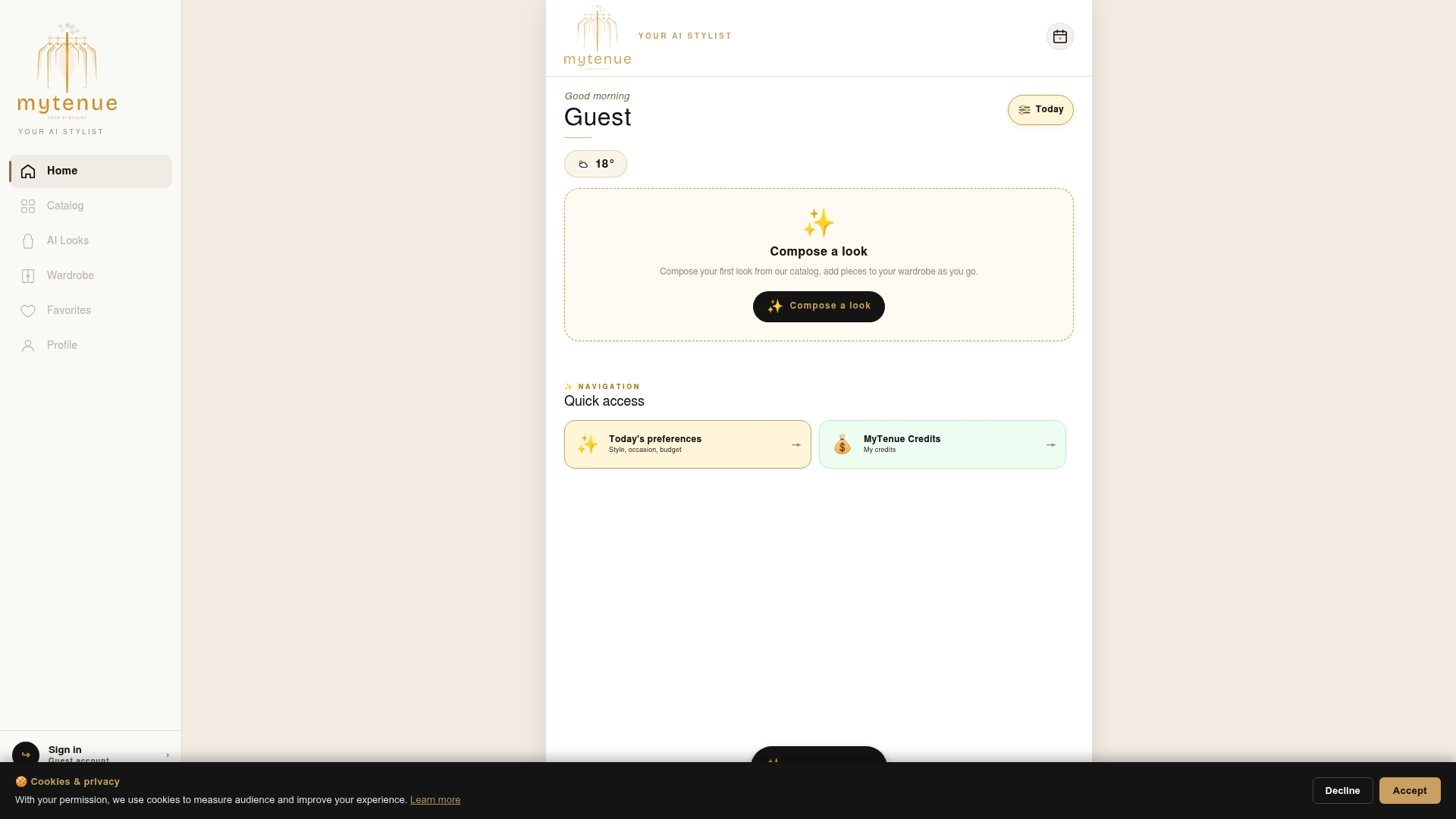
The platform does not show you isolated products. It builds complete outfits, mixing items from your existing wardrobe with new pieces, so every suggestion is practical and ready to wear. The AI processes your style history and occasion context while the curation layer ensures every look meets a real aesthetic standard. You get the speed of an algorithm and the judgment of a stylist in one place. Visit Mytenue to see your first AI-curated outfit, or read more about AI outfit curation step by step to understand exactly how the process works.
FAQ
What is the role of algorithms in outfit curation?
Algorithms analyze personal data, occasion context, and style history to generate coordinated outfit combinations rather than single-item suggestions. They apply computer vision and NLP to score color harmony, material compatibility, and occasion fit simultaneously.
How do AI outfit algorithms learn your personal style?
AI systems track clicks, skips, purchases, and viewing time as feedback signals to continuously refine recommendations. Advanced platforms use hierarchical negative feedback to understand not just what you like, but specifically what you dislike and why.
Why are human stylists still needed in AI outfit curation?
AI excels at processing data volume and attribute matching, but human stylists define aesthetic boundaries and catch combinations that are technically correct but feel wrong. The hybrid model consistently outperforms fully automated systems on style quality.
How fast can an algorithm generate outfit suggestions?
Systems using modern retrieval-scoring architectures generate multiple distinct outfit options in under 5 seconds on standard hardware. That speed makes real-time personalization practical for everyday use.
Does weather data actually affect outfit recommendations?
Incorporating weather data such as temperature, wind, and precipitation measurably improves outfit personalization accuracy. Occasion-aware systems that include environmental inputs produce suggestions that are practical to wear, not just visually appealing.