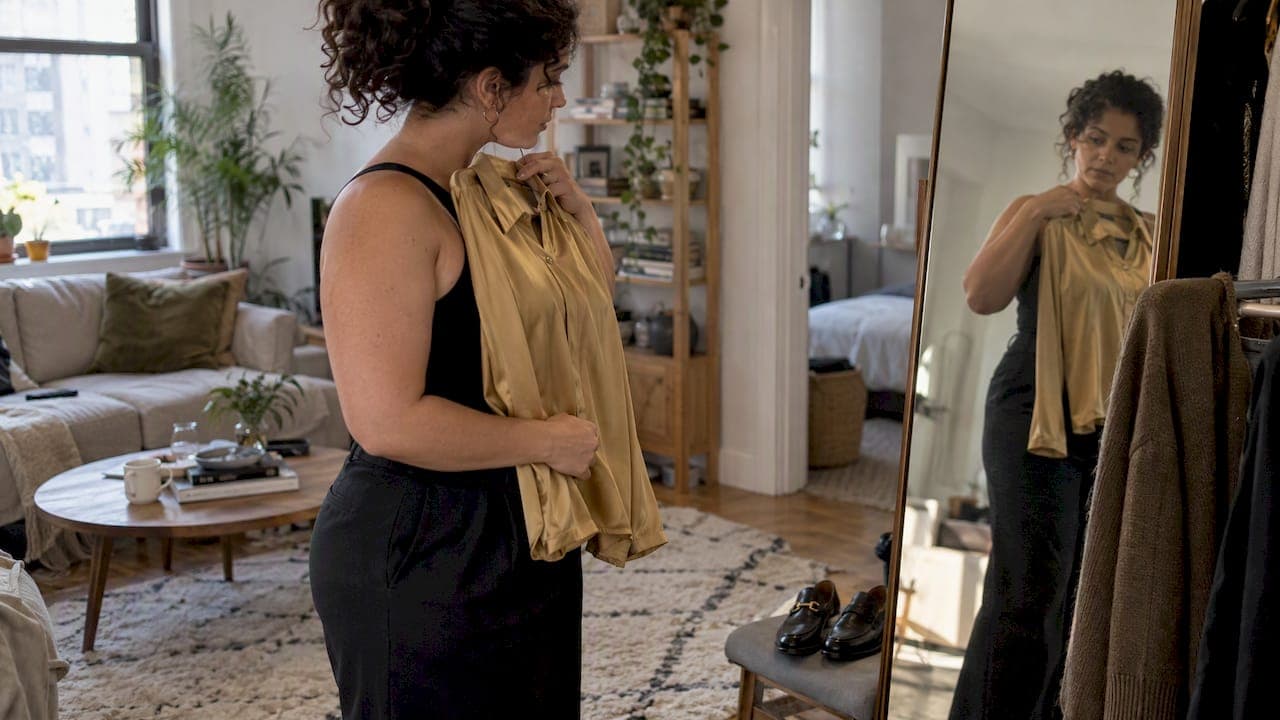
The fastest way to match clothes is a three-part formula: one dominant piece, one grounding neutral, and one small accent. Color-wheel pairings and proportion checks back this up, but you do not need theory to start, you need a repeatable structure. Below, we break down the logic and hand you ready-to-copy templates.
TL;DR:
- Keep outfits to three colors: choose a dominant shade, a neutral secondary, and one accent; soften complementary colors with muted tones for everyday wear.
- Mix prints only when their scales differ and they share a color; otherwise, use one patterned piece with calm, solid layers around it.
- Aim for a one third to two thirds silhouette rather than equal halves, using a tuck, belt, or cropped layer to shift proportions.
- Match pieces to a consistent dress level, or make contrast deliberate; when an outfit feels mismatched, replace the outlier instead of rebuilding everything.
- Save successful outfits as photos and spend five minutes each evening choosing tomorrow’s clothes; grouping pieces by color makes repeat combinations easier.
Table of Contents
- Color basics: color wheel, temperature, and the three-color rule
- The 3-part outfit formula (one statement + grounding neutral + styling moment)
- How to mix patterns and textures without looking chaotic
- Proportions and fit: apply the rule of thirds to create balanced silhouettes
- Match formality and occasion: keep the level of dress coherent
- Six quick outfit formulas you can copy (ready-to-wear recipes)
- Closet organization and quick rituals that make matching fast
- One-minute checklist to verify outfit cohesion
- Adapting outfit matching to personal body shape and skin tone
- Incorporating accessories to complete and enhance outfits
- Layering techniques for versatile looks
- Seasonal considerations in matching clothes
- Building a capsule wardrobe to maximize outfit combinations
- Styling tips for different occasions (casual, business, formal)
- Why outfit formulas beat outfit rules
- Try MyTenue: digitize your wardrobe and test these formulas
- FAQ
- Sources
Color basics: color wheel, temperature, and the three-color rule
Three color relationships cover most outfits you will ever build: complementary, analogous, and monochrome. Complementary colors sit across from each other on the wheel, think navy and rust, and give an outfit instant visual energy. Analogous colors sit next to each other, like olive and mustard, and read as calm and cohesive. Monochrome means staying in one color family at different shades, which is close to foolproof when you are short on time.
Fashion editors recommend complementary schemes for contrast and analogous schemes for harmony, and they suggest softening saturation so bold pairings stay wearable day to day. A bright orange sweater next to a bright blue skirt can feel costume-like, but a rust sweater with faded denim keeps the same contrast without the shout.
Temperature matters too. Warm tones (reds, oranges, warm yellows) tend to energize an outfit, while cool tones (blues, greens, purples) read as calmer and more polished. Mixing warm and cool is fine as long as one side dominates and the other plays a supporting role.
A few quick tests take the guesswork out of color matching:
- Hold two pieces together in natural light before committing to an outfit.
- Treat denim as a neutral, it pairs with nearly every color family.
- Sort your closet by color zone so you see what pairs naturally.
- When in doubt, limit yourself to three colors total: dominant, secondary, and accent.
For 2026, stylists suggest capping an outfit at three colors, a dominant, a secondary, and an accent, with tonal pairings like dusty pink and camel leading current palettes. That cap is a useful guardrail: past three colors, an outfit starts to look busy rather than intentional.
The 3-part outfit formula (one statement + grounding neutral + styling moment)
A statement piece, a grounding neutral, and a styling moment: that is the whole formula, and it works because each part does a different job. The statement piece carries the outfit's personality, whether that is a color, a print, or a cut. The neutral keeps things wearable and prevents the statement piece from overwhelming the look. The styling moment, a belt, a scarf, rolled sleeves, is the small detail that makes an outfit look finished instead of thrown together.
This structure shows up across current style coverage as one of the more reliable ways to dress without reinventing an outfit from scratch each morning, since a single repeatable recipe reduces daily decision fatigue compared to following many separate rules.
Here is how the formula plays out across different outfit types:
- Coat-led: A bold camel coat, a black turtleneck and trousers, gold hoop earrings as the moment.
- Skirt-led: A pleated plaid skirt, a cream sweater, loafers with a subtle buckle as the moment.
- Dress-led: A printed midi dress, a denim jacket as the neutral layer, a woven belt as the moment.
- Knit-led: A chunky striped sweater, straight-leg jeans, a structured crossbody bag as the moment.
- Shoe-led: Statement colored boots, an all-neutral outfit in gray and white, a thin gold necklace as the moment.
- Seasonal swap: Summer's linen shirt in a bold color pairs with white shorts and woven sandals as the moment, then becomes a fall formula when the shirt moves under a neutral sweater with the same sandals swapped for boots.
Pro Tip: Pick your statement piece first, then build backward: the neutral and the moment exist to support it, not compete with it.
If you want to practice this formula against pieces you already own, six quick outfit formulas and color-combo examples are a useful next stop.
How to mix patterns and textures without looking chaotic
Pattern mixing looks intentional when you control scale and tie prints together with a shared color. A small gingham check and a large floral print can coexist, but two large, loud prints next to each other usually compete for attention. The easiest way to test a print safely is to start small: a patterned scarf, socks, or bag under an otherwise neutral outfit.

Mixing prints works best when pattern scales differ and one color links them together, with a neutral outer layer acting as a buffer when you are not ready to commit to two prints at once. A striped shirt under a solid blazer, for example, lets you test stripes without full exposure.
Texture does similar work to pattern, adding depth without adding visual noise:
- Pair a chunky knit with slim leather or suede to create contrast without clashing colors.
- Use one textured piece per outfit as a focal point, then keep the rest smooth.
- Let texture separate two similar colors that would otherwise blend together.
- Suede boots or bags soften an otherwise sharp, tailored look.
A printed shirt under a solid blazer, patterned socks peeking out of tailored trousers, or a leather jacket over a floral dress all use this same logic: one busy element, supported by calm neighbors.
Proportions and fit: apply the rule of thirds to create balanced silhouettes
A 50/50 outfit, equal halves of top and bottom, tends to look flat and shorten your frame. Applying the rule of thirds, roughly a one-third to two-thirds split, creates a more intentional, elongated silhouette, and it is one of the simplest fixes available once you know to look for it.
A few adjustments get you there without any tailoring:
- Tuck a shirt into high-waisted pants to shift the proportion away from 50/50.
- Add a belt at the natural waist to visually break up a long silhouette.
- Choose a cropped jacket over a longer top, or the reverse, to avoid matching lengths.
- Favor vertical lines, like a long cardigan or straight-leg trousers, to elongate rather than cut the body in half.
A long sweater over slim pants reads as one-third, two-thirds. A cropped jacket over a flowy skirt does the same in reverse. Either version avoids the flat middle-ground that a matched-length top and bottom create.
Match formality and occasion: keep the level of dress coherent
Every outfit has a formality ceiling set by its most dressed-up piece, and the rest of the outfit should either match that level or contrast with it on purpose. A structured blazer over clean white sneakers works because the contrast is deliberate, not accidental. The same blazer over scuffed running shoes reads as a mismatch rather than a style choice.
A few quick reference points:
- For work, anchor to tailored pieces and keep sneakers or sandals limited to clearly casual Fridays.
- For weekend wear, relax the whole outfit at once rather than mixing one formal piece into an otherwise sporty look.
- For evening, lean into fabric and finish, silk, velvet, or polish, since formality often reads through material as much as cut.
- If an outfit feels off, check whether one piece is pulling in a different formality direction than the rest.
When formality feels wrong, the fix is almost always to swap the one piece that does not match the others, rather than rebuilding the whole outfit.
Six quick outfit formulas you can copy (ready-to-wear recipes)
These recipes follow the dominant, neutral, accent structure, so you can copy them directly or swap in your own wardrobe equivalents.
- Camel coat formula: Camel coat (dominant), black knit and trousers (neutral), gold jewelry (accent). Swap boots for loafers to dress it down.
- Denim-on-denim formula: Medium-wash jeans (dominant), chambray shirt (neutral, since denim counts as one), a woven belt (accent). Works year-round with a light jacket added in winter.
- Monochrome formula: All-gray outfit in varying shades (dominant), white sneakers (neutral), a red bag (accent). The single accent color keeps monochrome from feeling flat.
- Print-and-neutral formula: Floral midi dress (dominant), a solid cardigan (neutral), straw or leather accessories (accent). Swap sandals for boots when the season shifts.
- Tailored-casual formula: Structured blazer (dominant), a plain white t-shirt and jeans (neutral), clean sneakers (accent). This is the easiest formula for bridging work and weekend.
- Color-block formula: A bold colored top (dominant), black or white bottoms (neutral), a complementary-colored shoe (accent). Keep the complementary pair to two colors, not three.
Pro Tip: Photograph each outfit once it works. A saved photo turns a one-time success into a formula you can repeat without rethinking it.
For footwear-specific pairings, four formulas for matching shoes and pants walk through the same dominant, neutral, accent logic applied just to shoes. If you are shopping for versatile everyday shoes to build around, a 2026 guide to choosing everyday footwear covers comfort and fit considerations worth factoring in alongside color.
Closet organization and quick rituals that make matching fast
Organizing a closet by color or by outfit sets speeds up matching and increases how often you repeat successful outfits, since you are choosing from pre-approved combinations instead of starting from scratch.
A few habits make this automatic:
- Group clothes into color zones so compatible pieces hang near each other.
- Pre-pair a few outfits on single hangers for low-effort mornings.
- Photograph outfits that work and keep them in one album for quick reference.
- Spend five minutes each night picking tomorrow's outfit while the day's wins are still fresh in mind.
That nightly five-minute ritual removes the morning scramble entirely, and it compounds: a few weeks of saved outfits gives you a personal lookbook built from clothes you already own.
One-minute checklist to verify outfit cohesion
Before you leave the house, run through this order:
- Dominant color: Does one piece clearly lead the outfit?
- Neutral anchor: Is there a calm piece grounding the statement?
- Accent: Is there one small detail, not three competing ones?
- Proportion: Does the outfit avoid a flat 50/50 split?
- Formality: Do all pieces sit at a similar dress level, or contrast on purpose?
If any step fails, swap just that one piece rather than rebuilding the whole outfit.
Adapting outfit matching to personal body shape and skin tone
The formulas above work on any body, but where you place the statement piece changes the effect. If you want to elongate your frame, put the dominant piece on top and keep the bottom neutral, or reverse it if you want attention on the lower half. Vertical lines, a longline cardigan, straight trousers, a column dress, tend to elongate regardless of body type, while the rule of thirds from earlier in this guide does most of the heavy lifting on proportion.
Skin tone matters more for color choice than most people expect. Warm undertones tend to glow next to camel, olive, and warm reds, while cool undertones often look brighter next to navy, emerald, and true blues. These are starting points, not fixed rules: trying colors on in person and noticing which shades feel right, rather than rigidly following a seasonal palette system, is the more reliable approach. Hold a few shades of the same color up to your face in daylight and watch which ones make your skin look brighter rather than tired. That simple test tells you more than any chart.

Incorporating accessories to complete and enhance outfits
Accessories are usually where the accent role in the three-part formula lives, and they are the cheapest way to change an outfit's entire feel without buying new clothes. A gold necklace, a patterned scarf, or a structured bag can carry the "styling moment" on its own, especially on days when your clothing is simple by necessity.
A few principles keep accessories from feeling like an afterthought. Limit yourself to one or two standout accessories per outfit so they do not compete with each other. Let accessories pick up a color already present elsewhere in the outfit, which ties the whole look together without adding a fourth color. Shoes and bags do not need to match exactly, but they should feel like they belong to the same formality level and color family as the rest of the outfit.
Layering techniques for versatile looks
Layering extends an outfit's range across temperatures and settings without requiring more pieces, and it works best when each layer differs slightly in length, texture, or weight. A fitted base layer under a looser middle layer under a structured outer layer creates visual interest through shape alone, even in a single color family.
Keep the formula in mind while layering: pick which layer is your dominant piece, let the others support it, and use one accessory as the accent once everything else is on. A simple sequence, a fitted tee, an open cardigan, a structured jacket, lets you remove a layer as the day warms up without losing the outfit's structure. Varying texture between layers, a smooth cotton base under a chunky knit under a leather jacket, adds depth the same way pattern mixing does.
Seasonal considerations in matching clothes
The three-part formula and the rule of thirds hold steady across seasons, but fabric and layering shift what counts as your neutral. In warmer months, lightweight neutrals like white, tan, and chambray ground brighter statement pieces, and accessories like straw bags or woven sandals serve as the accent. In colder months, your "neutral" often becomes a heavier layer, a wool coat or chunky cardigan, which means the statement piece sometimes moves underneath rather than on top.
Transitional seasons are where layering formulas shine: a bold top works as your statement piece in early fall, then gets tucked under a neutral coat once temperatures drop, with the same accessories carrying the accent role through both versions. Thinking of seasonal dressing as the same formula with substituted fabrics, rather than a completely different set of rules, keeps your wardrobe decisions consistent year-round.
Building a capsule wardrobe to maximize outfit combinations
A capsule wardrobe works because it multiplies combinations rather than clothing count. A small set of pieces chosen to share a color palette and formality level can generate far more outfits than a closet full of one-off pieces that do not talk to each other.
The three-color rule from earlier in this guide is the easiest filter for building one: choose a dominant neutral (black, navy, or camel), a secondary neutral (white, gray, or cream), and two or three accent colors that repeat across your pieces. Every new item should pair with at least three things you already own, following the logic that insiders rely on outfit formulas and photographed sets to remove daily friction, with a handful of tested combinations expanding quickly into many wearable outfits. Before buying anything new, check it against your existing capsule rather than against the outfit you saw it in.
Styling tips for different occasions (casual, business, formal)
Casual dressing has the most room for error, but the three-part formula still sharpens it: a statement sneaker or graphic tee as the dominant piece, well-fitted basics as the neutral, and one accessory as the accent keeps casual from reading as sloppy.
Business dressing benefits most from the formality-coherence rule covered earlier: anchor to your most polished piece, a blazer or tailored trouser, and let one detail, a bag, a watch, or a shoe, carry personality without disrupting the professional baseline.
Formal dressing leans on fabric and fit more than color variety. A single well-chosen fabric, silk, wool crepe, structured cotton, often does more work than an elaborate color scheme, and the accent role can be as simple as jewelry or a clutch rather than another garment.
Why outfit formulas beat outfit rules
Most style advice piles on rules: no black with brown, no mixing metals, no patterns with patterns. Rules like these solve for avoiding mistakes, not for building outfits you actually want to wear, and they tend to fall apart the moment your wardrobe does not match the example in the article. A formula does the opposite: it gives you a structure flexible enough to fit whatever is actually hanging in your closet today.
The three-part formula works because it reduces every outfit decision to three small choices instead of one overwhelming one. That is a decision-fatigue problem as much as a style problem, and treating it that way is what makes the formula repeatable rather than a one-time trick.
— Ahmed
Try MyTenue: digitize your wardrobe and test these formulas
Building outfit formulas gets easier once you can see your whole wardrobe at a glance instead of digging through a closet each morning. We built this type of AI stylist app to do exactly that: scan your wardrobe, suggest outfits based on color, fabric, and occasion compatibility, and let you save the combinations that work so they become repeatable recipes rather than one-time wins.

Here is what you get when you start:
- Daily outfit suggestions adapted to weather, built from pieces you already own.
- Virtual try-on with a personal avatar, so you can preview a formula before wearing it.
- A free tier to start, with subscription plans available if you want the full catalog and credits.
Getting started costs nothing: download the MyTenue app and test one five-minute outfit formula from your own closet today.
FAQ
How do you know what style of clothes you like?
Start by noticing which pieces you reach for repeatedly and which colors show up most across your closet, since that pattern usually points to your natural style more than any quiz. Trying colors and silhouettes on in person and paying attention to what makes you feel confident, rather than following a fixed seasonal chart, tends to be more reliable than theory alone.
What is the 7 rule for outfits?
There is no single, universally recognized "7 rule" for outfits in mainstream style guidance. If you have seen it referenced, it likely points to a personal styling tip rather than an established framework, so the three-part formula covered in this guide (dominant, neutral, accent) is a more consistently taught structure to rely on.
What is the 3-3-3 rule for clothing?
Definitions of a "3-3-3 rule" vary depending on the source, with some using it for packing light and others for wardrobe minimalism. The more broadly supported color guidance is simpler: limit an outfit to three colors total, a dominant, a secondary, and an accent, which keeps combinations cohesive without overthinking it.
How to check color combination for clothes?
Hold pieces together in natural light before wearing them, since lighting changes how colors read against each other. Lean on complementary pairings for contrast and analogous pairings for a calmer, more cohesive look, and treat denim as a flexible neutral that pairs with almost anything.
Sources
- The rule of thirds: a beginner’s guide to transforming your look — The Guardian
- How to master color theory in clothing like a Vogue fashion editor — Vogue
- Every It Girl's outfit formula for easy dressing in 2026 — Who What Wear
- How to mix prints and patterns to create a stylish outfit — MasterClass