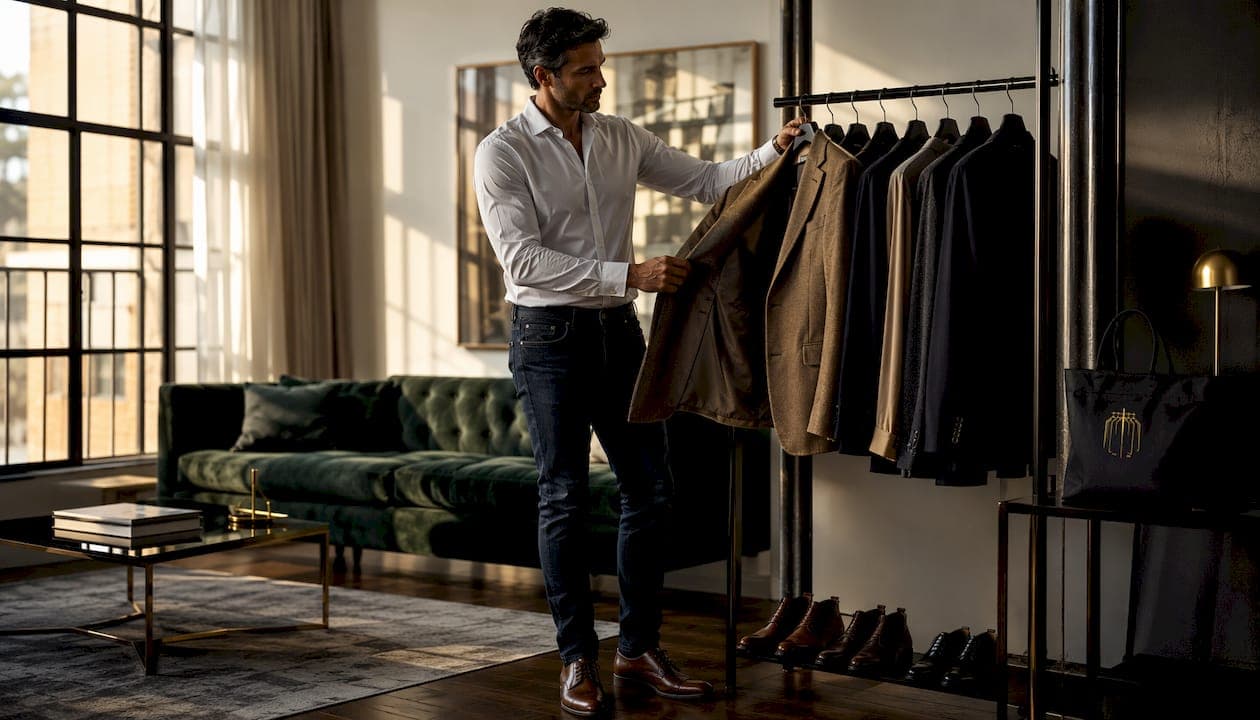
Here are 8 ready-to-wear smart casual outfit combinations that cover most occasions, plus 3 rules to keep every look intentional. These formulas work because they apply one consistent principle: pair one structured piece with one relaxed piece, then let your shoes seal the register.
8 headline combos to start with:
- Navy unstructured blazer + white tee + dark jeans + tan loafers
- Oxford button-down + chinos + Chelsea boots + leather belt
- Fine merino crewneck + tailored trousers + white leather sneakers
- Polo shirt + tailored trousers + suede loafers + watch
- Linen shirt + linen trousers + suede derbies (summer ready)
- Knit sweater + dark jeans + brogues + minimal watch
- Midi dress + denim jacket + clean white sneakers (women's)
- Tailored trousers + silk blouse + loafers + simple earrings (women's)
3 universal rules:
- Fit first. A well-fitted $40 chino beats an expensive blazer that pulls at the shoulders.
- Balance high and low. One structured piece, one relaxed piece. Never two formal, never two casual.
- Shoes close the deal. Clean leather or suede footwear keeps the look on register; athletic running shoes break it.
Quick swaps: Add a blazer to move any look one notch up. Swap loafers for white leather sneakers to relax it. Trade dark jeans for chinos when the venue is smarter. These three swaps alone cover most last-minute adjustments. Mytenue's AI stylist automates exactly this kind of swap, pulling from your actual wardrobe to suggest what works tonight.
Table of Contents
- What does "smart casual" actually mean?
- What wardrobe essentials do you actually need?
- 15+ smart casual outfit combinations by occasion
- How do fabrics and seasonal swaps affect your look?
- Common smart casual mistakes and how to fix them fast
- How do you choose the right formality level in one minute?
- What styling rules actually hold up across every context?
- Why the high-low approach is the only rule worth memorizing
- Your AI stylist for smart casual outfit combinations
- Useful sources and references
What does "smart casual" actually mean?
Smart casual sits one tier below business formal and one tier above everyday casual. The defining characteristic is intentionality: every piece looks chosen; nothing looks grabbed. You're polished enough for a client lunch or a gallery opening, relaxed enough that a tie would feel conspicuously out of place.
Occasions where smart casual is the right call:
- Dinner out at a mid-to-upscale restaurant
- Client lunch or coworking event
- First or second date
- Gallery opening or cultural event
- Weekend brunch with friends
- Casual travel day (airports, trains)
Quick visual cues — too casual vs. too formal:
- Too casual: graphic tees, ripped denim, athletic shoes, hoodies, flip-flops
- Too formal: full suit with tie, formal Oxford shoes with jeans, stiff dress shirt buttoned to the collar without a tie
- On register: chinos or dark denim, collared shirt or fine knit, loafers or clean leather sneakers, unstructured blazer
Business casual leans office-appropriate: dress trousers, a button-down shirt, and formal leather shoes. Smart casual relaxes that. Chinos and dark jeans become viable; a polo or fine knitwear can substitute for a formal shirt. The easiest test: smart casual works for a restaurant dinner or a social event. Business casual belongs in an office with a no-suit dress code.
What wardrobe essentials do you actually need?
A five-piece capsule solves most smart casual situations: a navy unstructured blazer, a white button-down or quality tee, dark denim or tailored trousers, white leather sneakers, and a leather-strap watch are considered strong foundation pieces for smart casual outfits.
Essentials by category
- Blazers: Unstructured, in navy, mid-gray, or a subtle pattern. No heavy padding or canvas. Behaves like a refined cardigan and layers over tees, polos, or shirt-and-knit combinations.
- Shirts/tops: Oxford cloth button-down (OCBD) in white or pale blue; fine merino crewneck; quality polo in piqué cotton; quarter-zip in merino or cashmere. The collar is your primary register signal.
- Trousers/chinos: Slim or tailored fit in stone, navy, mid-gray, or olive. Not relaxed, not cropped, not distressed.
- Dark denim: Clean dark indigo or charcoal wash, slim or straight cut, no distressing or fading. Paired with a blazer and polished leather footwear, dark denim reads as smart casual.
- Shoes: Loafers (penny, tassel, or horsebit in quality leather), Chelsea boots, derbies or brogues, clean minimal white leather sneakers for the casual end only.
- Outerwear: Harrington jacket in quality fabric, wool sport coat or tweed jacket for fall/winter, topcoat for evenings.
- Accessories: Leather belt matching shoes, simple watch, pocket square (optional), minimal jewelry for women.
Fit checklist (one-line checks)
- Shoulders: Seam sits at the shoulder point, no overhang.
- Chest/waist: Shirt lies flat with no pulling; blazer closes without strain.
- Trouser break: Slight break or no break; never pooling at the ankle.
- Sleeve length: Shirt cuff shows 0.5 inches below blazer sleeve.
- Hem length: Untucked shirt hem hits mid-fly; never below the seat.
Gender-neutral note: The same rules map directly to women's silhouettes. Swap chinos for tailored trousers or a midi skirt; swap loafers for ballet flats or block-heel mules; swap the OCBD for a silk blouse or fitted knit. The high-low principle and fit checklist apply identically.
Pro Tip: The single highest-leverage purchase in any smart casual wardrobe is an unstructured blazer. It raises formality without the stiffness of a suit jacket, because it lacks heavy padding and canvas. Wear it over a tee and jeans and the outfit immediately reads as intentional. Nothing else in your closet does that job as efficiently. You can explore more on building a wardrobe that works with a capsule-first approach.
15+ smart casual outfit combinations by occasion
These formulas are repeatable and interchangeable. Each includes a swap to dress up or down.
Office and client meetings
1. Classic Oxford Top: pale blue OCBD (tucked) | Bottom: charcoal tailored trousers | Shoes: dark brown leather derbies | Layer: navy unstructured blazer Dress down: swap derbies → tan loafers, remove blazer. Dress up: add a pocket square, swap chinos → wool-blend trousers.

2. Elevated denim Top: white button-down | Bottom: dark indigo slim jeans | Shoes: brown brogues | Layer: gray unstructured blazer Dress down: swap brogues → white leather sneakers. Dress up: add a leather belt, tuck the shirt fully.
3. Knit and trousers Top: fine merino crewneck (navy) | Bottom: mid-gray tailored trousers | Shoes: white leather sneakers | Accessory: leather-strap watch Dress down: swap trousers → dark chinos. Dress up: layer an unstructured blazer over the knit.
Date night and evening events
4. Relaxed formula Top: quality polo (burgundy or navy) | Bottom: tailored trousers | Shoes: suede loafers | Accessory: minimal watch Dress down: swap trousers → dark chinos. Dress up: add a sport coat.
5. Smart evening Top: fine-knit turtleneck | Bottom: wool-blend trousers | Shoes: suede Chelsea boots | Layer: topcoat (optional) Dress down: swap Chelsea boots → clean white sneakers. Dress up: add a structured blazer.
Women's: Date night Top: silk blouse | Bottom: slim dark jeans | Shoes: heeled mules | Layer: tailored blazer Dress down: swap mules → loafers, remove blazer. Dress up: swap jeans → tailored trousers.
Weekend brunch
6. Casual-leaning Top: linen shirt (open collar) | Bottom: stone chinos | Shoes: suede chukkas | Layer: none needed Dress down: swap chukkas → white leather sneakers. Dress up: tuck the shirt, add a blazer.
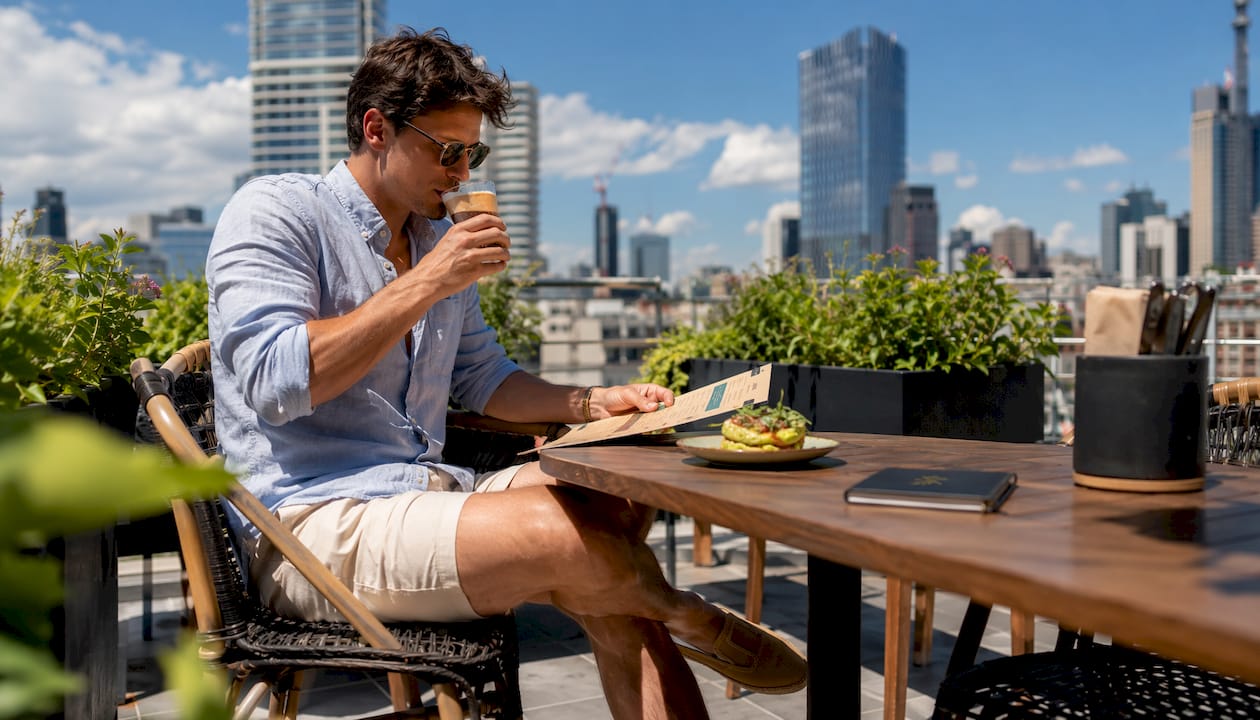
Women's: Brunch Top: fitted knit | Bottom: midi skirt | Shoes: loafers | Accessory: simple earrings Dress down: swap loafers → clean white sneakers. Dress up: add a longline blazer.
Travel days
7. Travel formula Top: fine merino crewneck | Bottom: wool-blend trousers (resist creasing) | Shoes: slip-on loafers | Layer: Harrington jacket Dress down: swap trousers → dark chinos. Dress up: swap Harrington → unstructured blazer.
Creative workplaces
8. Textured layer Top: OCBD under a lightweight crewneck sweater | Bottom: slim corduroy trousers | Shoes: suede Chelsea boots | Accessory: pocket square Dress down: swap Chelsea boots → white leather sneakers. Dress up: add a tweed blazer.
Women's: Creative office Top: camisole | Bottom: wide-leg trousers | Layer: longline cardigan | Shoes: ballet flats Dress down: swap flats → clean sneakers. Dress up: swap cardigan → structured blazer.
Seasonal occasion looks
9. Summer dinner Top: linen shirt (tucked) | Bottom: linen trousers | Shoes: leather loafers | Accessory: minimal watch
10. Winter evening Top: wool turtleneck | Bottom: tailored wool trousers | Shoes: leather Chelsea boots | Layer: topcoat
For more occasion-ready outfit ideas with less effort, the swap logic above applies across every setting.
How do fabrics and seasonal swaps affect your look?
Fabric choice signals quality before anyone reads your label. Structure, drape, and texture all affect perceived formality, and the wrong fabric in the wrong season makes an otherwise solid outfit look sloppy or uncomfortable.
Season-by-season fabric rules
Linen and lightweight cotton in summer; wool blends and merino in fall and winter; midweight cotton and cotton-linen blends in spring. Linen communicates ease without sacrificing structure, provided the cut is right. Wool-blend trousers resist creasing better than cotton chinos, which makes them the smarter travel and evening choice.
| Season | Trousers | Top | Shoes |
|---|---|---|---|
| Summer | Linen or cotton-linen blend | Linen shirt, short-sleeve OCBD | Suede loafers, espadrilles |
| Spring | Midweight cotton chinos | Cotton OCBD, lightweight knit | Suede derbies, loafers |
| Fall | Corduroy, wool-blend | Merino crewneck, OCBD + knit layer | Chelsea boots, brogues |
| Winter | Tailored wool trousers | Turtleneck, fine-knit sweater | Leather Chelsea boots, derbies |
Fabric also affects how much a piece can carry the outfit on its own. Tailored wool-blend trousers in fall or winter anchor any smart casual look without requiring a jacket above them. They carry the formality through the fabric alone.
Pro Tip: Match shoe material to weather conditions. Suede looks sharp in dry, cool weather but absorbs moisture and stains easily. On wet or variable days, smooth leather is the practical choice. Keep both in your rotation and the decision becomes automatic. For budget-friendly ways to refresh your seasonal wardrobe, the seasonal style refresh guide is worth a read.
Common smart casual mistakes and how to fix them fast
Most smart casual failures come down to one of five errors. Each has an immediate fix you can apply before leaving the house.
Common mistakes:
- Wrong jeans: Light wash, distressed, or wide-leg denim reads as weekend casual, not smart casual. Fix: swap for clean dark indigo, slim or straight cut.
- Athletic running shoes: Technical mesh uppers and chunky soles break the register instantly. Fix: swap for clean white leather sneakers or loafers.
- Mismatched formality levels: Pairing a suit jacket with jeans and a tee, or a blazer over a graphic tee. Fix: match the formality tier of every piece.
- Stiff dress shirt without a tie: A fully buttoned formal shirt with no tie looks unfinished. Fix: swap for an OCBD, open the top button, or add a fine knit layer.
- Oversized or bloused fit: Excess fabric reads as careless. Fix: tuck or half-tuck the shirt, tighten the belt, or have key pieces altered.
Pre-leave checklist:
- Are your shoes clean and leather or suede (not athletic)?
- Does every piece fit at the shoulder and waist?
- Is there at least one structured piece in the outfit?
- Is the shirt tucked, half-tucked, or intentionally untucked (not just forgotten)?
- Does the overall color palette hold together (no more than three tones)?
Pro Tip: Sneakers are the most common smart casual mistake. Minimalist leather or suede sneakers in white or neutral tones can work, but only when every other element skews smart. If the trousers are chinos and the top is a tee, the sneakers will not save the look. Upgrade the shoes or upgrade the outfit first.
How do you choose the right formality level in one minute?
Start with the venue and time of day. A corporate lunch reads smarter than a Saturday gallery visit, even if both say "smart casual." Map the setting to a formality level, then build the outfit from one anchor piece outward.
Three-step decision guide:
- Pick your anchor piece. For a smarter setting: start with tailored trousers or a structured blazer. For a relaxed setting: start with dark denim or chinos and build up. The anchor sets the ceiling and floor for everything else.
- Balance with a relaxed counterpart. Blazer + tee. Tailored trousers + polo. Midi dress + denim jacket. One structured, one relaxed. Never two formal, never two casual.
- Add one finishing detail. A leather belt that matches your shoes, a clean watch, neat grooming. This is what separates an assembled outfit from a considered one.
Pivot examples:
- Sneakers → loafers: adds one full formality notch.
- Chinos → tailored trousers: moves the look toward business casual territory.
- Remove blazer: drops the look one notch, useful for relaxed creative settings.
- Tuck the shirt: adds intentionality without changing a single piece.
When in doubt, choose the most polished version of the most relaxed piece. If jeans are the choice, pick the darkest clean pair and wear structured shoes. That single rule keeps you on the right side of the line almost every time. For a deeper system, the occasion-based dressing guide maps outfits to specific event types.
What styling rules actually hold up across every context?
The single most reliable heuristic: use one elevated piece plus one relaxed piece. That high-low pairing creates deliberate contrast rather than accidental formality or accidental sloppiness. It works because it forces a decision at every level of the outfit.
Rules that hold across contexts:
- High-low principle: Pair a formal tailored piece with a relaxed item (blazer + tee, tailored trousers + polo) to create intentional contrast. This is a philosophy of balance, not a fixed costume.
- Dark denim criteria: Clean dark indigo or charcoal wash, slim or straight-leg cut, no distressing or fading. Paired with a structured blazer and polished leather footwear, dark denim qualifies.
- Unstructured blazer role: Lacks heavy canvas and padding; behaves like a refined cardigan. It raises formality without stiffness and layers over tees, polos, or shirt-and-knit combinations.
- Footwear rule: Avoid athletic running shoes and overtly technical details. Stick to clean leather or suede loafers, derbies, Chelsea boots, or minimal white leather sneakers when every other element skews smart.
- Fabric-season alignment: Linen and lightweight cotton in summer; wool blends and merino in colder months. Fabric choice signals quality and affects perceived formality.
"The best way to nail the smart casual aesthetic is to swap smart pieces for casual ones and vice versa so that there's a balance of smart and casual garments in your outfit." — The Modest Man
These rules work because they are structural, not prescriptive. They do not tell you which specific shirt to buy. They tell you how to evaluate any combination you already own. That is what makes them reliable across contexts, seasons, and body types.
Key Takeaways
Smart casual outfit combinations work best when you pair one structured piece with one relaxed piece, finish with clean leather or suede footwear, and let fit do the heavy lifting.
| Point | Details |
|---|---|
| High-low is the core rule | Always pair one structured piece with one relaxed piece to keep the look intentional. |
| Dark denim qualifies with conditions | Clean dark indigo or charcoal wash, slim or straight cut, no distressing, worn with leather footwear. |
| Shoes determine the register | Clean leather or suede footwear keeps the look on track; athletic shoes break it regardless of what's above. |
| Seasonal fabrics preserve the silhouette | Linen and lightweight cotton in summer; wool blends and merino in fall and winter. |
| Mytenue automates the decision | Mytenue's AI stylist builds outfit combinations from your wardrobe with weather-aware, occasion-specific suggestions. |
Why the high-low approach is the only rule worth memorizing
Most style advice overcomplicates smart casual. Lists of approved items, color-matching charts, occasion matrices. Useful, but not what you reach for at 7 AM when you need to look good in 10 minutes.
The high-low principle cuts through all of it. One structured piece, one relaxed piece. That single decision framework reduces what would otherwise be a combinatorial puzzle into a binary check. Does this outfit have a high element? Does it have a low element? If yes to both, you are almost certainly on register.
What I find genuinely useful about this approach is how it changes buying behavior. Once you internalize it, you stop chasing complete outfits and start buying anchors: one great unstructured blazer, one pair of dark slim jeans, one pair of quality loafers. Those three pieces combine with almost anything casual you already own. Fewer purchases, more combinations. That is the practical payoff of low-effort stylish dressing done right.
The mistake most people make is trying to dress smart casual by adding formality to a casual base. It usually produces something that looks like a costume. The better move is to start from a neutral, well-fitted base and introduce one deliberate contrast. The outfit reads as considered because it is.
Your AI stylist for smart casual outfit combinations
Getting the high-low balance right every morning takes practice. Mytenue makes it automatic.
The Mytenue app digitizes your wardrobe and uses AI to build outfit combinations from what you already own, matched to the occasion, the weather, and your personal style. No guessing whether the blazer works with those trousers. No second-guessing shoe swaps. The app handles the decision.
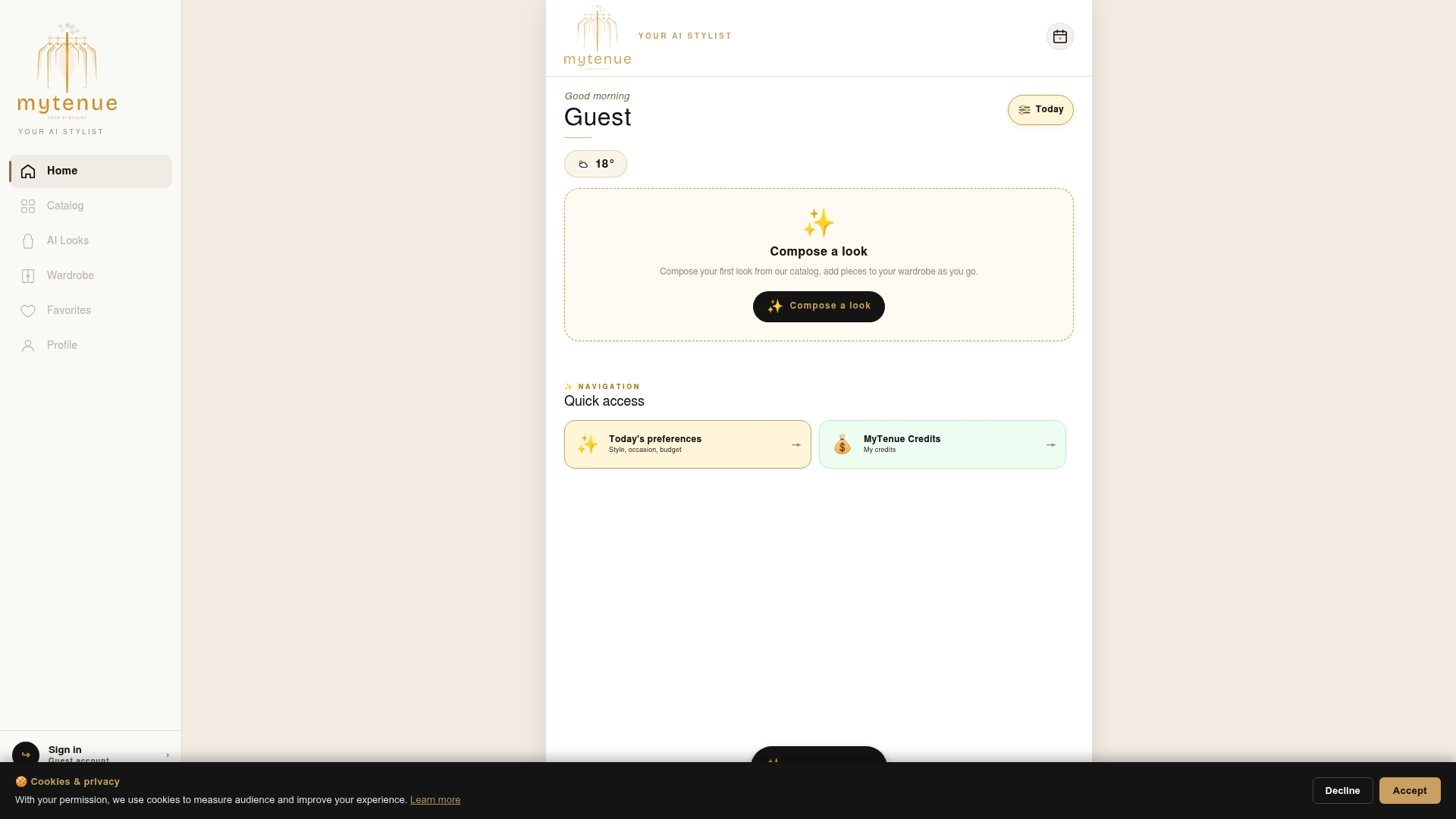
What Mytenue does for you:
- Generates daily outfit suggestions adapted to weather and occasion
- Analyzes color, fabric, and formality compatibility across your wardrobe
- Creates editorial flat-lay images so you can see the outfit before you wear it
- Plans outfits on a calendar so you are never caught unprepared
- Suggests seasonal swaps when temperatures shift
Smart casual is about looking intentional. Mytenue gives you that intentionality without the time cost. Try it free at mytenue.com and let your wardrobe work harder than you do.
Useful sources and references
- Smart Casual Men: The Outfit Rules Nobody Actually Explains — dark denim criteria, collar as register signal, palette guidance
- The Complete Guide to Smart Casual Style for Men — high-low principle, outfit examples, balance philosophy
- Smart Casual Men's Outfit: The Definitive Guide — fabric guidance, formula-based outfit building, linen and wool rules
- Smart Casual Outfit Ideas: 30 Effortless Looks That Always Work — women's and men's outfit combinations, occasion-based examples
- The Smart Casual Dress Code, Decoded — unstructured blazer guidance, dark denim criteria, five-piece capsule
- Smart Casual Outfits for Men 2026: The Formula That Works Every Time — repeatable formulas, footwear rules, "most polished version" heuristic
- Hockerty: Men's Smart Casual Dress Code Guide — seasonal fabric guidance, linen and wool blend recommendations
- How to Master Smart Casual Without Looking Overdressed — layering guidance, anchor-piece approach
- The 7 Smart Casual Outfit Ideas Worth Noting This Spring — women's smart casual looks, seasonal outfit ideas