
A short wardrobe audit, done once, shows you exactly which pieces you're missing and which ones you already own but never wear. Give yourself one to two hours to inventory your closet, then a week to test outfits around the gaps you find. You'll walk away with a short list of real missing pieces, a tested plan for using them, and a simple twice-yearly schedule to keep the whole thing current.
TL;DR:
- For each weekly occasion, build two or three complete outfits from existing clothes; if three work without one item appearing in all three, move on.
- Before naming a gap, check overlap, fit, condition, and alternate styling, then revisit the occasion two weeks later to see whether the failure remains.
- Rank confirmed gaps by how often they arise, how versatile one fix would be, and whether a candidate pairs with at least two essentials.
- Plan a candidate across seven days before buying; keep it only if it fits four or more outfits, rather than a single look.
- If a purchase fails at least two checks, compare secondhand, rental, or tailoring options; a $15 repair may rescue a jacket you already love.
Table of Contents
- 1. Quick inventory: what to record and how to digitize it
- 2. Map your closet to real life with the 2 to 3 outfit test
- 3. A five-step diagnostic to separate real gaps from styling uncertainty
- 4. Prioritize and validate: frequency, versatility, and the 7-day test
- 5. Shopping decision checklist: buy, repair, borrow, or skip
- 6. How MyTenue speeds up the audit: digitize, test, and plan
- Why usage-based gap analysis beats aspirational checklists
- Ready to run your own wardrobe gap analysis?
- FAQ
- Sources
1. Quick inventory: what to record and how to digitize it
Start by pulling everything out, or at least everything you haven't worn in three months. Sort into five buckets: tops, bottoms, layers, footwear, accessories. For each item, jot down four things:
- Size and current fit
- Condition (great, worn, needs repair)
- Times worn in the last three months
- The occasions it actually gets used for
This step surfaces the items doing all the work in your closet and the ones quietly taking up space.
You've got three ways to capture this:
- Smartphone photos sorted into folders by category
- A basic spreadsheet with columns for the four data points above
- The MyTenue app, which lets you scan 10 to 15 items in one to two hours and tags each piece automatically
Whichever method you pick, the goal is the same: a visible, searchable record of what you own, so gaps show up as gaps instead of guesses.
2. Map your closet to real life with the 2 to 3 outfit test
Once your inventory exists, hold it up against how you actually spend your week. Define your main occasion buckets (work, casual weekends, travel, events) and note roughly how often each comes up.
- Pick one bucket, say "work."
- Try to build two or three complete outfits using only what's in your inventory.
- Write down exactly where each attempt breaks down.
A failure here isn't vague. It's specific: "no light neutral layer that works over both denim and a skirt" or "no shoe that pairs with tailored pants and a dress." Naming the missing function this precisely is what separates a real gap from a passing urge to shop.
Pro Tip: If you can build three outfits without one item appearing in all of them, that bucket is already solved. Move to the next one.
3. A five-step diagnostic to separate real gaps from styling uncertainty
Not every outfit failure means you need to buy something. Run each one through this check before it earns a spot on your shopping list.
- Collect every outfit failure from the occasion mapping and group repeats under one missing function.
- Check your existing pieces for overlap: do three sweaters already cover the same role?
- Look at condition and fit. A stained hem or a jacket that no longer sits right is a tailoring job, not a gap.
- Before buying, try restyling what you own, a different layering combination, a belt, a swapped accessory, and see if the failure disappears.
- Wait two weeks and revisit the same occasion bucket. If the same failure shows up again, the gap is real.
This diagnostic exists to catch the difference between "I don't own the right piece" and "I haven't tried enough combinations yet." Most closets have more styling slack than they get credit for.
4. Prioritize and validate: frequency, versatility, and the 7-day test
Once you've confirmed a real gap, rank it against any others using one simple rule: frequency times versatility times how easy it is to fix.
- A gap that shows up weekly and could be solved by one flexible piece ranks above a gap that shows up twice a year.
- A candidate item that pairs with at least two existing essentials beats one that only works with a single outfit.
- Cost-per-wear matters more than price tag: a $90 jacket worn 40 times a year costs less per use than a $20 top worn twice.
Before buying anything, run a 7-day outfit plan using the candidate item on paper or in an app, pairing it across different days and occasions. This is the same logic behind a workweek outfit planning checklist: if a piece earns a spot in four or more outfits across the week, it's doing real work.
Nearly half of clothing bought in a year ends up as one of the 3.602 billion textile and footwear items placed on the market in 2025, with 43 new garments purchased per person that year. Testing before buying is how you avoid adding to that pile.
Keep the habit light: 15 to 20 minutes of weekly planning, plus a full seasonal audit twice a year.

5. Shopping decision checklist: buy, repair, borrow, or skip
Before any purchase, run it through a short checklist:
- Does it integrate with at least two pieces you already own?
- Does it solve a specific outfit failure you named, not a vague "I need more options" feeling?
- Does it fit your actual climate and daily routine?
- Does the estimated cost-per-wear make sense for how often you'll use it?
If an item fails two or more of these, consider alternatives first. Secondhand platforms, rental for one-off events, or a tailor for a piece that almost fits can all solve the same problem without a new purchase. Reuse and repair strategies extend an item's life and quietly lower your average cost-per-wear across the whole closet.
Pro Tip: A $15 tailoring fix on a jacket you already love is almost always a better trade than a new jacket that fits "close enough."
6. How MyTenue speeds up the audit: digitize, test, and plan
We built MyTenue to simplify the wardrobe audit and outfit testing process using digital wardrobe management and AI-generated outfit combinations
Here's what can speed up the process with digital wardrobe tools:
- Visualizing candidate pieces in outfit contexts before buying
- Using a planning calendar to run and review outfit tests
- Receiving daily suggestions adapted to the weather
- Comparing outfit options with editorial-style flat-lay images
Instead of pushing you toward another purchase, we show you what's already possible with what you own, and flag the one piece that would unlock several more outfits.
Why usage-based gap analysis beats aspirational checklists
Most wardrobe advice hands you a universal list of "ten essentials everyone needs." We think that's backward. Home visits in a 2025 ADEME and ObSoCo study found people own an average of 175 garments, nearly double the 79 they estimated, with more than half sitting unused. The gap most people have isn't a missing item. It's missing visibility into what they already own. A frequency-based audit, built around your real occasions, catches that before a checklist ever could.
— Ahmed
Ready to run your own wardrobe gap analysis?
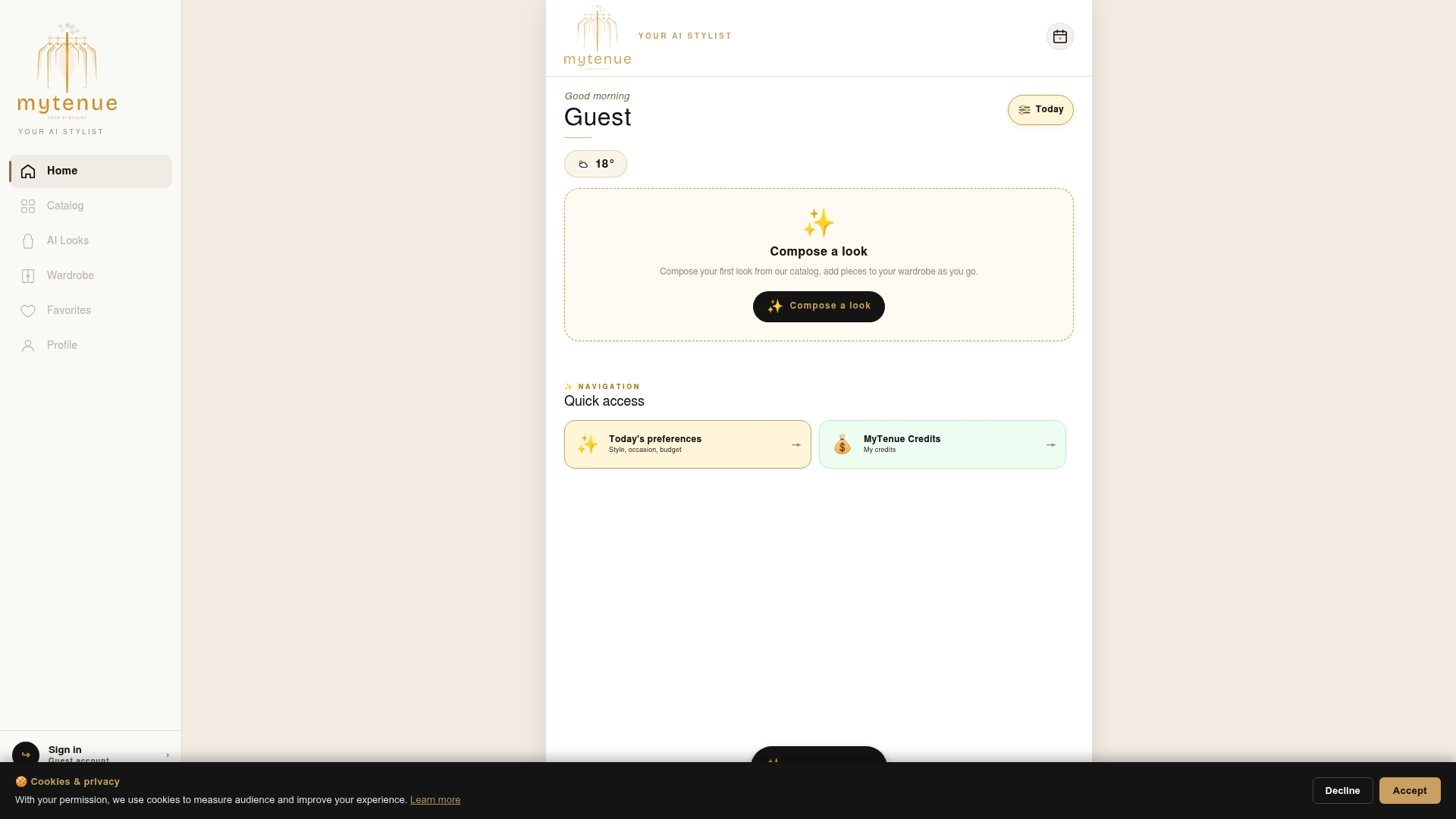
We make the whole process faster: digitize your closet in MyTenue, generate outfits from what you already own, and run your 7-day test without opening a single shopping app first.
- Scan your wardrobe once and get outfit suggestions pulled from your own pieces.
- Try the 7-day validation test with virtual try-on before any purchase.
- Plan your week in minutes with weather-adapted daily looks.
Visit the MyTenue app to start digitizing your wardrobe and see what you're actually working with.
FAQ
What is the 3-3-3 rule for a wardrobe?
The 3-3-3 rule is an informal styling approach where you build outfits using three tops, three bottoms, and three pairs of shoes for a given stretch of time, usually a season. It's a useful starting constraint for the 2 to 3 outfit test described above, since it forces you to check whether your current pieces actually combine well together.
What is the 5-4-3-2-1 method for a wardrobe?
Definitions of this method vary depending on the source, and there's no single authoritative version. In practice it's usually framed as a tiered capsule structure (a set number of tops, bottoms, layers, shoes, and accessories), so treat it as one style of capsule planning rather than a fixed rule to follow exactly.
What is the 70/30 rule for a wardrobe?
Like the 5-4-3-2-1 method, this one doesn't have one agreed definition. It's generally used to describe a ratio of versatile basics to statement or trend pieces, which lines up with the versatility-first prioritization covered in the sections above.
What is the 3-3-3 rule for decluttering?
Outside of outfit building, the 3-3-3 rule for decluttering typically refers to sorting items into three categories (keep, donate, discard) in sets of three to make the process feel less overwhelming. It overlaps with a wardrobe audit in spirit, since both rely on confronting what you actually use rather than what you intended to use.
How often should I run a wardrobe audit?
A full seasonal audit twice a year, paired with a lighter mid-season scan, keeps your inventory accurate without becoming a chore. Pairing that cadence with a short weekly outfit planning session, around 15 to 20 minutes, keeps gaps visible before they turn into impulse purchases.
Sources
- ADEME / ObSoCo 2025 dossier de presse on textile
- Refashion 2025 barometer of textiles and footwear consumption