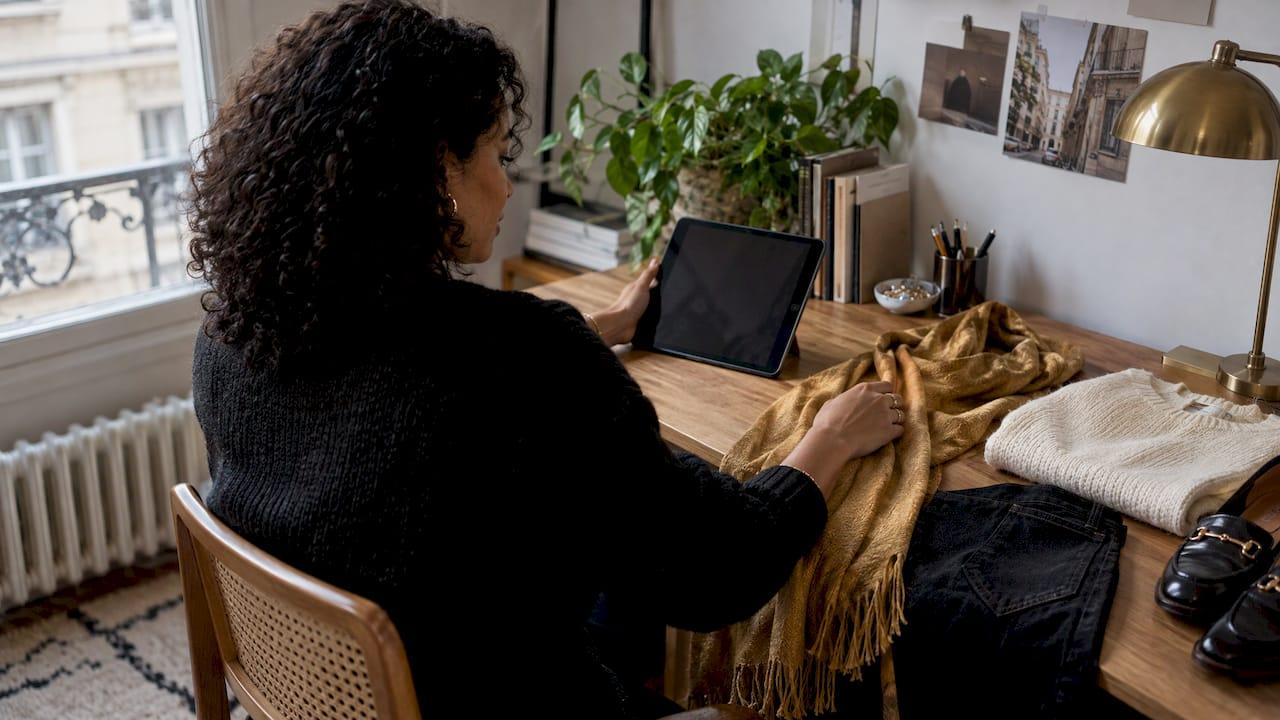
A flat lay is a real outfit laid out on a surface and photographed from above. A collage is a digital board: cut-out photos of separate pieces, arranged on one page. Both show a look without a person wearing it. They answer different questions. The flat lay shows how pieces look together in real life. The collage shows what the pieces are, and lets you swap one for another in seconds.
So which one should you use? It depends on the job: planning from your own closet, sharing a look, or deciding what to buy. Then add a third step, because neither format shows how a piece fits your body. That is where a virtual try-on on your own avatar completes the picture, and why we built Mytenue to generate editorial flat-lay images and try-on in the same app.
TL;DR
- Flat lay: real clothes, shot from above. Great for seeing color, texture and how pieces sit together.
- Collage: cut-out pieces on a clean background. Great for comparing options and listing where each item comes from.
- Neither shows fit. Length, drape and cut on your body stay invisible in both formats.
- Research: a peer-reviewed study found the best format depends on how much you enjoy styling yourself.
- Easiest route: generate the flat lay from your own wardrobe, then check it with a try-on on your avatar.
Table of Contents
- What a flat lay is, and what a collage is
- Flat lay vs collage at a glance
- What the research says
- When a flat lay is the better choice
- When a collage is the better choice
- What neither format can show: fit
- How to make a flat lay that looks good
- How to make a collage that helps you decide
- The shortcut: digitize once, generate looks
- Which one should you use? A quick guide
- Our view
- Try it in the app
- FAQ
- Sources
What a flat lay is, and what a collage is
A flat lay is a photo taken from directly above, with clothes and accessories arranged on a flat surface. Shopify's French photography guide describes it as presenting garments on a flat surface, shot from above, to show colors, textures and style combinations. Trousers, shirt, hat, accessories and shoes sit in one frame, with no model.
An outfit collage is a digital composition. Each piece gets its own photo, usually cut out from its background, and all the pieces are placed on one page: top above bottom, shoes underneath, bag and jewelry on the side. Nothing is photographed together. You assemble the image on a screen.

A third word shows up in searches: photomontage. It usually means an image built from pieces of several photos, often for artistic effect. For outfits, "collage" is the word you want.
Flat lay vs collage at a glance
| Flat lay | Collage | |
|---|---|---|
| What you start with | The real clothes | Photos of each piece |
| Made with | A phone, a surface, daylight | A screen and cut-out images |
| Strongest at | Texture, color, real-life feel | Comparing and swapping pieces |
| Effort | Steaming, folding, setting up, shooting | Finding clean photos, cutting out, arranging |
| Works with items you don't own yet | No | Yes |
| Shows fit on your body | No | No |
| Typical use | Social posts, daily planning, wardrobe inspiration | Shopping shortlists, mood boards, "where is it from?" |
The row about items you don't own matters most for shopping. A flat lay needs the garment in your hands. A collage can mix what you own with what you are thinking of buying.
What the research says
The question is not just about taste. A peer-reviewed study in Fashion and Textiles (Qu and Baek, published February 2024) compared how people react to outfits shown assembled (on a body) versus unassembled (flat). In the first study (126 participants), the assembled presentation produced more imagery elaboration, meaning people pictured themselves wearing the look more vividly (average 4.62 against 3.99). It also produced more positive purchase intentions (4.32 against 3.45).
The twist came in a third study (182 participants). For people with high fashion involvement, the flat, unassembled presentation led to more imagery and better evaluations of the products. The authors explain that it suits their wish to make their own styling choices.
What that means for you:
- If you are building a look and want to picture yourself in it, seeing the outfit on a body helps.
- If you love mixing and matching on your own terms, flat presentations leave room for your creativity.
The trend side agrees. Creative Review reports the return of the fashion flat-lay collage and notes that fashion ads have moved from clothes modeled on the body toward flat presentations, alongside wardrobe apps. Flat-style imagery is everywhere because it is fast, readable and easy to share.
When a flat lay is the better choice
Choose the flat lay when you want to see the look as it will really be.
- Planning tomorrow's outfit. Real colors side by side tell you quickly whether the navy sweater and the black trousers fight each other.
- Showing texture. Rib, cable knit, twill and linen read much better in a real photo. Chasing Stone's photographer Jennifer Kidd explains that side light brings out knit and twill texture, while overhead light erases it.
- Posting a look. Flat lays are the classic format for outfit posts. They look put together without needing a photographer or a model.
- Packing. Laying out three outfits for a trip shows you what overlaps and what is missing.
- Keeping it cheap. No studio, no model, no editing skills.
The limit is physical. A full outfit with a coat can take roughly the floor space of a twin bed, according to Sew Mama Sew. And every new combination means pulling clothes out, laying them down and putting them back.
When a collage is the better choice
Choose the collage when you want to compare and decide.
- Shopping shortlists. You can put the jacket you own next to the boots you are considering, without owning the boots.
- Swapping one piece. Duplicate the board, change only the shoes, keep everything else. Two boards that differ by one item are far easier to judge than two completely different looks.
- Source lists. A collage with each piece separate answers "where is that from?" at a glance, which is why it often opens an outfit carousel on social media.
- Themes and occasions. A board for a job interview, a wedding guest look or a weekend trip keeps your choices focused.
The limit is realism. Cut-out photos show what an item is, not how it behaves. The fabric's drape, the true shade of two whites together and the length on you stay hidden. A collage narrows the choices. It does not confirm them.
What neither format can show: fit
Both formats are flat. Photographed from above or placed on a screen, a skirt's length on a body, the way a fabric falls and how a cut suits your shape are all invisible. The ecommerce world knows this: stores mix formats on purpose, using flat lays for catalog grids and style suggestions, then adding model or ghost-mannequin photos on the product page to show the cut.

For your own wardrobe, the equivalent is simple. Use the flat lay or collage to choose the combination. Then check it on a body. That is the point of a virtual try-on: you see the outfit on a personal avatar before you get dressed or before you buy. If you want to see why that step changes decisions, read the real benefits of planning outfits on your avatar.
How to make a flat lay that looks good
A clear flat lay is mostly preparation. These steps combine advice from Sew Mama Sew, Shotkit and ELLE Australia.
- Prepare the clothes. Steam or iron them. Hide tags and hanger loops. Lint-roll dark fabrics. Stuff sleeves, boots and bags with tissue paper so they hold their shape.
- Pick a clean surface. A white or light background shows true colors. A floor, a bedsheet or a large sheet of paper all work.
- Choose the stars. Pick two or three main pieces and complete them with small accessories. Keep the colors in harmony.
- Place the largest garment first. Then add bottoms, shoes, bags, jewelry, belts and weather pieces. Leave space between items: crowding is the most common reason a flat lay looks cluttered.
- Fold with intent. Shotkit suggests laying t-shirts flat and unfolded, placing sweatshirt sleeves in opposite directions, and angling one pair of jeans slightly to show belt loops and cuffs.
- Keep it real. Stylist-bloggers quoted by Who What Wear recommend that a flat lay look like a bedroom floor, not a store display: tops folded a little messily, jeans cuffed as you would wear them.
- Mix scale. Balance large pieces with very small ones, such as a ring or a pair of earrings.
- Shoot from above. Hold the camera parallel to the floor, and take shots from three angles, since changing direction shifts focus and shadows.
Light matters more than the camera
The most reliable setup is one large, soft light source to one side and slightly above the surface, such as a window. A white card or foam board bounces light into shadows. If you want to go deeper on choosing between light sources, this comparison of ring light versus softbox explains how each shapes shadows and surface detail.
It works. It also takes time: steaming, folding, lighting, shooting, putting everything back. Most people do it once for a post, not every morning.
How to make a collage that helps you decide
A collage is quicker than a flat lay once you have clean photos. The method:
- Start with an occasion and one main piece. A work meeting, a dinner, a weekend market. The anchor piece guides the rest.
- Collect full-garment photos shot from a similar angle, preferably from the front. Mixed angles make a board look messy.
- Cut out each item so the background is transparent.
- Arrange by logic. Top above bottom, shoes below, accessories at the side. Keep proportions realistic so a bag does not outsize a coat.
- Group similar colors and balance heavy and light pieces so the eye moves without overload.
- Duplicate and swap. Change one item at a time to compare.
- Check before buying. Confirm the measurements, the fabric composition and the real color on the actual garment.
The weak point is steps 2 and 3. Finding consistent photos and cutting them out takes patience, especially for pieces already in your closet. Your own wardrobe has no catalog photos.
The shortcut: digitize once, generate looks
This is where an app changes the routine. In Mytenue you digitize your wardrobe and organize it in the app. From there, our AI styliste generates outfit recommendations from the pieces you own, and creates editorial flat-lay outfit images of those looks. No steaming, no floor space, no tissue paper in the sleeves.
Then comes the step neither format offers. You try the outfit on your personal mannequin, a high-quality virtual try-on on your own avatar, so you see how it sits on a body. The AI also analyzes color, fabric, style and occasion compatibility, and the app adapts daily suggestions to the weather. A calendar lets you plan outfits ahead.
If you want the photo side done well too, we explain how to photograph your clothes for AI try-on, including four angles and how photos stay private. And to see how the recommendations work, read how AI curates complete looks.
Which one should you use? A quick guide
| Your situation | Best pick |
|---|---|
| Choosing tomorrow's outfit from your closet | Flat lay generated from your wardrobe, then a try-on |
| Posting a look on social media | Flat lay |
| Packing for a trip | Flat lay of each outfit |
| Comparing a new item with what you own | Collage-style comparison, then try-on |
| Building a look for an event | Flat lay for the combination, try-on for the fit |
| Shopping on a student budget | Start from what you own: see how to remix your closet |
| Short on time (parents, busy mornings) | Generated daily suggestions, reviewed on your avatar |
Our view
We see the flat lay vs collage question as a question about the next step. Both formats help you see a look. Neither helps you feel sure about it.
A flat lay gives you the real colors and textures. A collage gives you flexibility. But the moment of doubt, "will this actually work on me?", sits after both. That is why we built Mytenue around your own wardrobe, an editorial flat lay of each look, and a try-on on your personal avatar.
The goal is a dressing room that works for you: fewer morning decisions, more outfits from what you already own, and purchases that fit your style and budget. Your styliste IA does the arranging. You keep the final say.
Ahmed
Try it in the app
Mytenue is available on iOS and Android, with mobile and web access and a bilingual French and English interface. There is a free version to start. Paid plans are Basic at 5.99 € per month, Premium at 9.99 € per month and Gold at 16.99 € per month. Digitize your closet, get looks, see them as flat lays, try them on your avatar.
Download Mytenue and see your first look
FAQ
Is a flat lay the same as a collage?
No. A flat lay is a real photograph of physical items arranged on a surface and shot from above. A collage is a digital arrangement of separate, cut-out photos on one page. The flat lay looks more natural, and the collage is easier to edit and compare.
Which is better for planning outfits?
A flat lay is better when you are choosing from clothes you own, because you see real color and texture together. A collage is better when you want to test combinations with pieces you do not own yet. In both cases, add a try-on to check how the look sits on your body.
What is a photo collage called when the images are blended?
When images are merged into a single new picture, it is usually called a photomontage. A photo collage places separate images side by side or overlapping, and each stays visible as its own piece. For outfits, a collage is the common format.
Do flat lays show how clothes fit?
No. Laid flat, a garment hides its drape, its length on a body and how the cut suits your shape. Flat lays show color, shape, pattern and combinations. To see fit, use a photo on a body or a virtual try-on on your own avatar.
How big a space do I need for a flat lay?
A full outfit with a coat can take about the area of a twin bed. A floor, a bed or a large sheet of paper works. Leave space between pieces, because crowding is the most common reason a flat lay looks cluttered.
Sources
- Assembled or unassembled? Different types of outfit coordination (Fashion and Textiles, 2024)
- The return of the fashion flat-lay collage (Creative Review)
- Comment faire de belles photos pour vendre des vêtements (Shopify France)
- 15 Autumn Fashion Flat Lay Ideas (Sew Mama Sew)
- Flat Lay Clothing Photography Tips, Ideas & Setup (Shotkit)
- How To Master The Flat Lay Instagram (Who What Wear)
- How To Style And Shoot Flatlays For Instagram And Blogging (ELLE Australia)
- Fashion Flat Lay Photography for Clothing Brands (Chasing Stone)