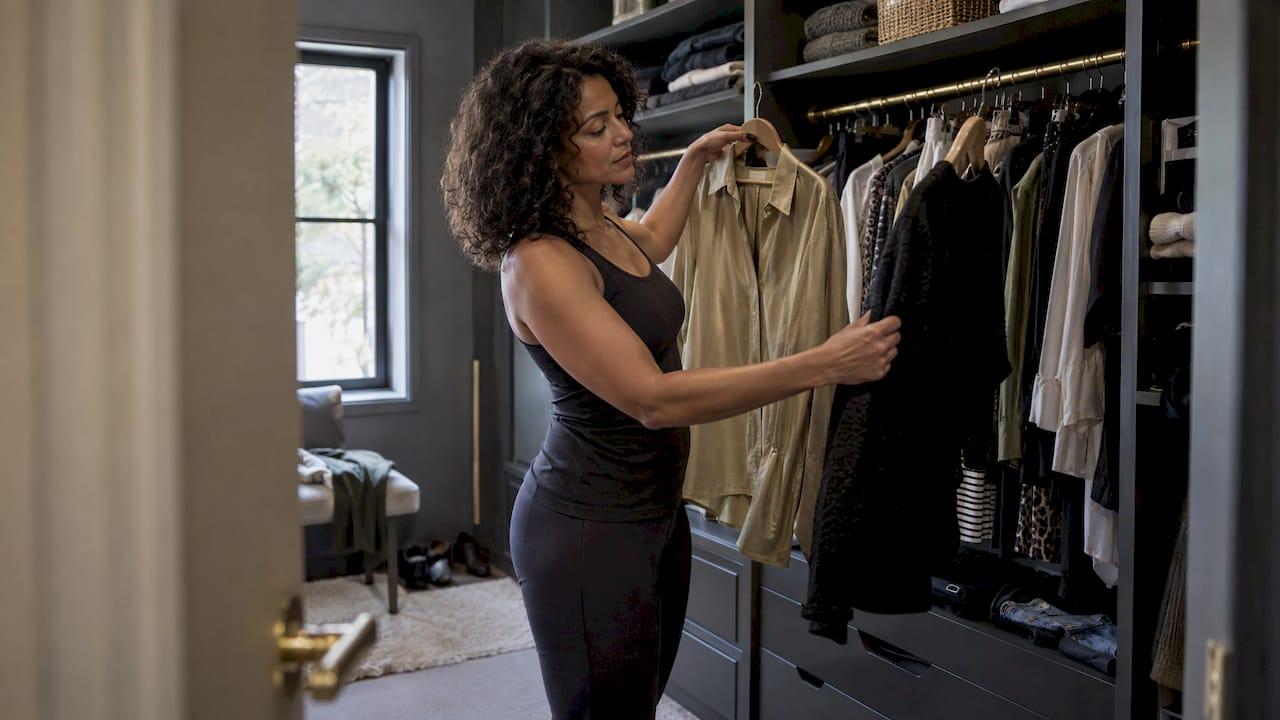
Sustainable outfit planning means deciding what to wear from the clothes you already have, and buying only when a real gap shows up. The method is simple: sort your closet, see what you actually wear, build repeatable outfit formulas, fill gaps with durable or secondhand pieces, and set a short routine to keep it going. Below, you get each step, with French sources and figures.
TL;DR
- Start with an audit. Pull everything out, sort by category and season, and keep what fits, is in good shape and gets worn.
- Find your gaps by building outfits around one favorite look. Missing pieces show up fast.
- Use formulas (3x3, 10x10, 1-1-1-2) to get many outfits from few pieces.
- Before buying, run a quick check: need, urgency, similar item, origin, use. Choose secondhand, repair, or quality.
- Keep it light: 30 minutes per week to plan, 30 minutes per quarter to review.
Table of Contents
- Why planning outfits is the most sustainable habit
- Step 1: Audit your closet
- Step 2: Find your wardrobe gaps
- Step 3: Define a style and a color palette
- Step 4: Mix and match with formulas
- Step 5: Fill gaps without adding clutter
- Step 6: Repair, reuse and buy secondhand
- Step 7: Keep a routine that sticks
- Plan outfits faster with Mytenue
- FAQ
- Sources
Why planning outfits is the most sustainable habit
The greenest garment is the one you already own. According to ADEME, as relayed by Oxfam France, each person in France buys about 9 kg of clothing a year. That is a lot of fabric for a closet that still feels empty on Monday morning.
The gap between "full closet" and "nothing to wear" is a planning problem. Charente Nature's detox dressing booklet points out the paradox: with too many clothes, it is hard to see every possible combination. So we feel we have nothing to wear and buy more of the same.
Longer life is what counts. The European Environment Agency figure, cited by L'Envers, says extending the life of clothes by just nine months cuts their carbon, water and waste footprints by 20 to 30%. Good planning is how you get those nine months.
Step 1: Audit your closet
An audit is not a purge. It is an inventory. Oxfam France suggests emptying the wardrobe, grouping clothes by category and season, then asking of each piece: does it still fit, is it in good shape, do I like it, and how often do I wear it?
The same page notes that sorting helps you rediscover forgotten items and curb impulse buys. Anything damaged can be worn, repaired or donated.
A simple three-pile method
Charente Nature proposes taking out all clothes, accessories and shoes and making three piles. Here is one way to label them:
- Wear now. Fits, suits you, gets worn.
- Fix or adjust. Loose button, broken zip, hem to take up.
- Let go. Donate, swap or resell.
Season matters too. A C&A France capsule guide says a capsule wardrobe usually holds 30 to 40 pieces per season, and that you can re-sort roughly every three months, at the end of a season. Treat that as a handy benchmark, not a rule.
Count wears, not items
Write down what you wear for two weeks. Many people find a small core does most of the work. One personal blog, Le Frugalisme, mentions the familiar 20/80 idea: about 20% of clothes worn 80% of the time. Your own count beats any average.
Want a deeper walkthrough? Our capsule wardrobe audit guide takes you through a two-hour audit, and the 6 to 24 month durable wardrobe plan adds wear counts and French labels.
Step 2: Find your wardrobe gaps
A gap is not "something I want". It is a piece that would unlock several outfits you cannot make today. Two methods help you spot one.
Build around your signature outfit
Charente Nature suggests picking your favorite look (your "phare" outfit), then identifying which pieces go with it. What is missing from that list is what you need. It works because it starts from what you love to wear, not from a generic checklist.
Test each piece for three outfits
Cortika suggests building mini-collections: one pair of pants, two tops, a cardigan and a jacket, then composing as many outfits as you can. If each piece gives at least three different looks, it is versatile. A piece that gives only one is either a gap-filler in waiting (it needs a partner) or a candidate for the "let go" pile.
Here is a quick gap table to fill in:
| Question | If the answer is no |
|---|---|
| Can I dress for work, weekend and one dressier event? | Note the missing occasion |
| Does each top work with at least two bottoms? | Look for a neutral bottom |
| Do I have a layer for each season? | Note the missing layer |
| Do my shoes go with most outfits? | Look for one versatile pair |
For a work-focused version, see our business casual essentials. Students on a budget will like the minimal wardrobe guide.
Step 3: Define a style and a color palette
Outfits come together faster when your colors play well together. IDEAL describes a capsule as versatile, good quality, timeless and harmonious in color, with mostly neutral shades and two or three stronger ones.
L'Envers recommends neutrals such as ash gray and cream for flexibility: they let you mix pieces effortlessly and compose outfits without frequent purchases.
A practical approach:
- Pick 2 or 3 neutrals as your base.
- Add 2 or 3 accent colors you already own and enjoy.
- Let new purchases fit this palette, or skip them.
Not sure which colors go together? Try our five-minute outfit formulas and 30+ color combos.
Step 4: Mix and match with formulas
Formulas turn a pile of pieces into outfits. Here are the best-known ones, as described by French sources.
| Formula | How it works | Source |
|---|---|---|
| 3x3 | 3 pants, 3 tops | Vogue France |
| 10x10 | 10 pieces, 10 outfits | Vogue France |
| Series of 7 | 7 pants, 7 tops, 7 jackets or coats, 7 pairs of shoes (Dominique Loreau) | Vogue France |
| 1-1-1-2 | 1 base, 1 balancing piece, 1 layer, 2 details | Mode au quotidien |
The 1-1-1-2 formula is the most practical for daily use. The site explains that it keeps a look readable even when you try a new pairing, and if it misses, you know where to correct (often shoes or a bag that is too off).
Layering is another low-effort lever. L'Envers calls it a simple way to get the most from your wardrobe and avoid buying new clothes every season.
Need ready-made combinations? Browse copyable outfit formulas, learn to match clothes faster, or see how to remix outfits from your closet.
Our perspective
We built Mytenue on one belief: the best outfit starts in your own closet. Most people do not need more clothes. They need to see what they own, in combinations they would not think of on a rushed morning.
That is why our AI stylist builds looks from your wardrobe first. It analyzes color, fabric, style and occasion compatibility, and you can preview the result with virtual try-on on your personal avatar before you get dressed. Our editorial flat-lay images show a whole outfit at a glance, so a forgotten piece gets a second life.
New pieces still have a place. When a gap is real, we think you should add something that works with many items you already have. Mixing what you own with a few well-chosen acquisitions is, for us, what sustainable style looks like in practice.
Ahmed
Step 5: Fill gaps without adding clutter
Once you know your gap, shop with a filter. Three tools help.
Ask five questions first
Charente Nature recommends the BISOU method: Besoin (need), Immédiateté (urgency), Semblable (similar item), Origine (origin) and Utilité (usefulness). Run each intended purchase through those five words. If you want a longer set of questions to ask before any purchase, this guide on buying smarter covers need, use, similarity to what you own and origin.
Read the label
ADEME advises sorting your closet before buying and relying on environmental labels (European Ecolabel, Ecocert textile, GOTS) to identify more durable items. For secondhand, ADEME's buying guide suggests asking for a photo of the composition label, so you do not pay the price of a natural-fiber garment for one that is 80% plastic.
Pick quality and versatility
Cortika names three habits: invest in quality, look for versatility, slow down your buying pace. A well-cut blazer, a timeless black dress, raw denim or well-made shoes can each be styled many ways.
Step 6: Repair, reuse and buy secondhand
Secondhand and repair are not only eco-friendly. They are budget-friendly too.
- Secondhand is mainstream. Oxfam France's 2026 report says secondhand now makes up nearly 30% of clothing spending in France, about 120 euros per person per year, and that 77% of secondhand buyers cite economic reasons.
- Quality pays off per wear. The same report says quality secondhand costs 33% less per wear because it lasts longer: eight times longer for a dress, four times for a coat.
- Price. Refashion's 2025 report puts the average secondhand garment in France at 8.30 €, close to an entry-level new one at 8.50 €. It also notes that fewer than 1% of secondhand pieces are repaired.
- Repair is supported. According to ADEME, some repairs qualify for the Bonus Réparation, up to 25 €. Tailors and menders who offer it are marked with a % symbol on the map.
One caution from ADEME: buying discounted secondhand to enlarge an already big wardrobe, then wearing it rarely, brings far less ecological benefit. What matters is extending the life of clothes. So the gap test from step 2 applies to secondhand too.
Make pieces last
ADEME also recommends not washing more than necessary, following the care label, choosing moderate temperatures and limiting the dryer to preserve fibers. The same logic applies to basics: wash, dry and buy smarter explains how to keep everyday garments from wearing out early.
The Interministerial Directorate for Public Transformation (DITP) identifies three barriers to repair: a social norm of replacing, a cost seen as too high, and a lack of practical options. Knowing this, a good habit is to put "fix or adjust" items on your calendar, so they do not sit in a drawer.

Step 7: Keep a routine that sticks
Plans fail when they are heavy. Two light rhythms work well.
Weekly: 30 minutes on Sunday
Styles et Tendances proposes 30 minutes to create five full outfits for the week: 5 minutes checking your agenda, 20 minutes building the outfits, 5 minutes photographing them as a visual catalog.

Quarterly: a 30-minute review
Noo-Infinity recommends a quarterly check: what you wore most, what you did not wear and why, what is starting to wear out, and what is missing for the coming season. Then adjust.
Both routines are easier with a visual wardrobe. Our seasonal capsule guide helps you set up each quarter, and the professional capsule plan shows 15+ outfits from a small set.
Plan outfits faster with Mytenue
Your AI stylist, in your pocket. Mytenue digitizes your wardrobe, then suggests outfits from what you own. You get weather-adapted daily ideas, virtual try-on on your avatar, editorial flat-lay images, and a calendar to plan your week.
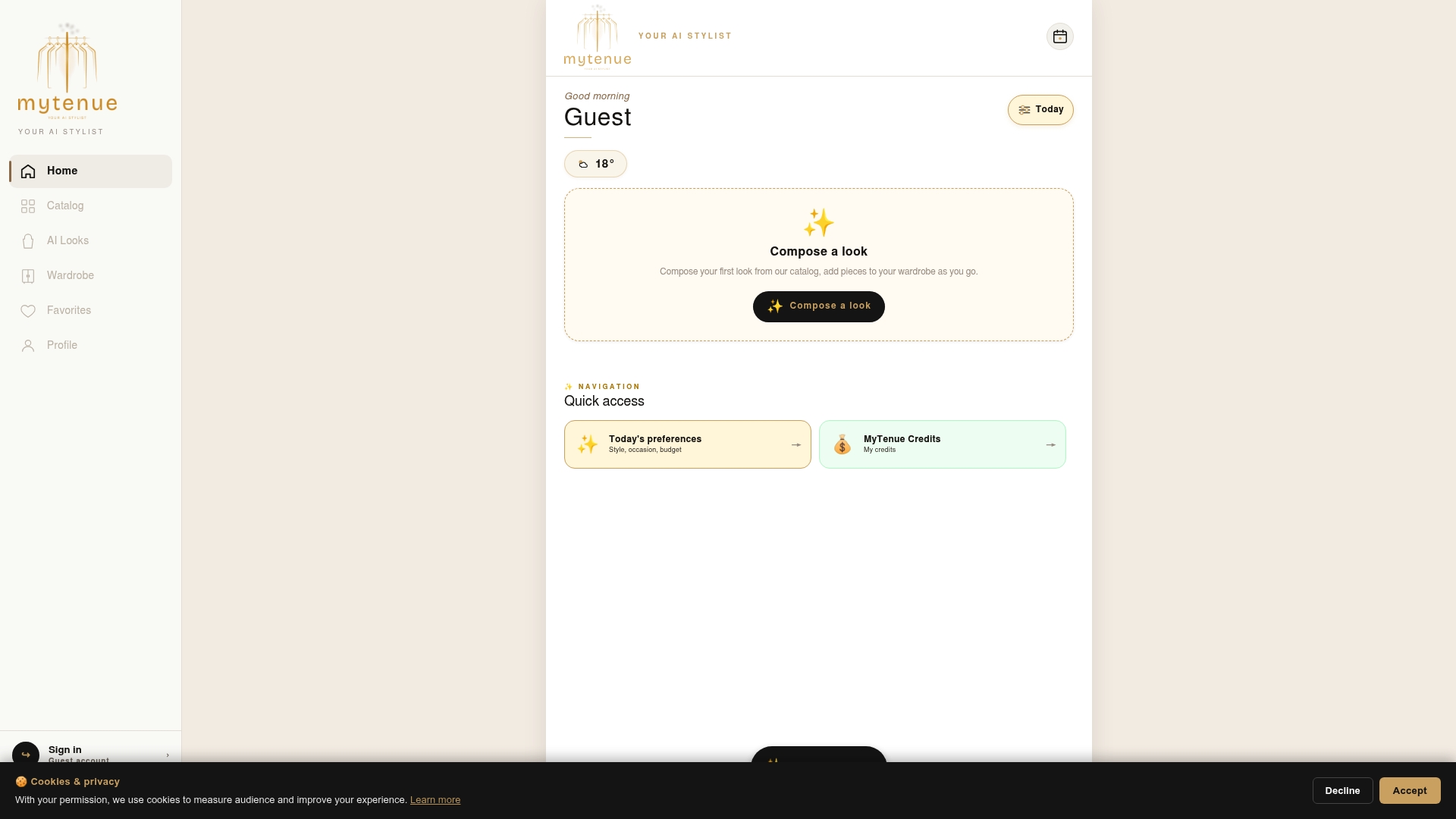
Plans start free. Basic is 5.99 € per month, Premium 9.99 € per month and Gold 16.99 € per month. The app is available on iOS and Android, in French and English. Choose your plan and download the app, or discover Mytenue.
FAQ
How do I find gaps in my wardrobe?
Build outfits around your favorite look and list which pieces match it. What is missing from the list is your gap. Also check that each piece works in at least three outfits, as Cortika suggests. A piece that works with nothing else may simply need one partner item.
How many clothes do I need for a sustainable wardrobe?
There is no single number. C&A France mentions 30 to 40 pieces per season for a capsule. Vogue France lists the 3x3, 10x10 and series-of-7 rules. Pick the one that matches your life, then count your wears to adjust.
Is buying secondhand always more sustainable?
It helps when you replace a real need and wear the piece often. ADEME warns that buying many discounted secondhand items to grow an already large wardrobe reduces the benefit. Run the same gap test as for new pieces.
How often should I review my outfit plan?
A quarterly review fits the changing seasons. Noo-Infinity suggests 30 minutes: what you wore, what you skipped, what is wearing out, what you need next season. A short weekly session keeps daily choices easy.
Sources
- Oxfam France: tips for sorting your clothes
- Charente Nature: Détox Dressing booklet
- L'Envers: slow fashion styling tips
- C&A France: capsule wardrobe
- Le Frugalisme: minimalist style on a budget
- Cortika: ethical style wardrobe guide
- IDEAL: sustainable capsule wardrobe
- Vogue France: capsule wardrobe
- Mode au quotidien: mixing basics
- ADEME: La Mode plus durable
- ADEME: buying secondhand clothes
- ADEME: what to do with used clothes
- Oxfam France: 2026 secondhand report
- Refashion: secondhand market 2025
- DITP: promoting clothing repair and secondhand
- Styles et Tendances: dress fast in the morning
- Noo-Infinity: seasonal clothing routine
- Buying smarter guide
- Wash, dry and buy smarter