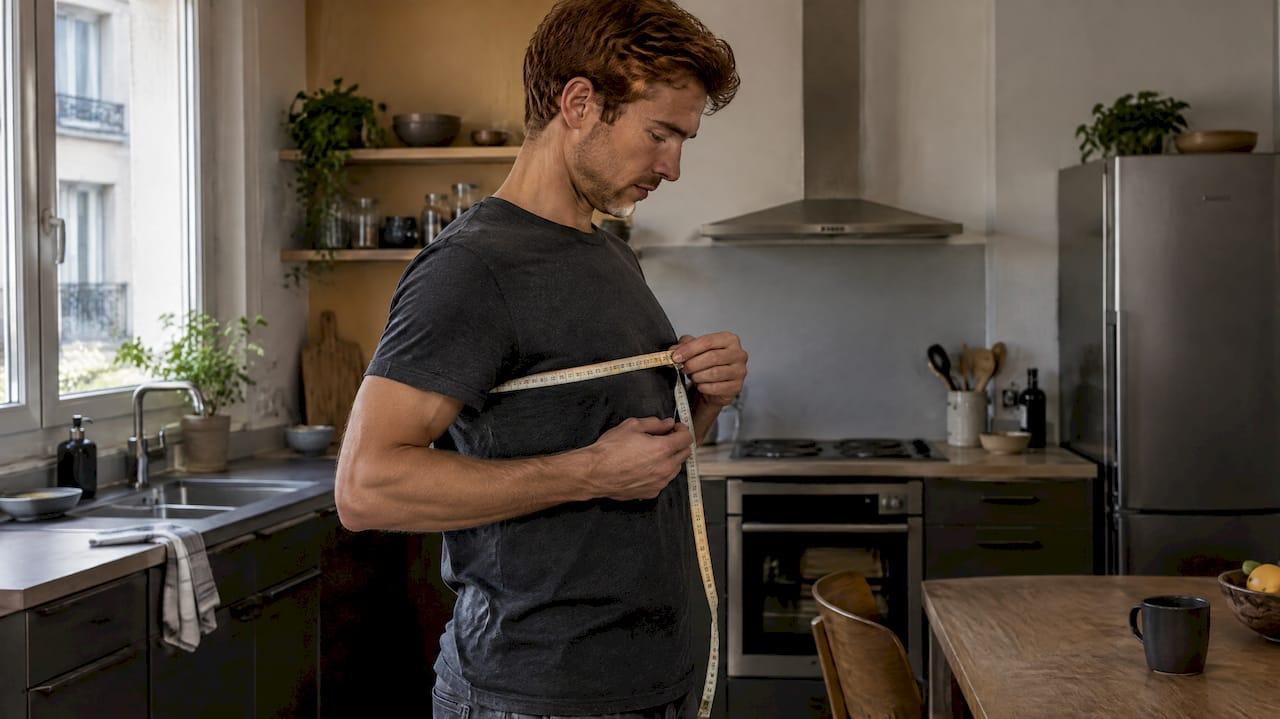
To find your size online, take your body measurements, read them against the size chart of the exact brand you are buying from, then check the fit notes on the product page. Three steps. No guessing. The label on your last jacket is not enough, because every brand draws its own grid.
This guide shows you how to measure, how to read FR, EU, UK and US labels, and how to decide when you fall between two sizes. Then you can see the result on your own avatar with the MyTenue app: your styliste IA, in your pocket.
TL;DR
- Measure bust, waist and hips with a soft tape, over light clothing, tape level and snug but not tight.
- Compare your numbers with the chart of the specific brand. Conversion tables are a starting point, not a rule.
- Check whether the chart shows body measurements or garment measurements before comparing.
- Between two sizes, many French retailers advise the larger one. Then check fit, fabric and reviews.
- Finish with a virtual try-on on your avatar to see how the outfit looks on you.
Table of Contents
- Why one size label means different things
- Step 1: Take your measurements
- Step 2: Read the brand's size chart
- Step 3: Convert FR, EU, UK and US sizes
- Step 4: When you fall between two sizes
- A five-minute routine you can reuse
- Step 5: See it on you before you buy
- Our point of view
- Try it on your avatar with MyTenue
- FAQ
- Sources
Why one size label means different things
You wear a 38 in one shop and a 40 in another. Nothing is wrong with your body. The size label is a brand decision.
There is an international standard for describing clothing sizes: ISO 8559-1:2017 covers the body measurements that help clothing professionals build size profiles for garment development. It guides the industry. It does not force every brand to cut the same 38.
The result is simple. Each brand publishes its own chart, and that chart is the only reliable reference for that brand's clothes. French shoppers see this daily: the same person can sit in a 36 at one label and a 40 at another.
So the method is always the same:
- Know your own numbers.
- Read the chart of the item you want.
- Check how the item is cut.
Step 1: Take your measurements
Two minutes. A soft tape measure. A mirror, or better, a friend.
The advice from French and international retailers lines up well. Bonprix's French guide says to measure close to the body without tightening the tape, over light clothing or underwear, standing straight and relaxed. It also suggests asking another person for precision.
What to measure
- Height. Head to sole, without shoes. Bonprix uses this definition in its guide.
- Bust or chest. Around the fullest point, tape level all the way round. Keep the tape parallel to the floor, as Etam's guide advises.
- Waist. Around your natural waist. Good Housekeeping's guide says to find it where your torso creases when you bend sideways.
- Hips. Around the widest part of the buttocks, not automatically at the hip bones, according to the same guide.
- Inseam. Along the inside of the leg. Ask someone to help.
Where it goes wrong
The usual mistakes are easy to avoid:
- Pulling the tape too tight, which gives a number smaller than your real size.
- Letting the tape slope at the back. Check in a mirror that it stays level.
- Measuring over thick clothes such as a sweater or jeans.
- Measuring the waist at the belt line instead of the natural waist.
- Holding your breath. Stand relaxed.
Write the numbers down in centimeters. French charts use centimeters, and you will compare numbers many times. Re-measure every few months, or after any change in your body, so your notes stay true.
Step 2: Read the brand's size chart
Open the "Guide des tailles" link on the product page. Do not use a generic chart from another site first. Quicksize's French guide makes the same point: compare your actual measurements with the chart of the brand you are buying, because brands have their own grids.
An example with real numbers
Here is what two French brands publish for women's sizes. The numbers differ, and that is the lesson.
| Label | Bust | Waist | Hips | Source |
|---|---|---|---|---|
| Maje FR/EU 34 | 82 cm | 62 cm | 90 cm | Maje |
| Maje FR/EU 42 | 96 cm | 82 cm | 110 cm | Maje |
| Bonprix FR 38 | 82 to 85 cm | 68 to 71 cm | 91 to 94 cm | Bonprix |
| Bonprix FR 42 | 90 to 93 cm | 76 to 79 cm | 98 to 100 cm | Bonprix |
Look at the bust of a Maje 34 and a Bonprix 38: both sit around 82 cm. Same body at the bust, two different labels. Look at the other measurements too, since the waist and hips differ by brand and by garment category.
Take the habit from this table: never decide with the label. Decide with your numbers.
Body measurements or garment measurements?
This point saves many wrong orders. Some charts list body measurements: the body the garment is made for. Others list garment measurements: the finished piece laid flat. UNIQLO's customer-care page explains that product measurements may differ from body dimensions, and that its charts can show centimeters or inches.
Before you compare anything, ask: which one is this chart?
- Body chart: compare with your own tape measurements.
- Garment chart: lay a similar garment you already own flat, measure it, and compare. A fitted top and a loose coat will not give the same margin.
If you shop second-hand, you meet garment measurements all the time, since sellers photograph and list pieces flat. This article on what to measure on clothing listings shows which garment dimensions matter and how to read them against your own.
Step 3: Convert FR, EU, UK and US sizes
Conversion tables help when you buy from a foreign shop. Treat them as a guide.
The common correspondences for women's clothing look like this:
| FR | EU | UK | US | International label |
|---|---|---|---|---|
| 34 | 34 | 6 | XS (Maje) | XS |
| 36 | 36 | 8 | S (Maje) | S |
| 38 | 38 | 10 | M (Maje) | M |
| 40 | 40 | 12 | L (Maje) | L |
| 42 | 42 | 14 | XL (Maje) | XL |
These values come from Maje's French size guide, which lists FR/EU 34 to 42 with UK/IE 6 to 14 and US labels XS to XL. John Lewis gives a similar picture in numbers: UK 10 is US 6, Europe 38 and France 38, and UK 8 is US 4, Europe 36 and France 36.
Now the catch. Bonprix maps FR 38 to EU 36 and S, and FR 42 to EU 40 and M. These are that brand's own correspondences, not a universal rule. Another brand, Ba&sh, uses its own scale where its size 0 matches US XS, FR/ES 34 and UK/AUS 6.
So what do you do?
- Use the conversion to know roughly where to look.
- Then go to the chart of the item and match your centimeters.
- Keep the US size as a loose guide, since letter sizes such as XS or M are the least precise labels of all.
Men, children and shoes
Men's shirts and jackets follow the same method: chest, waist, hips, then the brand's grid. For children, most charts work by height and approximate age, so measure the child's height first and expect variation by brand. Shoes are different: you measure foot length with the tape, then match the brand's chart. The principle does not change. Your numbers first, the brand's grid second.

Step 4: When you fall between two sizes
It happens to everyone. Your bust says 38 and your hips say 40.
Mer.fr recommends choosing the larger size for comfort when your measurements fall between two sizes. Etam's French guide says the same.
Then check the context, as ASOS's customer-care guidance suggests. Size choice combines three things: your body measurements, the intended fit of the item, and feedback from real customers. Read:
- The stated fit. Slim, regular, oversized? An oversized cut may allow you to go down. A close cut rewards the larger size.
- The fabric. A stretch knit forgives. A stiff woven cotton or a tailored blazer does not.
- The model's size. Look at the height and size the model wears, and compare with your own.
- Customer reviews. Look for comments about the item running small or large.
Which measurement wins?
It depends on the garment. For a top, a jacket or a dress, the bust usually decides. For trousers and skirts, waist and hips decide. For a dress with a fitted waist, check all three. A garment can be altered smaller more easily than larger, which is one more reason the larger size is the safer choice when you hesitate.
A five-minute routine you can reuse
Keep a note on your phone:
- Your height, bust, waist, hips and inseam in centimeters.
- The date you measured.
- The size you take at three or four brands you buy often.
- Fit comments, such as "short in the sleeves" or "runs small at the shoulders."
Before each order, open the chart, compare, and read the fit notes. That is it. After a few orders, you will know which brands cut for your shape.
Step 5: See it on you before you buy
A number tells you the garment may fit. It does not show how the outfit looks. That is where a virtual try-on helps.
With MyTenue, you try outfits on your personal avatar. You see the whole look, not one piece in isolation. You can also digitize your wardrobe, so you check a new piece against what you already own.
Our guide on accurate virtual try-on sizing in six steps goes through how to set up your measurements for the best result. To judge render quality, see our six fidelity checks for virtual fitting. Light matters when you photograph yourself or your clothes, so read how to get accurate try-on results with lighting. To add your own pieces, follow how to photograph clothes for the app.

For a wider view, our look at the real role of virtual fitting rooms explains where they help most. And for outfits that suit your shape, see AI outfit recommendations for your body.
Our point of view
Size is only half the question. The other half is: does this piece work with what I already own?
That is why we built MyTenue around your own wardrobe. Your styliste IA generates outfit recommendations from the pieces you have, analyzes color, fabric, style and occasion compatibility, and lets you try looks on your avatar. Essayage virtuel, flat-lay editorial, weather-adapted daily suggestions, a calendar to plan the week.
Measure well, read the chart, then see the full outfit. A good size in the wrong outfit is still a wasted purchase. A dressing sublimé starts with pieces that fit you and go together.
Ahmed
Try it on your avatar with MyTenue
Short version. You measure. You choose. You see the look on your personal avatar.
MyTenue is a styliste IA app for iOS and Android, with web access too. Start with the Free plan. Go further with Basic at €5.99 per month, Premium at €9.99 per month or Gold at €16.99 per month. The interface is available in French and English.
Download on the App Store or Google Play from the MyTenue app page.
FAQ
How do I find my size when ordering clothes online?
Measure your bust, waist and hips in centimeters, then match them to the size chart on the product page. Check the stated fit, the fabric and customer reviews. The brand's own chart always beats a general conversion table.
Is an XS the same in every shop?
No. Maje, for example, maps its FR/EU 34 to US XS with a bust of 82 cm, waist of 62 cm and hips of 90 cm. Another brand can use different numbers for its XS. Read the chart of the item you want.
What size should I pick if I am between two sizes?
French retailers such as Mer.fr advise the larger size for comfort. Then look at the fit notes and reviews. A stretch fabric or an oversized cut may allow the smaller size.
What is the French equivalent of a UK size 10?
At John Lewis, UK 10 corresponds to US 6, Europe 38 and France 38. Some brands use their own scale, so confirm with the brand's chart before you order.
Sources
- ISO 8559-1:2017, Size designation of clothes
- Bonprix, Guide des tailles femme
- Good Housekeeping, How to Measure Yourself Accurately
- Etam, Guide des tailles
- Maje, Size Guide for Clothes
- John Lewis, International Clothing and Shoe Size Charts
- Ba&sh, Size guide
- UNIQLO US, How can I figure out my size?
- ASOS, Finding the right size
- Mer.fr, Guide des tailles des vêtements
- Quicksize, Guide des tailles
- Measurements for Clothing Listings