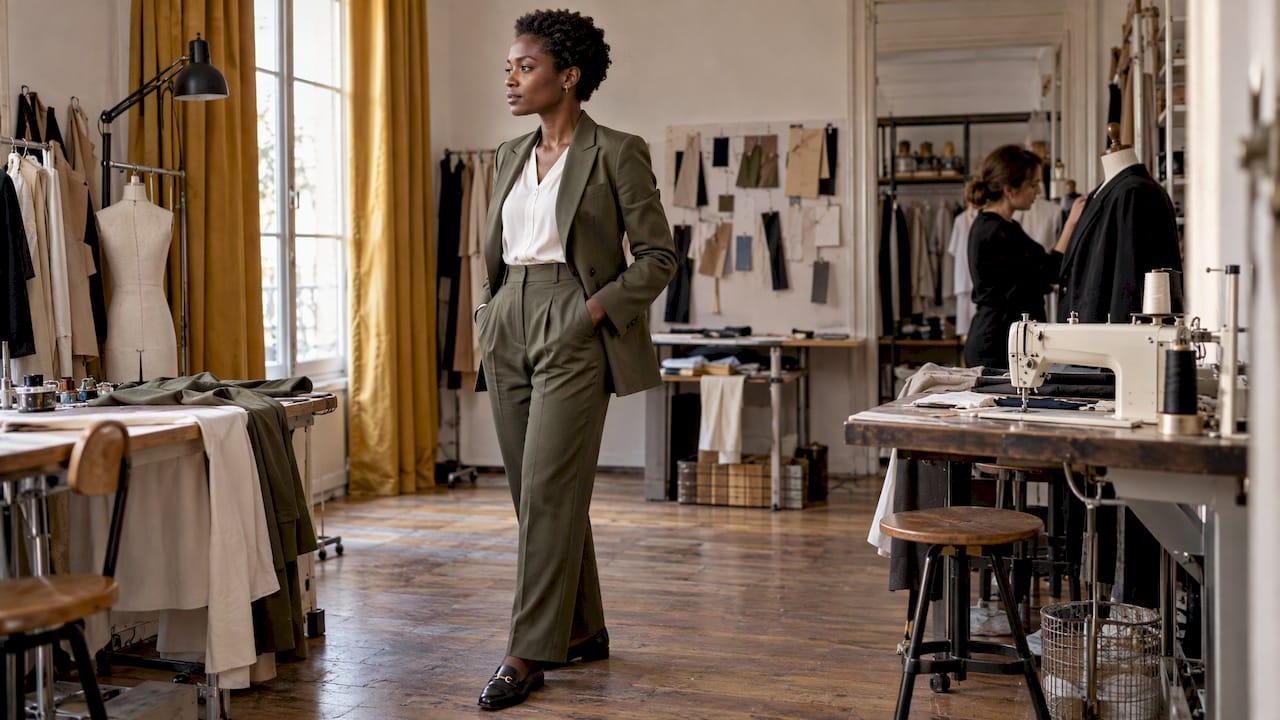
Petite workwear is about proportion, not size. Put roughly one third of your body in the top half of the outfit and two thirds in the legs. Keep the lines long. Check that hems, shoulders and waistlines land where your body does, not where a standard pattern expects. Then test the look before you commit. In the Mytenue app you can digitize your wardrobe and try outfits on your personal avatar, so you see the proportions before you get dressed or buy anything.
TL;DR
- Petite is a height category, not a small size. It is generally cut for women around 5'3" (1.60 m) and under, with length reduced across the whole garment.
- Aim for a 1/3 top, 2/3 legs balance: high-rise bottoms, jackets that end at the waist or hip, and a trouser hem that skims the shoe.
- Vertical lines make you look taller: one color family, open blazers, a visible waist.
- Fit points decide the outcome: shoulder seams, sleeve end, rise, hem, and skirt length when seated. A tailor fixes most of them.
- Try looks on your avatar in Mytenue and score them before you buy or wear them.
Table of Contents
- What petite really means (and why a smaller size is not the fix)
- The 1/3 to 2/3 rule: your baseline
- Jackets and blazers: where they should end
- Trousers, skirts and dresses
- Color, lines and shoes
- Tailoring: the cheapest way to fix proportions
- Seven mistakes that unbalance petite work outfits
- Settings and seasons
- Build more looks from what you already own
- Check proportions before you buy
- Promo: your AI stylist, in your pocket
- Perspective
- FAQ
- Sources
What petite really means (and why a smaller size is not the fix)
Petite describes stature, not weight or waist. In France, the media explainer on size labels says the "Petite" mention is designed for women under about 1.60 m, and that the category exists in many sizes because being petite does not mean being slim. A size guide from a British brand with a French site says its petite cut suits people of 1.60 m and under, with length shortened proportionally across the whole garment, not only at the knee or ankle.
Why does that matter? Standard ready-to-wear is patterned for a height of roughly 1.65 to 1.70 m. On a shorter frame, the result is sleeves about 5 cm too long, trouser rises that land on the hips and bust darts set too low. Buying a size down fixes the width and leaves those proportions untouched. You end up with a jacket that fits at the shoulder but swallows your hands, or trousers that fit at the waist but pool at the ankle.
One practical point for France: dedicated petite lines are rare. Most brands follow a standard numbering of bust, waist and hips plus a height in centimeters, so you choose adapted cuts or use alterations. That makes proportion knowledge your main tool.
The 1/3 to 2/3 rule: your baseline
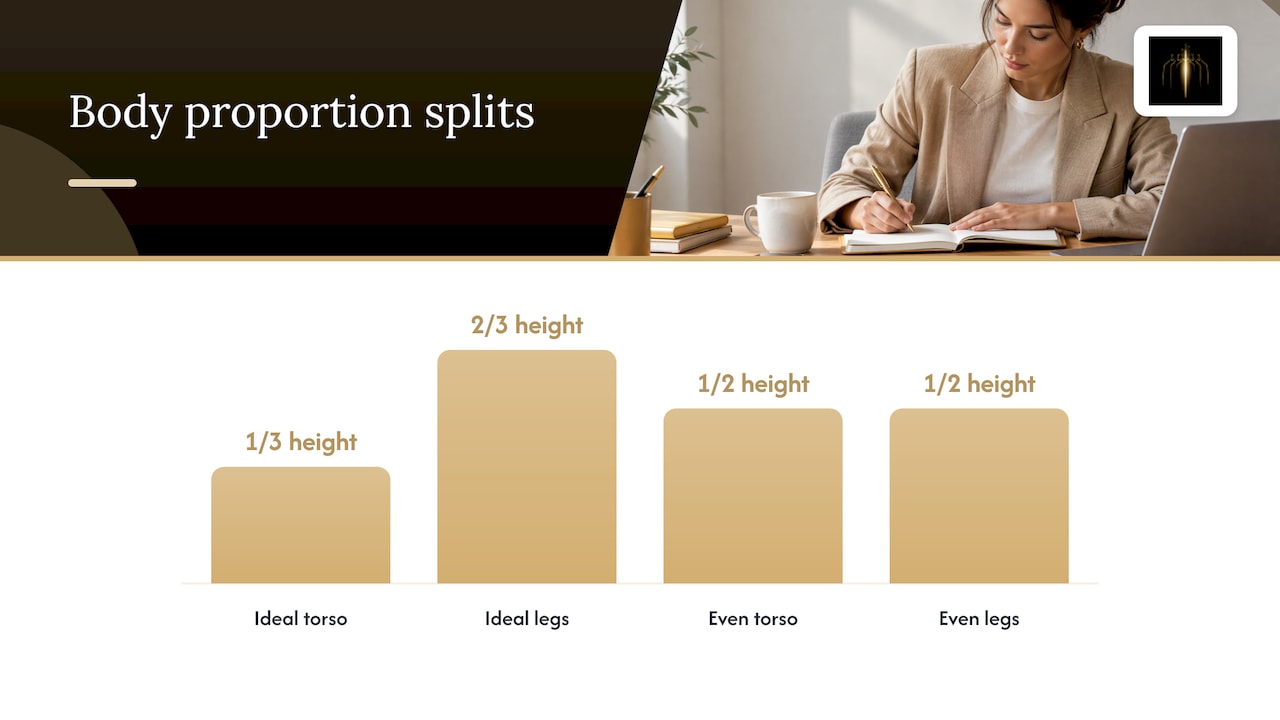
The simplest formula in petite styling is the ratio of one third to two thirds. The torso takes one third of the visual height, the legs two thirds. The thing to avoid is a 50/50 split, which shortens the stature.
A classic 50/50 office outfit: a tunic blouse worn untucked to mid-hip over standard trousers. It cuts the body in half at the widest point. Office-focused guidance calls this a 1:1 ratio and notes it visually shortens the lower body on smaller frames.
How to build the 1/3 to 2/3 split in practice:
- Start with a high waist. Trousers or a skirt with a high rise move the dividing line up and give you more leg.
- Tuck or shorten the top. A tucked shirt, a fitted knit or a cropped blazer shows the waist.
- Let the hem finish the line. Trousers that skim the shoe, or a skirt ending at the knee, keep the leg uninterrupted.
- Repeat a color. The eye travels from top to bottom when the tones are close.
A worked example: high-rise straight trousers in navy, a tucked white shirt, a navy blazer ending at the hip, and loafers. The waist sits high, the jacket stops at the hip, and navy runs from shoulder to shoe. That is the formula in one outfit.
Jackets and blazers: where they should end
The jacket is the piece that most often breaks petite proportions, because it sets the visual cut-off for your torso.
Length. Aim for the waist, the hip or just below. A jacket ending at the hip or slightly below, paired with trousers that graze the shoe, is a dependable shape. Short, fitted blazers mark the waist and keep the leg from being "cut". A long blazer (mid-seat or lower) can swallow the silhouette, especially when everything under it is wide, as one blazer guide puts it.
Fit checkpoints. These come from a detailed layering guide for petite office wear:
- The main button lines up with your natural waist or ribs.
- The shoulder seam sits exactly on the bone at the tip of your shoulder.
- The sleeve stops at the base of the thumb joint, with 0.5 to 1 cm of shirt cuff showing.
Shoulders matter most. A tailor can shorten sleeves and hems far more easily than they can rebuild a shoulder. If the shoulder is wrong, move on to another jacket.
Worn open. A blazer, vest or coat worn open draws an uninterrupted vertical line down the body. With wide-leg trousers, one stylist-style guide recommends a marked high waist and a short jacket ending just below the hip, worn open, in soft fabrics such as crepe, light gabardine or stretch viscose.
Trousers, skirts and dresses
Trousers
The reliable shapes are straight, tapered or cigarette cuts with a high rise. The hem should graze the shoe, or sit just above the ankle if you wear a flat that matches your skin tone or trouser color. A 7/8 length that shows the ankle also works, because it lets the leg read as longer. Choose one hem logic and stick to it: either the trouser nearly touches the floor with a heel, or it clearly stops at the ankle. A hem that stops halfway is the one that shortens you.
Trousers that are "always too long" are a fact of life for many petite women. Vogue France's profile of a woman measuring 1.59 m says she sends them to the tailor and wears heels of at least 5 cm.
Skirts
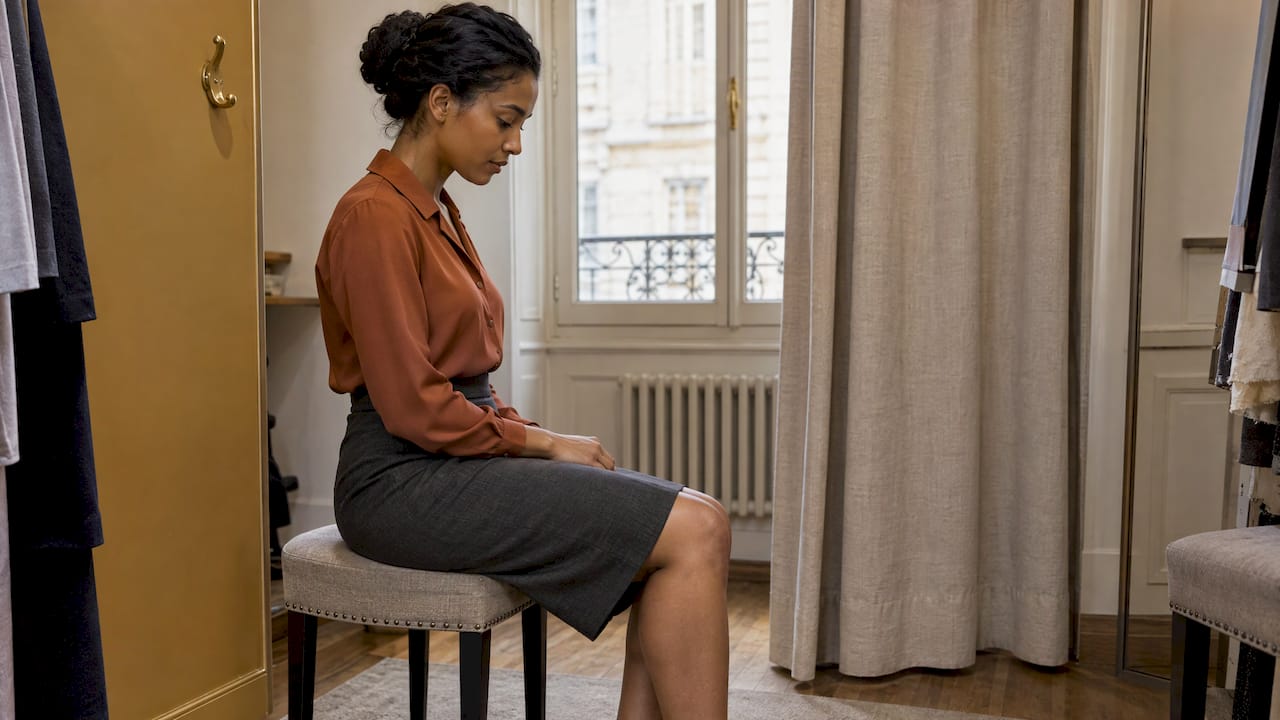
For a pencil skirt, the hem sits just above or at the knee, with a high waist. Check the length seated, because a skirt rides up when you sit. That is a simple test before you buy. Midi and long skirts can work, but only with a slit or a very high waist, so the line of the leg is not blocked. If you wear a midi, balance it with a heel.
Dresses
Sheath dresses, knee-length wrap dresses and A-line skirts keep the silhouette clean. Anything too voluminous can overwhelm a small frame. Nude-toned pointed flats or heels extend the leg line.
Color, lines and shoes
One-color dressing. A monochrome suit in beige, navy, black, gray or chocolate creates visual continuity that lengthens the body. Pants and blazer in the same shade is the shortcut to a polished look, and it also simplifies the morning choice, since pieces in one color family combine easily.
Necklines and waist. V-necks lengthen the torso. Wide belts do the opposite: they cut the body into blocks. A slim belt, or a tucked top, marks the waist without a hard break.
Shoes. A heel of about 5 cm lengthens the leg while staying comfortable with a suit. Pointed toes and nude tones extend the line. Chunky shoes break it. If you prefer a harder-edged look, it is possible to wear combat boots at work in polished ways by matching their color to your trousers so the leg line stays unbroken. For comfortable flat options, our guide to sneaker-friendly office outfits applies the same logic.
Tailoring: the cheapest way to fix proportions
Almost every petite office wardrobe depends on a tailor. Good news: the fixes are small and cheap compared with the effect. A French stylist's "3 cm rule" says that adjusting a hem, waistband, sleeve or neckline by a few centimeters instantly sharpens the silhouette.
A fit checklist for any work piece:
| Piece | What to check | Usual fix |
|---|---|---|
| Trousers | Rise on the waist, hem length with your work shoes | Hem |
| Blazer | Shoulder seam on the bone, sleeve at thumb base, button at waist | Sleeves (not shoulders) |
| Shirt | Sleeve length, cuff showing 0.5 to 1 cm under the jacket | Sleeves |
| Pencil skirt | Knee length, also when seated, waist not hidden | Hem |
| Dress | Waist position, hem at the knee | Hem, sometimes the waist |
When shopping, look at inseam and rise measurements, not size alone. Some petite-focused guides advise that crotch depth and waist height in the measurements tell you more than the label does.
Seven mistakes that unbalance petite work outfits
- Long, loose layers. Oversized pieces overwhelm the frame. Swap for fitted, structured cuts.
- Wide belts. They block the vertical line. Use a thin belt or tuck.
- A hidden waist. A top worn over a skirt waistband buries the high waist. Tuck it in.
- A 50/50 split. Untucked mid-hip tops over standard trousers. Shorten the top or raise the bottom.
- Unchecked skirt length. Test it seated.
- Chunky shoes on a fine line. Choose a slim or pointed shoe, ideally close to your trouser color.
- A jacket that is too small for "smartness". Going a size up or choosing a straighter cut works better than pulling a tight jacket.
Settings and seasons
Dress codes differ by office. A formal setting calls for structured pieces and sober colors. Business casual and smart casual relax the rules. A look that is right in a law firm may feel stiff in a communications agency. Keep the proportions fixed and vary the pieces:
- Formal: matching suit, white shirt, 5 cm heels.
- Business casual: blazer over raw denim, a fluid dress or a straight midi skirt (with a heel).
- Winter: structured coat open over a monochrome base, long cardigan, wool jacket. Keep the vertical line.
- Summer: light fabrics with precise cuts. A fitted shirt tucked into high-rise trousers.
A full week of repeating formulas is easier to plan than it sounds. Our five office outfit formulas and workweek planning checklist show how.
Build more looks from what you already own
Petite proportion pieces are hard to find, so use each one many ways. A well-cut blazer works with trousers, a midi skirt or jeans. Keep a tight color palette so everything combines. One Vogue France profile describes buying the same piece in several colors once it fits. That is the uniform approach: when a cut works for your frame, repeat it.
To stretch a budget, work through the capsule wardrobe plan, run a wardrobe gap analysis before buying anything, and use the outfit stretching checklist. Spend on the pieces that need the right shoulders and length, then alter the rest.
Check proportions before you buy
Proportion errors are easy to see in a picture and hard to feel in a mirror at 7:45 a.m. This is where Mytenue works for you. The app digitizes and organizes your wardrobe, generates outfit recommendations from the pieces you own, and lets you try looks on your personal avatar. Its AI analyzes color, fabric, style and occasion compatibility, and it creates editorial flat-lay images of outfits. Plan the week in the calendar, and get daily suggestions adapted to the weather.
A simple routine:
- Photograph your blazers, trousers and skirts to build your digital wardrobe.
- Generate looks for a work occasion and check the avatar: where does the jacket end, and where is the waist?
- Apply the 1/3 to 2/3 test. If the look splits in half, swap one piece.
- Put the best looks in your calendar for the week.
Promo: your AI stylist, in your pocket
Mytenue is an AI-powered personal stylist for iOS and Android, with mobile and web access and a French and English interface. The Free plan costs nothing. Paid plans are Basic at €5.99 per month, Premium at €9.99 per month and Gold at €16.99 per month. Download the app and start with your own wardrobe.
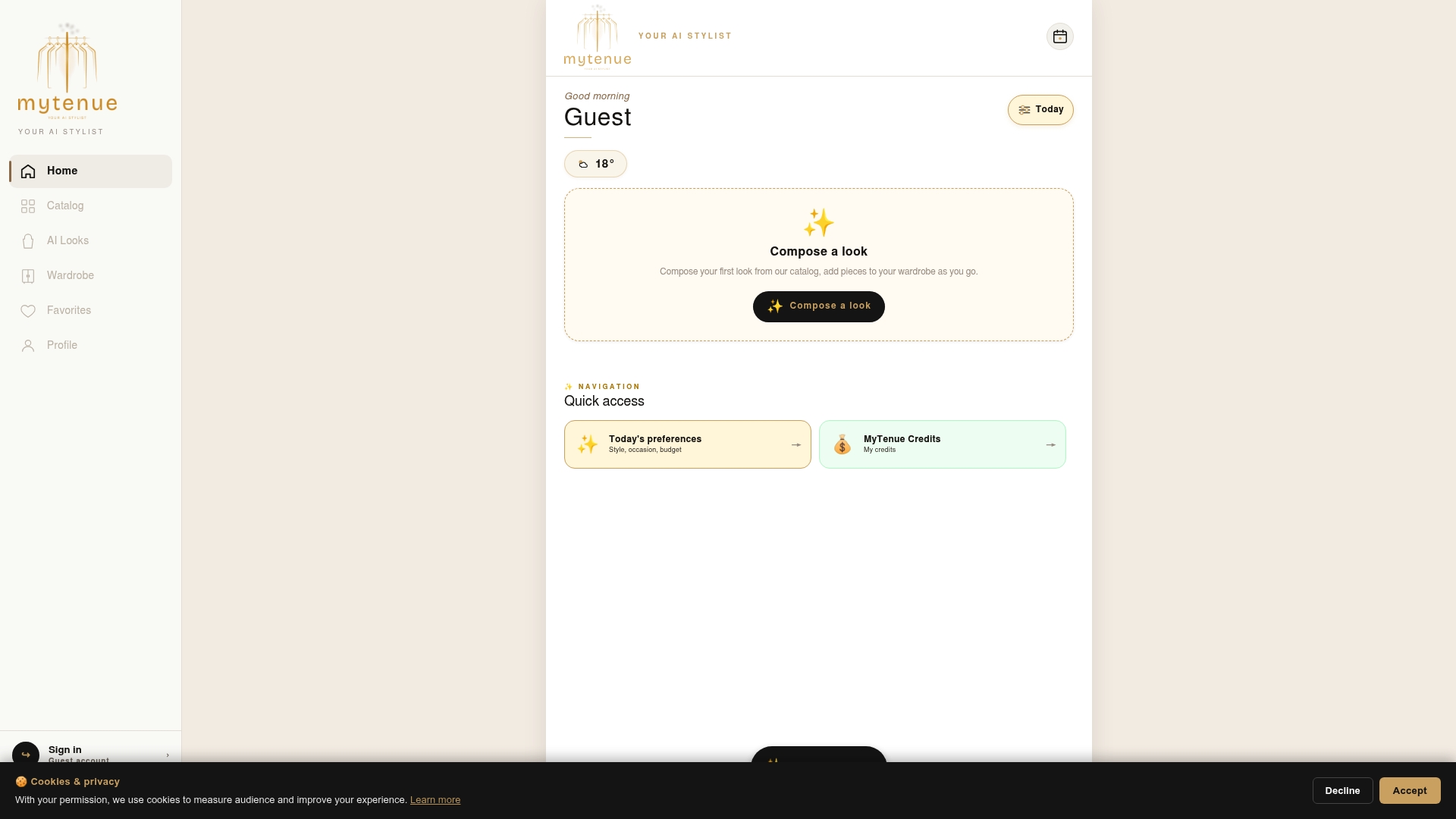
Virtual try-on, daily suggestions, flat-lay images and a calendar: your dressing room, refined.
Perspective
We built Mytenue around one idea: you already own most of what you need. Petite dressing proves it. The difference between a look that works and one that does not is rarely a new purchase. It is a hem, a jacket length, a waist that shows.
That is why we start from your wardrobe. Our AI stylist looks at color, fabric, style and occasion, then builds outfits from your own pieces. The virtual try-on on your avatar lets you see where a blazer lands and whether the line from waist to shoe stays unbroken.
A stylist quoted in Elle puts it well: nothing is ever an obstacle in fashion. A petite frame is worked with cleverly chosen pieces. We want that cleverness available every morning, in a few taps.
Mix what you own with a few well-chosen new pieces. It is better for your budget, and better for the planet.
Ahmed
FAQ
What height counts as petite?
In France, the "Petite" label is generally designed for women of about 1.60 m (5'3") and under. It describes stature, not body width, so petite pieces exist in many sizes.
Should I just buy a smaller size?
A smaller size narrows the garment but keeps proportions made for a taller body, such as sleeve length, rise and waist position. Choose pieces cut for your height, or keep a tailor for hems and sleeves.
Where should a blazer end if I am petite?
At the waist, at the hip or slightly below. The shoulder seam should sit on the tip of your shoulder bone and the sleeve should reach the base of your thumb.
Do heels help with workwear proportions?
A heel of about 5 cm lengthens the leg line and stays comfortable with a suit. Flats work too when their color is close to your trousers or your skin tone.
Can I check proportions without trying everything on?
Yes. In Mytenue, digitize your wardrobe and try looks on your personal avatar. You see the jacket length and the waist line, then keep the combination that balances.
Sources
- Tall, Petite, Curve: what the size labels really mean
- Size and care guide, petite cut
- Petite fashion: look advice by height
- French clothing sizes and petite availability
- Petite office outfits: proportion formulas
- How to wear a suit when you are petite
- Blazer cuts guide
- Which jacket with wide-leg trousers
- Cigarette trousers: easy looks
- Vogue France: how a woman under 1.60 m dresses
- Pencil skirt complete guide
- Business casual for women
- Elle: the 3 cm rule
- Brands that cut for petite frames
- Elle: how to lengthen the silhouette when petite