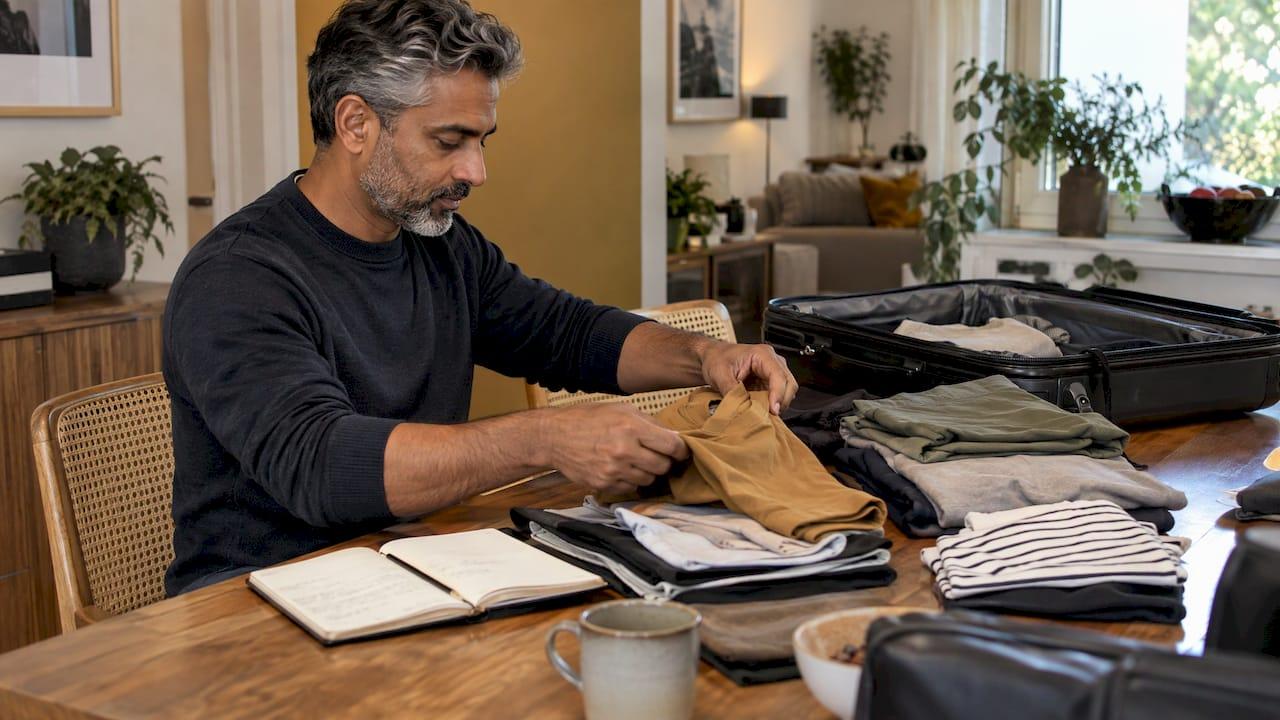
A travel outfit calendar is a day-by-day plan of what you will wear on your trip, built before you pack. You list each day and evening, note the activity and the weather, assign one look to each, and pack only what the plan needs. The result: fewer pieces, no "I have nothing to wear" moment, and a lighter bag.
This guide shows you how to build one in six steps. It includes mix-and-match formulas, advice for France across the seasons, and what to do when plans change.
TL;DR
- A travel outfit calendar assigns one look to each day and evening of your trip, so you pack from a plan instead of from worry.
- Start from the itinerary and the forecast, not from your closet. Then choose pieces that each work in at least two contexts.
- Pick a formula (for example 5-4-3-2-1, or a 10-piece capsule) and keep one palette: two neutrals and one accent.
- In France, layers rule. Add a light waterproof layer and comfortable walking shoes for cobblestones.
- Keep the calendar flexible: fixed anchors, movable looks, and a swap plan for rain.
Table of Contents
- What a travel outfit calendar includes
- Step 1: List your days and what each one asks of your clothes
- Step 2: Record the weather range
- Step 3: Choose a formula for how many pieces you need
- Step 4: Stick to one palette and make each piece work twice
- Step 5: Fill in the calendar
- Step 6: Adapt the plan to the season in France
- Turn the calendar into a packing list
- When the weather or the itinerary changes
- Our perspective
- Plan your trip looks with Mytenue
- FAQ
- Sources
What a travel outfit calendar includes
Think of it as a simple table with one row per day. A good one holds five things:
- The date and the place. Day 1, Paris. Day 2, day trip.
- The activities. Walking tour, museum, long dinner, work meeting, hike, swimming.
- The weather range. Expected low and high, rain risk, humidity, and whether you move between heated interiors and the outdoors.
- The outfit. Top, bottom, shoes and a layer, written down for the day and, if needed, the evening.
- The swap. A backup look if the forecast or plans change.
The idea is common in travel planning. One planner recommends listing the trip days with their activities, then assigning one outfit per day made of a top, a bottom, shoes and a layer. Doing so removes the daily decision and confirms you have enough clothes. If you want the same system for everyday life, see our guide to outfit calendar planning.
Step 1: List your days and what each one asks of your clothes
Open a blank page or a note. Write one line per day. Next to each, add what you will actually do. Be specific: "Louvre in the morning, dinner at 8 p.m." tells you more than "sightseeing".
Then mark the activities that need special clothing. A capsule wardrobe planner suggests flagging things like walking tours, swimming, dinners, work meetings, hikes or formal events. Those are the days that decide your suitcase. Everything else can be filled with your neutral basics.
A useful shortcut: group your days into types. One city-focused guide advises identifying three types of days and keeping to three outfit families at most. For a week in Paris, that might be:
- Walking days: museums, markets, long streets.
- Dinner days: a slightly dressier evening.
- Travel days: train, plane, in-between.
Step 2: Record the weather range
Do this a few days before you leave, and check again the night before. Write down the expected temperature range, the rain risk and the humidity. The same planner suggests noting whether you move between heated or air-conditioned interiors and outdoor spaces. It also says a thin base layer and a packable outer layer are often more useful than one bulky item.
If you travel in France, our guide on Météo-France forecasts and a 9 to 12 piece plan walks through this step in detail. For a day-by-day view of what to wear in different conditions, see weather-based outfit ideas.
Step 3: Choose a formula for how many pieces you need
You do not need a separate outfit for each day. You need pieces that combine. Here are formulas that travel writers and planners use. Pick one as a starting point and adjust to trip length.
| Formula | Pieces | What it gives you |
|---|---|---|
| 5-4-3-2-1 | 5 tops, 4 bottoms, 3 pairs of shoes, 2 dresses or jackets (depending on weather), 1 set of accessories | Up to 60 combinations, fits in one carry-on |
| 10-piece capsule | A few mixable tops, one or two bottoms, one dressier outfit, one cool-weather piece, two versatile shoe pairs | A light bag for a holiday with walks and dinners |
| 6-3-2-1 example | 6 tops, 3 bottoms, 2 pairs of shoes, 1 layer | Six days of outfits, with tops and bottoms you can swap |
| Carry-on checklist | 2 to 4 tops (at least one polished), 2 bottoms that go with most tops, 1 weatherproof or structured outer layer | A minimal base to extend |
The 5-4-3-2-1 method also comes with a tip worth copying: start with the shoes, because they are the bulkiest items, then try outfits in advance and keep only what truly goes together.
For business travel, the same logic applies with a sharper palette. Our business trip capsule wardrobe guide shows how to pack less and still look sharp. If you want a more detailed suitcase test, read how to pack 9 to 12 pieces and test outfits.

Step 4: Stick to one palette and make each piece work twice
This is the rule that makes a calendar work. One itinerary-based guide recommends two base colors and one accent, fabrics that dry quickly and wrinkle little, and one light warm layer even for a summer destination. Its core principle: each piece must serve in at least two different contexts.

The examples are easy to picture. A fine cotton shirt goes under a jacket in the evening and stands alone in the afternoon. A straight-leg pant replaces a skirt when the program gets more demanding. This reasoning removes the "precaution suitcase" that holds everything and serves nothing.
Another practical idea from the capsule planner: find one item that bridges categories. A simple dress can go with flat shoes by day, then with dressier accessories and a layer at night. Fewer single-purpose garments means a lighter bag.
Step 5: Fill in the calendar
Now assign looks. Here is a sample for a five-day city trip in spring, using a small capsule. Adapt it to your own pieces.
| Day | Plan | Look |
|---|---|---|
| Day 1 | Arrival, evening walk | Jeans, cotton shirt, light jacket, walking shoes |
| Day 2 | Museum, long dinner | Straight trousers, fine knit, same shoes; add a scarf and the jacket at night |
| Day 3 | Market and a day trip | Jeans, tee, packable rain shell, walking shoes |
| Day 4 | Neighborhood loop, nice dinner | Dress or skirt, knit layer, accessories, second pair of shoes |
| Day 5 | Departure | Day 1 look, swapped with a different top |
Notice that nothing is new each day. The shirt returns, the jacket repeats and the shoes rotate. That is the point. If you want to see how this looks on a specific city, our guides to Paris weather outfits and a Paris travel capsule for spring give you concrete looks for rain and cobblestones.
Step 6: Adapt the plan to the season in France
France changes quickly from region to region and from season to season, so the calendar needs a weather column. A France packing guide gives a useful baseline: smart-casual layers in spring and autumn, breathable linen and cotton in summer, insulated layers and waterproofs in winter. It also notes that Paris summer can bring hot afternoons and cool riverside evenings, so light layers help.
For most first trips, that guide suggests a small carry-on capsule of weather-matched layers, comfortable walking shoes and one smart evening layer. That covers museums, cafés, quick rainy walks and long dinners.
A few season-specific points:
- Spring and autumn: scarves help, and a packable rain shell is useful for drizzly visits.
- Winter: add gloves to the scarf, and keep the waterproof layer.
- November: one France packing guide describes the month as cold and damp, with lows around 10°C, so warmth and waterproofing matter most.
- All year: the same France weather guide recommends breathable shirts, jeans and a waterproof jacket as core items, plus comfortable shoes for cobblestones.
For a broader seasonal base, see our wardrobe essentials for every season.
Turn the calendar into a packing list
Once each day has a look, count. Write every piece once, even if it appears on three days. That list is your suitcase.
Then run three checks:
- Does every piece appear at least twice? If not, cut it or replace it with something that does.
- Do shoes and layers cover the worst weather day? Pack for that day, not the average.
- Is there room to spare? The 5-4-3-2-1 method is presented as a way to travel with less stress, less weight and more space for souvenirs. Because every outfit is ready and tested before departure, the "nothing to wear" worry disappears.
When you prefer lightweight, wrinkle-resistant fabrics and two versatile pairs of shoes (one for walking, one slightly dressier), the 10-piece capsule approach stays easy to carry.
When the weather or the itinerary changes
Plans move. A calendar that cannot bend is a calendar you abandon on day two. Flexible trip planning advice offers a structure that fits outfits well: fixed anchors, movable blocks and optional extras.
Applied to clothes:
- Fixed anchors: the dinner, the meeting, the wedding. Their look is locked.
- Movable blocks: everyday looks you can shuffle between days, because the pieces coordinate.
- Optional extras: the scarf, the second jacket, the fun shoes.
Also write simple decision branches. Heavy rain? Swap the long walking route for a transit-based neighborhood loop, and wear the waterproof layer with your sturdiest shoes. The same guide recommends preparing indoor, low-cost and low-effort options for each travel day. Do the same for your clothes: one rainy look and one hot look per day type.
Our perspective
We built Mytenue around one belief: the best outfit plan starts from the clothes you already own. A travel outfit calendar is that idea applied to a trip. You decide the days, the weather and the occasions. Then you assign looks and keep only what earns its place in the bag.
That is why our AI styling works from your own wardrobe. It checks color, fabric, style and occasion compatibility. It can suggest looks adapted to the weather, and you can see them on your personal avatar before you pack. You plan in the calendar, you test the look, you close the suitcase.
For us, a good trip wardrobe is not about owning more. It is about mixing what you have, adding a piece only when it brings real value, and arriving with looks you already love.
Ahmed
Plan your trip looks with Mytenue
Your AI stylist helps you build the calendar instead of drawing it by hand. Digitize your wardrobe, plan outfits in the calendar, get weather-adapted suggestions and try each look on your avatar. Mytenue also creates editorial flat-lay images of your outfits, which is handy for a packing check.
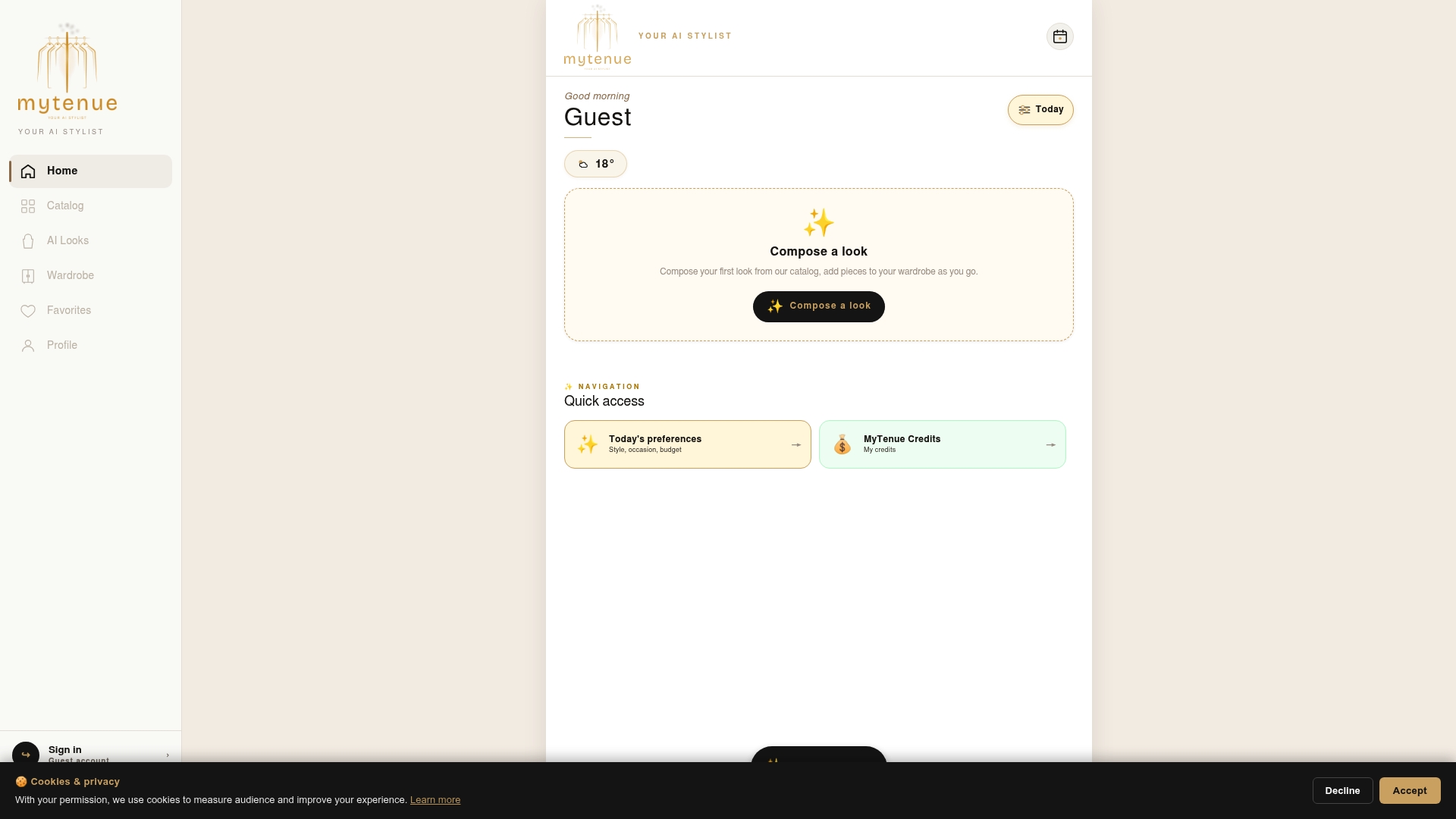
The app is on iOS and Android, with web access too, in French and English. You can start with the Free plan. Paid plans are Basic at 5.99 € per month, Premium at 9.99 € per month and Gold at 16.99 € per month. See the plans and download the app.
FAQ
How many outfits do I need for a one-week trip?
Fewer than you think. One planner's example uses 6 tops, 3 bottoms, 2 pairs of shoes and 1 layer for six days. Because the pieces coordinate, you can swap tops and bottoms if plans change. Use that as a base, then add one dressier look if you have a special dinner.
Should I plan one outfit per day or per activity?
Per day, with a note for the evening. List the day's activities, then assign one look made of top, bottom, shoes and layer. If the evening is dressier, plan the bridge: a dress or shirt that changes with accessories or a jacket.
What should I wear in France in November?
Expect cold and damp weather. One packing guide lists a low around 10°C and stresses warmth and waterproofing. Think insulated layers, a waterproof jacket, a scarf and comfortable shoes for cobblestones.
How do I avoid overpacking?
Start from the itinerary, not the closet. Choose one palette, and keep only pieces that work in at least two contexts. Count every piece in your calendar once, then pack that list and nothing else.
Can I plan a travel outfit calendar in an app?
Yes. In Mytenue you can digitize your wardrobe, schedule looks in the outfit calendar and try them on your avatar. For a deeper walk-through, read our outfit calendar planning guide.
Sources
- How to Plan Travel Outfits That Mix and Match
- Carry-On Capsule Wardrobe Planner
- La méthode 5-4-3-2-1 pour une valise légère
- Voyager en ville : la garde-robe qui suit l'itinéraire
- Petite valise en vacances : comment partir léger
- What to Wear in France: Packing Guides for Every City
- France packing list: Smart-casual layers
- France Weather Guide: Seasons, Packing and Regional Differences
- Flexible Itinerary Planning for Travel Uncertainty