
Outfit calendar planning means choosing your looks ahead of time and putting them on dates, so mornings stop being a decision. The simplest version takes 20 minutes on a Sunday: pick three outfit formulas, assign them to the week, and check the forecast. Add a monthly reset and a seasonal rotation, and your wardrobe starts working harder. Here is how to build it, step by step.
TL;DR
- Plan one week at a time. Assign an outfit to each day, then adjust for weather and events.
- Build three outfit formulas with two or three variations each. Fewer choices, less repetition.
- Rotate by season on fixed dates, with a quick monthly reset in between.
- Paper, spreadsheet, phone calendar or app: pick the tool you will open every day.
- Our app, Mytenue, plans outfits on a calendar from your own digitized wardrobe.
Table of Contents
- What an outfit calendar actually is
- Why it is worth the effort
- How to plan outfits ahead: the weekly method
- The monthly outfit planner: what to include
- Wardrobe rotation calendar: seasons on fixed dates
- Outfit rotation strategy: repeat without feeling repetitive
- Paper, spreadsheet, phone calendar or app?
- Planning on a budget, and more sustainably
- Our point of view
- Start planning with Mytenue
- A 20-minute starter routine
- FAQ
- Sources
What an outfit calendar actually is
It is a calendar where each day has a look attached. That is all.
The look can be a sketch, a photo, a list of pieces or a saved outfit in an app. The point is the same: the decision is made before you are tired, rushed or staring at the closet.
A good outfit calendar does three jobs:
- Removes the morning decision. You already chose.
- Shows what you really wear. Repeats and neglected pieces become visible.
- Connects to your real life. Meetings, school runs, dinners, weather.
That last point matters most. A pretty plan that ignores your week gets abandoned by Wednesday.
Why it is worth the effort
Most of us own more than we use. An ADEME and ObSoCo study found that French people have an average of 175 clothing items in their closets and wear less than half. Half of a wardrobe sitting idle is a planning problem, not a shopping problem.
Planning helps in three ways:
- Time. Less deciding, less changing at the door.
- Money. You see gaps before you buy, so you fill real gaps only.
- Sustainability. The same ADEME guidance recommends buying less but better and checking what is already in your wardrobe before purchasing. A calendar does exactly that, every week.
If you want a deeper look at stretching what you own, our outfit stretching checklist for a tight budget goes through it piece by piece.
How to plan outfits ahead: the weekly method
This is the core routine. Keep it short, or you will skip it.
Step 1: Look at your week first
Open your calendar. Mark the days that need something specific: a presentation, a dinner, a school event, a trip, a workout. Everything else is a "regular day."
Then check the forecast. In France, weather swings can be sharp from one day to the next. Our guide to using four Météo-France signals to plan outfits shows how to turn alerts into clothing decisions without buying on impulse.
Step 2: Start with the fixed days
Plan the special days first. They have constraints. Regular days are flexible and fill the gaps.
Step 3: Fill regular days from formulas
Do not invent seven new looks. Choose three outfit formulas that match your real week, then build two or three variations of each. This is the approach suggested in a seasonal switch method for refreshing outfits without buying.
A formula is a pattern, not a specific outfit. For example:
- Trousers + knit + blazer + loafers
- Dress + denim jacket + flat boots
- Straight jeans + shirt + coat + sneakers
Swap the colors or one piece and it reads as new. Our mid-season outfit formulas are a ready-made starting point for spring and fall.
Step 4: Leave a buffer day
Keep one day in the week open. Plans change. A flexible slot stops the system from collapsing the first time something shifts.
Step 5: Check and adjust the night before
Two minutes. Weather changed? Swap the layer or shoes, not the whole look. Finishing pieces such as outerwear and shoes are the easiest to rotate.
The monthly outfit planner: what to include
A monthly view gives you the big picture. It is where you catch repeats and spot gaps.
A simple monthly planner can include a month and year heading, a list of wardrobe items, and date columns where you mark what you wore, as one capsule wardrobe season planner lays it out. The log tells you which pieces you wear most.
Here is a practical monthly layout:
| Section | What goes in it | Why it helps |
|---|---|---|
| Month and year | Title and main theme (work-heavy, travel, holidays) | Sets the context |
| Fixed events | Meetings, dinners, trips, ceremonies | Anchors the plan |
| Daily outfit slots | One look per day, even rough | Removes decisions |
| Wear log | Items worn, with a tick | Shows favorites and unused pieces |
| Gaps list | What you wished you had | Guides purchases |
| Monthly reset note | What to retire, repair, or move | Keeps the system current |
Do a mini reset once a month. Fifteen minutes: review the log, note what you ignored, and adjust next month's formulas.
Wardrobe rotation calendar: seasons on fixed dates
A rotation calendar answers a different question: which clothes are in front, and which are stored?
Know your seasons
Météo-France defines meteorological seasons in France as three-month blocks: spring from March to May, summer from June to August, autumn from September to November, and winter from December to February. Those blocks are a handy default for your calendar.
Living in an overseas territory? Climate differs. Météo-France notes, for example, that Guadeloupe has a dry season and a warm, wet one, and French Guiana has four seasons. Build your rotation around your local pattern, not the metropolitan one.
The four-switch rhythm
A seasonal switch works well about four times a year, with a mini reset monthly, according to the seasonal switch method. The same source puts a full switch at 60 to 90 minutes.
Put those four switches on your calendar as recurring events, with real dates. Rotations that happen are scheduled, not left to "when it gets cold."
What a switch looks like
- Edit. Pull everything out. Keep, repair, donate, resell.
- Sort. Current season in front, off-season in storage.
- Rebuild formulas. Three formulas, two or three variations each, with the new season's pieces.
- Rotate finishing pieces. Shoes, outerwear, scarves, bags.
- Note gaps. Write the list. Do not shop yet.
A useful rule of thumb from French capsule thinking: keep most of your pieces year-round and swap only a small share each season. Our French chic capsule wardrobe guide builds it around 12 pieces, and the five-piece French wardrobe method shows how outfit formulas work for a hot-weather capsule. For the full seasonal list, see wardrobe essentials for every season.
Outfit rotation strategy: repeat without feeling repetitive
Repeating clothes is not a flaw. Repeating the same exact look is what feels dull. Rotation fixes that.
Try these habits:
- Rotate the anchor, change the accent. Same trousers, new top. Same dress, new layer.
- Space your favorites. Put your best look on a calendar once every two weeks, not three days in a row.
- Use the wear log. If a piece has no ticks after a month, either style it this week or let it go.
- Change one finishing piece. Shoes and outerwear transform a formula more than you expect.
- Plan travel separately. Packing is a mini calendar. Our Paris travel capsule shows it for spring, and a travel fashion checklist helps you pack light.
Weather matters for rotation too. Rain and cobblestones change shoe choices. See four copyable Paris weather looks for rainy days.
Paper, spreadsheet, phone calendar or app?
Each format works. The best one is the one you open daily.
| Format | Strengths | Weak spots | Best for |
|---|---|---|---|
| Paper planner or printable | Tactile, no screen, easy to sketch | Manual, no wardrobe link, hard to edit | People who enjoy writing |
| Spreadsheet | Wear log, counts, filters | Setup time, no visuals | Data lovers |
| Phone calendar | Already with you, ties to events | No images of pieces | Simple weekly lists |
| Outfit planning app | Photos of your pieces, saved looks, weather, calendar | Needs an initial wardrobe upload | Busy people who want speed |
Paper and spreadsheets ask you to remember what you own. An app can show it. That is where planning with a digital wardrobe changes the habit: you see your actual pieces, not a list.
Planning on a budget, and more sustainably
A calendar is a shopping filter. Before you buy, check three things: is there a gap in the log, does the piece fit at least three of your formulas, and do you own something similar?
ADEME advises buying less but better, choosing durable pieces, repairing clothes and considering local secondhand. On secondhand, ADEME reports that 42% of French people buy clothes on secondhand platforms. Your gaps list tells you exactly what to look for there.

For a fit-first approach to buying less and wearing things longer, this guide on how to shop more sustainably pairs well with a wear log. We also cover a seasonal style refresh on a budget and a 6 to 24 month durable wardrobe plan with wear counts and French labels. For quick wins, try effortless wardrobe upgrade strategies.
Our point of view
We built Mytenue around one idea: your best outfits are already in your closet.
Most planners fail for the same reason. They are separate from your clothes. You write "blue shirt, black trousers" and then dig for them. That friction kills the habit.
So we start from your wardrobe. Digitize it, and the calendar uses your real pieces. Weather-adapted daily suggestions, color, fabric, style and occasion checks, a virtual try-on on your personal avatar, editorial flat-lays. Plan, preview, wear.
Planning should feel light. Short sessions. Clear looks. A dressing that looks its best, without more shopping.
Ahmed
Start planning with Mytenue
Your AI stylist, in your pocket. Mytenue is available on iOS and Android, with a bilingual French and English interface and web access.
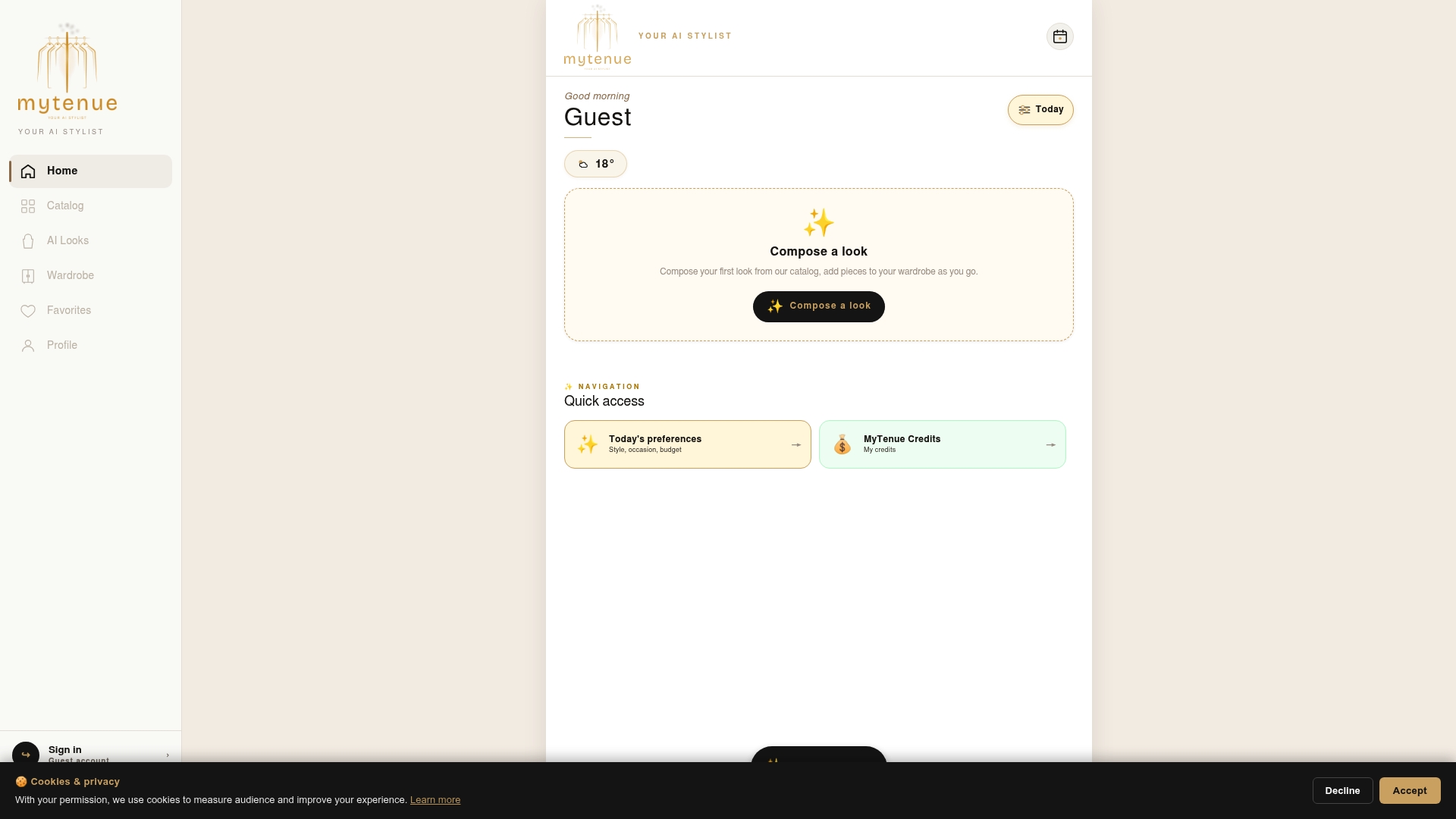
What you get:
- Outfit suggestions from your own wardrobe
- Calendar planning for your looks
- Virtual try-on with your avatar
- Daily weather-adapted ideas
- Flat-lay outfit images
Plans: Free, Basic at 5.99 € per month, Premium at 9.99 € per month, and Gold at 16.99 € per month. See the plans and download the app.
A 20-minute starter routine
No setup marathon. Just this:
- Minutes 1 to 5. List your week's events and check the forecast.
- Minutes 6 to 10. Choose three formulas.
- Minutes 11 to 17. Assign a look to each day. Leave one flexible.
- Minutes 18 to 20. Set a recurring reminder for next Sunday, and four seasonal switch dates for the year.
Run it for three weeks. Then review what you wore, what you skipped, and what you need. Adjust the formulas. Keep going.
FAQ
How far ahead should I plan outfits?
One week is the sweet spot for most people. It is long enough to save time and short enough to adapt to weather and events. Add a monthly overview for fixed events, and plan trips separately.
How often should I update a rotation planner?
Do a quick reset monthly and a fuller switch four times a year, as suggested by the seasonal switch method. Put these on your calendar with real dates so they actually happen.
What if the weather changes after I plan?
Swap the finishing pieces first: shoes, outerwear, a scarf. Keep the base of the look. A buffer day in the week also gives you room to move things around.
Do I need to own a lot of clothes to plan outfits?
No. Three formulas with two or three variations each already cover a working week. A smaller wardrobe is often easier to plan, because every piece gets used.
Can I plan outfits in an app instead of on paper?
Yes. An app keeps photos of your pieces, saved looks and a calendar together. With Mytenue, you digitize your wardrobe once, then schedule looks and preview them with the virtual try-on.
Sources
- Quels sont les enjeux d'une mode plus durable ? (ADEME)
- Comment bien acheter des vêtements d'occasion ? (ADEME)
- Le climat en France hexagonale et Corse (Météo-France)
- Les climats en outre-mer (Météo-France)
- The Seasonal Switch Method: Refresh Outfits Without Buying
- Capsule Wardrobe Season Planner (PDF)