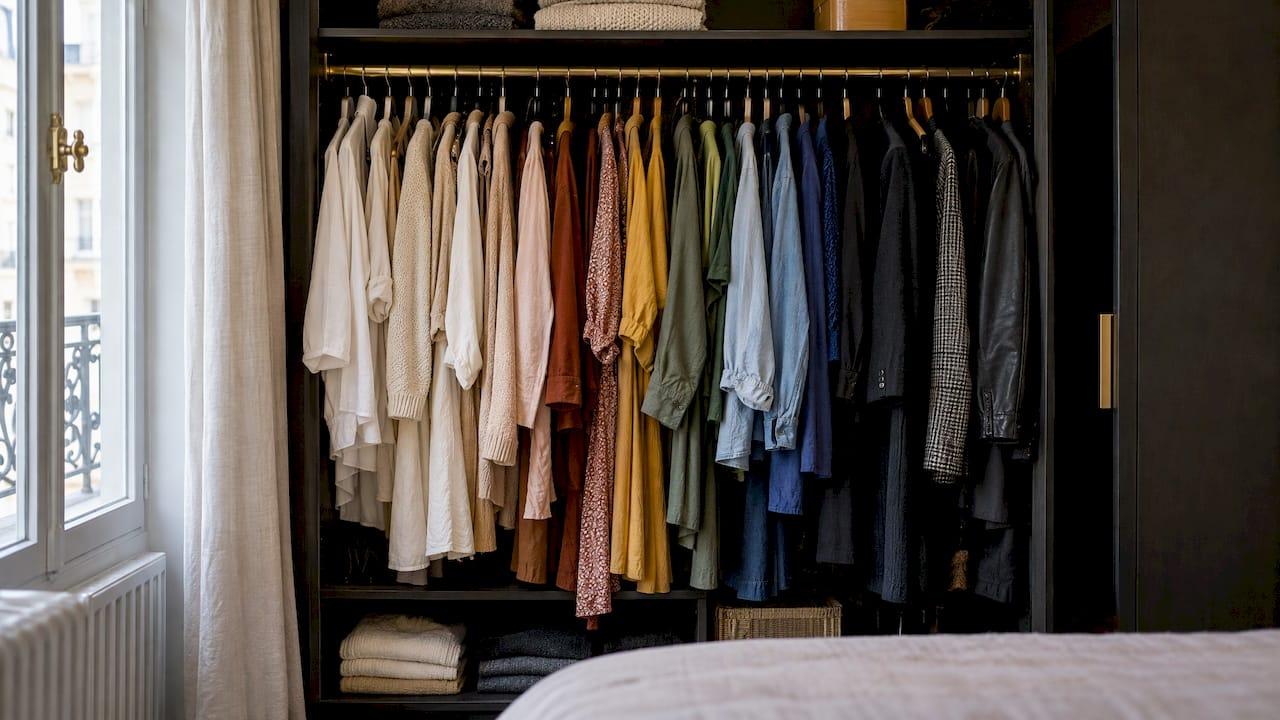
The fastest way to search a closet by color is a two-level system: group by garment type first, then arrange each group by color family, light to dark. Then take the same logic to your phone. Photograph your pieces, and let an AI stylist read the colors, match them and show the outfits. We built Mytenue for that second step: your wardrobe digitized, your colors analyzed, your looks ready.
This guide gives you both. The physical method takes an afternoon. The digital one takes a few evenings. Together they end the "I have nothing to wear" morning.
TL;DR
- Sort by type first (tops, pants, dresses, coats), then by color inside each type. A pure color rail slips out of order quickly.
- Pick one order and keep it: rainbow, or light to dark. Neutrals sit together at one end.
- Give prints a home: file them under their dominant color, or in one dedicated zone.
- Check your lighting. Navy and black look alike in a dim closet.
- Digitize your wardrobe in the Mytenue app to search, match and try on looks without opening the closet.
Table of Contents
- Why search a closet by color at all?
- Step 1: Empty and sort before you color-code
- Step 2: Type first, color second
- Step 3: Choose your color order
- Step 4: Handle the tricky pieces
- Step 5: Fix your lighting
- Step 6: Run the 10-second test
- Searching by color when you dress
- Why the physical method has a ceiling
- Search your wardrobe by color with Mytenue
- Get started with the app
- Our point of view
- FAQ
- Sources
Why search a closet by color at all?
Color is the quickest thing your eye reads. Before you think "shirt" or "knit", you see "white" or "navy". A closet that follows that logic lets you choose by sight.
Three practical gains:
- Speed. You scan a row, not a pile.
- Harmony. Sorting by color lets you see color combinations before you build them.
- Honesty. Seven near-identical gray sweaters show up at once. So do the colors you never wear.
That last point saves money. You spot duplicates before you buy another one.
Step 1: Empty and sort before you color-code
Color-coding a messy closet only organizes the mess. Start with a clear-out.
- Take everything out. Yes, everything.
- Make three piles: keep, let go, and "maybe". A three-pile approach with a six-month rule for the maybes works well: if you have not reached for a maybe piece in six months, let it go.
- Move off-season pieces out of the main rail. Vogue France reports an expert tip to store off-season clothes in zippered bags under the bed or in a spare room.
- Put hangers in one matching set. Identical hangers make a rail readable.
Twice a year is a sensible rhythm for a full reset, at the change of seasons.
Step 2: Type first, color second
Here is where most color-coded closets fail. People sort by color alone, and then cannot find "the black shirt" among forty black and blue things.
The approach that holds up: sort by type, then by color within each type. The same source notes that a pure color closet gets disorganized the moment a piece comes back from the wash and lands in the wrong spot.
So build it like this:
- Rail 1: shirts and blouses
- Rail 2: knits and sweaters
- Rail 3: pants and skirts
- Rail 4: dresses
- Rail 5: jackets and coats
Inside each rail, color takes over. Think of color as the third level of reading: family first, then use or formality, then shade. That keeps categories intact while giving your eye a gradient to follow.
A closet with an open rail suits full color order well. A small closet with drawers benefits most from type-first sorting. Pick the logic that fits your space and your routine.
Step 3: Choose your color order
Two orders work. Choose one and stay with it.
Option A: the rainbow
Red, orange, yellow, green, blue, indigo, violet. It is the best-known method. Neutrals (white, gray, black, beige) usually go apart, at the start or the end of the rail.
Option B: light to dark
Within each color family, run from lightest to darkest. A cream sweater comes before a golden beige, then a deep camel. This suits drawers and shelves especially well.
A full neutral-first layout could run like this: ecru, beige, camel, gray, black, then pink, red, orange, yellow, green, blue, violet. Within each family, go light to dark.
Hanging versus folding
| Storage | How to arrange by color | Why it works |
|---|---|---|
| Hanging rail | Dark on the left, light on the right (or the reverse, but be consistent) | Your eye follows one gradient |
| Folded piles | Lightest on top, darkest at the bottom | Quick visual scan of the stack |
| Drawers | Fold vertically, stand pieces upright by color | You see every edge at once, nothing to lift |
For piles, leave about 5 cm between stacks so nothing gets lost in the gap, as one stylist suggests. Vertical folding turns a drawer into an index: spot a pale pink top without lifting three others.
Step 4: Handle the tricky pieces
Real wardrobes are not a clean rainbow. Plan for the exceptions.
Neutrals
Black, white, gray, navy, beige and camel are the bulk of many closets. Give them their own block, at one end of the rail. Inside it, go light to dark. Your neutrals are your base, so you want to reach them fast.
Prints and multicolor pieces
The rule is simple: file by dominant color. A red scarf with black dots goes with the reds. If a piece is hard to place, or you own many, make a dedicated prints zone at the end of the rail as a buffer.
Near-identical shades
Navy, black and charcoal confuse everyone. Compare them side by side, in daylight, and place the darker one first. If you hesitate every time, that is a signal to merge two families into one.

Small wardrobes
Do not create ten color zones for twenty pieces. Adapt the number of families to your real volume. Three or four groups (neutrals, warm, cool, prints) are enough.
Step 5: Fix your lighting
A badly lit closet distorts shades. Navy passes for black. Anthracite gray looks forest green. For accurate sorting, use neutral light of around 4000K, which renders colors faithfully.
No light in the closet? Sort near a window, in daylight. Carry the doubtful pieces there. It takes one minute and saves a re-sort.
Step 6: Run the 10-second test
Once everything is in place, test it. Try to find a light top, black pants and a colored knit in under 10 seconds. If you hesitate, reduce the zones or group the categories you wear together.
Then add a two-minute routine after each laundry. Check the category, then the color family, then the shade, before you put things back. That small habit prevents a full re-sort weeks later.
Searching by color when you dress
A sorted closet is not the goal. A good outfit is. Here is how to use color order when you choose what to wear.
Start from one anchor. Pick the piece you want to wear: raw denim, a black dress, beige pants. Then scan the neighboring rails for tops that fit.
Limit your palette. A defined look often uses 3 to 4 colors per outfit. Accessories such as a scarf, a bag or shoes add a color touch to a simple base.
Build a palette. A practical formula: 2 or 3 neutrals as a base, 2 or 3 main shades, a few accents. Terracotta, olive, burgundy and mustard are typical accent colors. When every top suits every bottom, mornings get easy. Our guides on wardrobe color palettes and on color combinations that always work give you tested formulas.
Finish the look. Once the clothes are chosen, small touches count. A fragrance can tie the whole outfit together, as this guide on why perfume completes an outfit explains.
Read what your closet tells you. A color-sorted rail shows imbalances: too many strong colors that do not match, or a palette too uniform. It also replaces the mental inventory you try to run while staring at a full closet.
For a streetwear angle on pairing colors and cuts, see these concert outfit ideas.
A weekly example
Six pieces can make a full week. One capsule example runs like this: raw denim, a white shirt, a blazer and loafers for the office. Swap the shirt for a white tee and a sweatshirt with sneakers for a casual day. A black dress with a blazer and heels covers an appointment. Beige pants, a white tee and a denim jacket handle errands. Raw denim, a burgundy blouse and ankle boots do the evening. Same few colors, five different days.

Why the physical method has a ceiling
A color-sorted closet is great at home. It cannot follow you to the store, the train or the airport. It cannot tell you which of your tops goes with the green skirt you are about to buy. It cannot show an outfit before you put it on.
That is where your phone comes in. Digitize the wardrobe once, and "search by color" works anywhere.
Search your wardrobe by color with Mytenue
Mytenue is an AI stylist app for iOS and Android. You digitize and organize your wardrobe in it. The AI then analyzes color, fabric, style and occasion compatibility, and builds outfit recommendations from the pieces you already own.
What that means in daily use:
- Your closet in your pocket. Every piece is catalogued, so you check what you own before you buy.
- Color-aware looks. The AI reads how your colors work together and scores the looks.
- Virtual try-on. Try the outfit on your personal avatar before you get dressed.
- Flat-lay images. Get editorial flat-lay visuals of the look.
- Weather-adapted suggestions. Daily ideas that fit the forecast.
- Calendar planning. Plan your week of outfits in advance.
The interface is available in French and English, on mobile and on the web. For a busy parent, it is a quick idea in the morning. For a student, it is more looks from fewer pieces. For a young professional, it is a polished week planned on Sunday evening.
You can mix and match what you own with new pieces. That keeps your wardrobe sustainable and your purchases deliberate.
Get started with the app
The Free plan lets you start without a published price. Paid plans are Basic at €5.99 per month, Premium at €9.99 per month and Gold at €16.99 per month. Download the Mytenue app on the App Store or Google Play, and begin with your favorite five pieces.

To go further once your wardrobe is in, read how to get more outfits from the closet you already have and how to remix what you own. Building a smaller, sharper wardrobe? Try our professional capsule wardrobe plan or the French chic capsule of 12 pieces.
Our point of view
We think color is the best entry point into a wardrobe. It is the first thing you see, so it should be the first thing you can search.
But a rail in rainbow order is only half of it. A wardrobe is a set of relationships: this knit with those pants, this scarf with that coat. Humans see those relationships slowly, one morning at a time.
That is why we built Mytenue around your own wardrobe. Our AI is designed to read color, fabric, style and occasion together, so the match you were looking for appears without the hunt. Try-on on your own avatar and flat-lay images let you judge the look before you commit.
Sort your closet. Enjoy the calm. Then let your AI stylist do the combining.
Ahmed
FAQ
How do I sort a closet by color?
Group by garment type first: shirts, knits, pants, dresses, coats. Inside each group, order the colors, either rainbow or light to dark, with neutrals together at one end. Put prints under their dominant color. Finish with a two-minute check after each laundry.
What order should clothing colors go in?
The classic order is red, orange, yellow, green, blue, indigo and violet, with neutrals placed at the start or the end of the rail. The other option is light to dark inside each family. Both work. What matters is that you keep the same order everywhere.
How do I search for clothes by color when choosing an outfit?
Pick an anchor piece, then scan the rails next to it. Keep to 3 or 4 colors per outfit and use accessories for the accent. In the Mytenue app, your digitized wardrobe and the AI's color analysis do this matching for you, with a try-on on your avatar.
What do I do with patterned clothes?
File each piece by its dominant color. If the colors are balanced or you own many multicolor pieces, give them their own zone at the end of the rail. That keeps the rest of your color order clean.
How often should I re-sort my closet?
Twice a year is a good rhythm, at the change of seasons. Between those resets, put each piece back in its place after washing. That keeps your color system working.
Sources
- Trier son dressing : pourquoi ? comment ?
- 5 astuces d'experts pour remettre sa garde-robe à jour
- Comment ranger son dressing : la méthode en 6 étapes
- Organiser sa garde-robe par couleur
- Au secours, j'ai rien à me mettre !
- Optimiser le classement de vos vêtements par couleur
- La garde-robe parfaite pour un style unique
- Comment ranger son dressing efficacement
- Garde-robe capsule femme