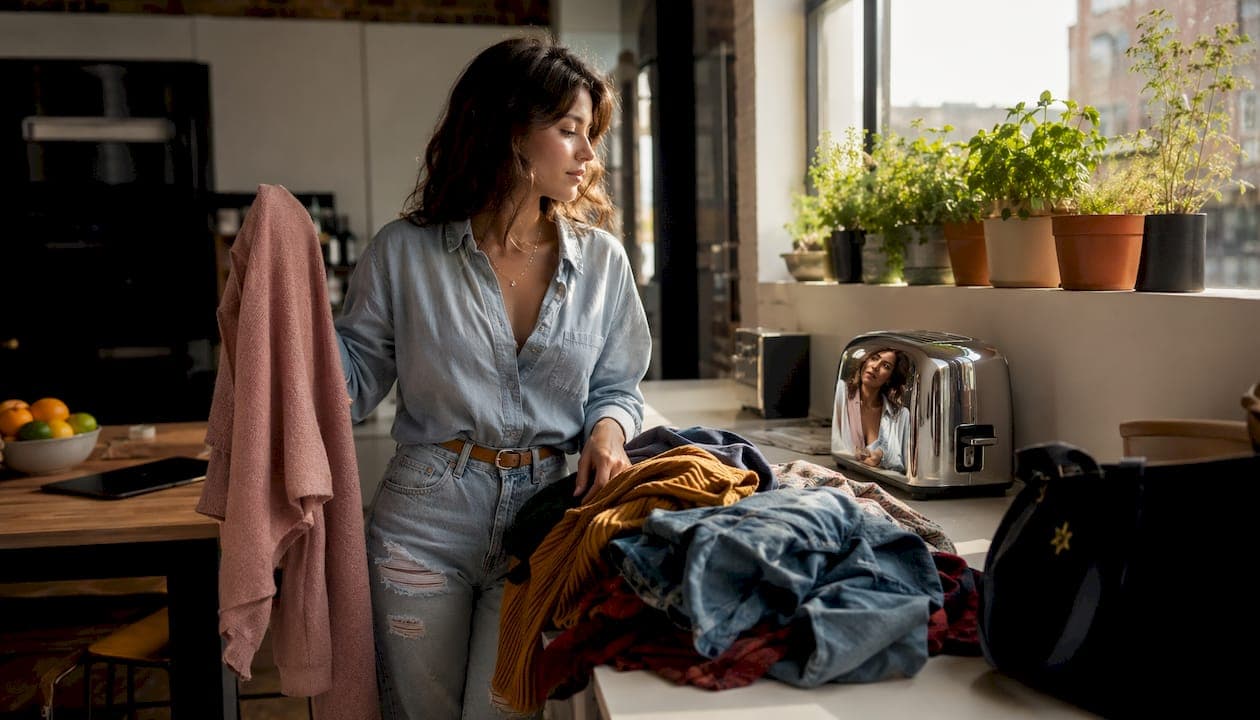
Here are 8 ready-to-wear thrift-store outfit ideas you can copy today. Each one follows the 4-piece formula that makes secondhand looks feel intentional: one structured layer + one clean base + one relaxed bottom + one grounded shoe.
- Day casual: White ribbed tank + thrifted straight-leg denim + loafers + leather tote. Swap: Trade the tote for a canvas bag if leather isn't in your closet yet.
- Smart work: Navy wool blazer + crisp white button-down + pleated trousers + low block heel. Swap: Swap the button-down for a fine knit if the office runs relaxed.
- Date night: Silk blouse + midi skirt + simple leather boot + one gold chain. Swap: A fitted turtleneck works if silk is hard to find.
- Night out: Vintage blazer + black fitted tee + dark straight jeans + clean sneakers. Swap: Swap sneakers for a low heel to shift the register up.
- Weekend casual: Oversized cardigan + plain tee + black jeans + white sneakers. Swap: A chore coat replaces the cardigan with zero styling effort.
- Vintage: Patterned blazer + well-fitting straight jeans + ankle boots + structured bag. Swap: Swap the patterned blazer for a solid one and add a silk scarf for the vintage cue.
- Monochrome: Camel turtleneck + camel wide-leg trousers + tan loafers + brown belt. Swap: Any single neutral family works — navy, grey, or all-black.
- Layered: Thin turtleneck + wool coat + straight denim + boots + scarf. Swap: A denim jacket over a hoodie gives the same layered proportion at a lower price point.
Pro Tip: Identify your wardrobe gaps before you shop. Fashion expert PJ Gach puts it plainly: "Drill down on exactly what you need — are you lacking a winter jacket, spring coat, or a blazer to wear with jeans?" Buying to fill a gap beats buying because the price is low.
Table of Contents
- Three flat-lay outfit examples you can build from thrift finds
- How do you adapt a thrift outfit to your own wardrobe?
- What should you look for when thrifting?
- Which tailoring jobs give thrift finds the biggest upgrade?
- What styling rules make thrifted outfits look curated?
- How does AI help you personalize thrifted outfits faster?
- Key Takeaways
- The part most thrift guides skip
- Your thrift finds deserve a smarter wardrobe
- Useful sources and further reading
Three flat-lay outfit examples you can build from thrift finds
Look 1: The easy city uniform
| Piece | What to find | Tag/fabric cue |
|---|---|---|
| Structured layer | Wool blazer, navy or camel | 100% wool or wool blend |
| Clean base | White ribbed tank | Cotton or modal |
| Bottom | Straight-leg dark denim | Mid-weight denim, no distressing |
| Shoe | Tan leather loafer | Full leather sole preferred |
| Finishing piece | Leather tote | Structured handles, brass hardware |
Why it reads elevated: the blazer shoulder creates one clean line from collar to hem. Dark denim keeps the bottom calm. The loafer grounds it without competing. Two easy swaps: replace the blazer with a trench coat for a longer silhouette, or trade the loafer for a clean white sneaker on weekends.
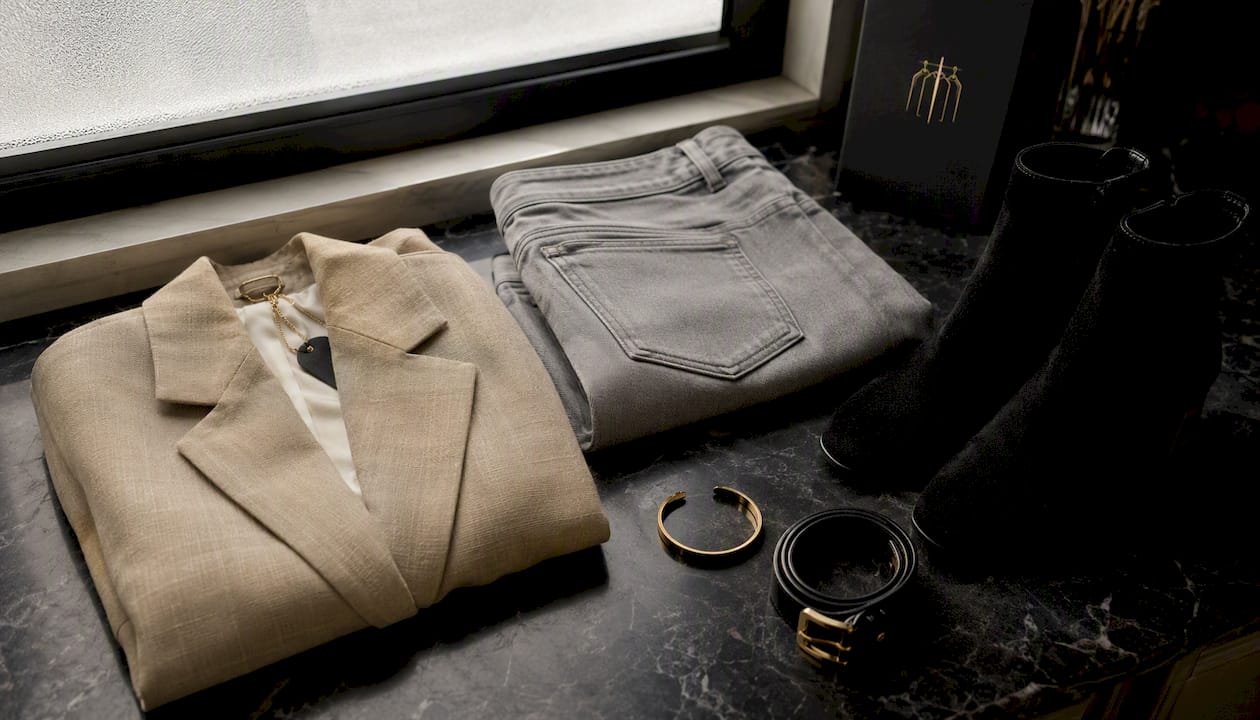
Shopping checklist: Check men's sections for oversized blazers that drape well on women. Look for wool content on the tag. Acceptable condition: minor pilling on inner lining, loose buttons (easy fix). Pass on weak shoulders or shiny synthetic fabric.
Pro Tip: Press the blazer with a damp cloth before wearing. A freshly pressed thrift blazer looks like a $300 purchase.
Look 2: The dressed-up weekend
Silk blouse (cream or ivory) + midi skirt (pleated, any neutral) + simple leather ankle boot + one delicate necklace. The texture pairing of silk and a structured skirt does the styling work without any loud color. Swap the silk blouse for a fine cotton button-down if silk is scarce, and check both the dress rack and the skirt rack for midi lengths since stores frequently misfile them.
Look 3: The layered cold-weather look
Thin turtleneck (black or grey) + thrifted wool coat + straight denim + leather boot + scarf. The coat is the anchor. Everything underneath is a neutral base. This look works because the coat gives the outfit its authority — the basics underneath barely matter. Swap: a structured denim jacket over a hoodie gives the same proportion at a lower cost.
How do you adapt a thrift outfit to your own wardrobe?
Start with the anchor item, then build outward.
- Lock in the anchor. Pick the one structured piece (blazer, coat, cardigan) that fits your shoulder width. Shoulder seams that sit at the edge of your shoulder are non-negotiable — everything else can be altered cheaply.
- Choose your base. A clean, fitted top in a neutral you already own. No new purchase needed here.
- Add a balancing bottom. If the top is structured, the bottom can be relaxed (straight jeans, wide-leg trousers). If the top is soft, the bottom should have shape (midi skirt, pleated pant).
- Ground with a shoe. Loafers, boots, or clean sneakers. The shoe stabilizes the look.
- One finishing detail. Belt, bag, or a single piece of jewelry. Not all three.
Pro Tip: Check sleeve length before buying a blazer. A tailor can shorten sleeves for $15–$20, but lengthening them is rarely possible.
| Body variation | Anchor swap | Bottom swap |
|---|---|---|
| Petite | Cropped blazer or short cardigan | Straight-leg jean (no break at ankle) |
| Tall | Long trench or maxi cardigan | Wide-leg trouser with full hem |
| Plus-size | Draped layer with shoulder shape | Midi skirt or dark straight-leg denim |
For a deeper look at wardrobe-stretching strategies, the same adaptation logic applies whether you're working with thrift finds or existing pieces.
What should you look for when thrifting?
Go in with a category target, not an open browse. Stores frequently misfile merchandise, so a focused search by category cuts decision fatigue and improves your hit rate.
- Fabric first: Check tags for cashmere, wool, and 100% cotton. Natural fibers last longer and feel premium. Pass on shiny synthetics.
- Seams and stitching: Flat, even seams signal quality construction. Puckered or fraying seams are a pass unless the item is otherwise exceptional.
- Lining and hardware: Metal zippers and structured linings indicate a higher-quality original garment.
- Odor check: Musty smell usually washes out; smoke smell often doesn't.
- Fit check: Shoulder width and overall length. Everything else is alterable.
- Cross-check sections: Look in men's shirts for oversized button-downs, and check both dress and skirt racks for midi lengths.
Pro Tip: Knitwear, button-downs, denim jackets, and structured bags are the most reliably good secondhand categories. Start there.
| Category | Typical thrift price range | Worth tailoring? |
|---|---|---|
| Wool blazer | $8–$25 | Yes — shoulder and sleeve fixes pay off |
| Silk blouse | $4–$15 | Minor hem only |
| Straight-leg denim | $5–$15 | Hem if needed |
| Leather bag | $10–$60 | Condition the leather; replace hardware |
| Wool coat | $15–$35 | Yes — hem and lining repairs worth it |
Which tailoring jobs give thrift finds the biggest upgrade?
Fit precision is what separates a thrift find from a thrift look. Minor tailoring is often the only difference between looking intentional and looking secondhand.
- Hem trousers or skirts: $10–$20. The single highest-impact fix.
- Take in a blazer at the waist: $20–$35. Transforms a boxy thrift blazer into a tailored one.
- Shorten sleeves: $15–$25. Sleeve length is the fastest tell of a poor fit.
- Replace a zipper: $10–$20. Cheap fix that extends the life of a great piece.
- Re-line a jacket: $30–$60. Worth it only for a wool coat or blazer you'll wear for years.
- Press and restitch loose seams: $5–$15. Often done same-day.
DIY fixes: Missing buttons (sew on a replacement in under five minutes), loose hems (fabric tape holds until you get to a tailor), and snapped bag hardware (replacement clasps cost under $5 at a craft store).
Pro Tip: Keep a local tailor on call for $10–$20 fixes. A well-fitted thrift blazer beats a poorly fitted new one at any price.
| Decision | Action |
|---|---|
| Fits at shoulder, too long | Tailor — hem it |
| Wrong shoulder width | Toss or donate |
| Loose button, minor hem | DIY |
| Great fabric, broken zipper | Tailor — worth the fix |
What styling rules make thrifted outfits look curated?
One structured line anchors every great thrift outfit. That line can come from a long blazer over a tank and straight jeans, a midi skirt with a tucked knit, or a trench over a simple dress and boots. The eye needs to see one calm shape before it notices pattern, color, or label.
- Silhouette first: Structured top + relaxed bottom, or relaxed top + structured bottom. Never both relaxed.
- Color story: Limit to two neutrals plus one accent. Monochrome reads most elevated.
- Texture pairing: Wool + cotton, silk + denim, knit + leather. Contrast in texture adds depth without adding color noise.
- Accessory restraint: One bag, one shoe choice, one jewelry piece. Adding a second statement cancels the first.
"Use one structured anchor piece per outfit and keep the palette calm to make thrifted pieces feel editorial." — Underpriced.app
Pro Tip: For seasonal thrift styling, swap textures rather than silhouettes. The same blazer-and-straight-jean formula works year-round when you change the base layer and shoe.
Frugal-chic guidance from trend editors confirms the same principle: thrift prints and seasonal colors freely, but invest in classic shapes like blazers and structured bags because those silhouettes hold their value across years.
| Before | After | What changed |
|---|---|---|
| Oversized blazer + baggy jeans + chunky sneaker | Oversized blazer + straight jean + loafer | Shoe and jean fit |
| Silk blouse + midi skirt + statement earrings + bold bag | Silk blouse + midi skirt + simple boot | Removed two accessories |
| Turtleneck + wide-leg trouser + sneaker | Turtleneck + wide-leg trouser + low heel | Shoe only |
How does AI help you personalize thrifted outfits faster?
A digital wardrobe turns your thrift finds into a searchable, styleable collection. Here's the workflow:
- Photograph each piece as a flat-lay against a plain background.
- Tag fabric, fit, and occasion (e.g., "wool blazer — structured shoulder — navy — work/casual").
- Add to Mytenue's digital wardrobe. The app organizes pieces by category, color, and occasion.
- Request outfit recipes. Mytenue's AI cross-references your wardrobe tags and suggests combinations you might not have tried.
- Use the outfit calendar to plan looks for the week, including weather-adapted suggestions.
- Try the virtual try-on to see how a new thrift find pairs with existing pieces before committing.
- Affinity tags let the AI understand your style preferences and filter suggestions accordingly.
- Swap suggestions show you what you already own that could replace a missing piece.
- Flat-lay image generation creates editorial-style outfit images from your actual wardrobe items.
Pro Tip: After a thrift haul, add every new piece to Mytenue before putting it away. The AI surfaces pairings with existing items you'd likely overlook on your own.
| Mytenue feature | How it maps to thrift styling |
|---|---|
| Digital wardrobe | Catalog every thrift find with fabric and fit tags |
| AI outfit recipes | Generate combinations from tagged pieces |
| Virtual try-on | Preview new thrift finds with existing wardrobe |
| Outfit calendar | Plan and repeat looks without re-deciding daily |
| Swap suggestions | Find existing pieces that fill a wardrobe gap |
Key Takeaways
Thrift store outfits work best when one structured anchor piece sets the silhouette, fit precision is treated as non-optional, and AI-assisted wardrobe tools like Mytenue turn scattered finds into repeatable, personalized looks.
| Point | Details |
|---|---|
| Anchor piece first | One structured layer (blazer, coat, cardigan) sets the outfit's silhouette before anything else. |
| Fit beats price | Minor tailoring at $10–$25 per fix is what separates a thrift find from a thrift look. |
| Shop with a gap list | Identify specific wardrobe needs before entering a store to avoid impulse buys that don't integrate. |
| Natural fibers win | Check tags for wool, cashmere, and 100% cotton — they last longer and tailor better than synthetics. |
| Mytenue digitizes the process | Add thrift finds to Mytenue's digital wardrobe to get AI outfit recipes, virtual try-on, and calendar planning. |
The part most thrift guides skip
The advice to "buy quality, not quantity" at thrift stores is correct but incomplete. The real gap is what happens after you get home. Most thrift finds sit unworn not because they're bad pieces, but because they were never connected to the rest of the wardrobe. A blazer hanging alone in a closet is just a blazer. The same blazer tagged in a digital wardrobe, cross-referenced with three pairs of trousers and two pairs of shoes, becomes five outfits.
That's the actual value of digitizing thrift finds. Not the novelty of AI, but the practical act of making a piece visible and combinable. The outfit recycling principle applies here directly: the more connections a piece has to other items, the more wear it gets. A thrift haul that goes straight into Mytenue the same day will generate more outfits per dollar than one that goes straight into a drawer.
The other underrated move: tailor one piece per haul. Not everything, just one. A single well-fitted blazer or hemmed trouser raises the perceived quality of every outfit it touches.
Your thrift finds deserve a smarter wardrobe
Mytenue turns every thrift haul into a personalized outfit plan. Upload a photo of your new find, tag the fabric and fit, and the AI generates outfit combinations from your existing wardrobe instantly.
- Digitize your haul in minutes with flat-lay photos and smart tagging.
- Get AI outfit recipes that pair new thrift finds with pieces you already own.
- Plan your week with the outfit calendar and weather-adapted daily suggestions.
Free to start. No subscription required to explore your first wardrobe. Try Mytenue now and see how many outfits you already own.
Useful sources and further reading
- How to Shop at Thrift Stores to Refresh Your Wardrobe — Martha Stewart: expert advice from PJ Gach on shopping with intention and identifying wardrobe gaps.
- Thrift Store Chic: Build Better Outfits for Less — Underpriced.app: the 4-piece outfit formula and fit-first styling rules.
- Thrifting 101: How to Score the Best Finds — The Everygirl: fabric literacy guide and best secondhand categories.
- 6 'Frugal Chic' Outfit Ideas of 2026 — Who What Wear: trend-editor guidance on which silhouettes to thrift vs. invest in.
- Thrifted Outfits Guide — Tumbleweed Thrift: anchor-piece strategy and tailor-on-call advice.
- Thrift Store Outfit Ideas — Needlestyle: targeted category search tactics and misfiled-item tips.
- Seasonal Style Refresh on Budget — Mytenue Blog: seasonal thrift styling examples and budget outfit planning.
- How to Dress Well Spending Less Money — Mytenue Blog: wardrobe gap strategy and budget-conscious styling guidance.
- One Item, Many Looks: Wardrobe Transformations That Work — Mytenue Blog: how a single anchor item generates multiple outfits.