Mix fabrics by contrast, not by similarity. Pair smooth with rough, matte with shiny, structured with fluid. Let one fabric lead, let a second support, and keep the colors calm. That is the whole method. The rest of this guide shows you how to apply it to a real wardrobe, in the morning, without second-guessing.
TL;DR
- Choose fabrics that clearly differ: leather with knit, denim with silk, corduroy with smooth cotton.
- Aim for two or three distinct textures per outfit, with one dominant.
- Avoid two heavy, rough fabrics as main pieces, and two very shiny ones together.
- Keep colors tonal or neutral when textures get bold.
- Preview combinations before you wear them: a virtual try-on does it in seconds.
Table of Contents
- The one rule behind every good fabric mix
- Fabric pairings that work
- How many fabrics in one outfit?
- Build the outfit from the inside out
- Fabrics you should not pair
- Sheer and light fabrics: a quick way to add depth
- Keep color and print calm
- Mix fabrics with the weather in mind
- Three worked examples
- A note on the 3-3-3 rule
- Our perspective
- Try your fabric mixes before you wear them
- FAQ
- Sources
The one rule behind every good fabric mix
Contrast is what makes a mix look deliberate. According to TRY's texture guide, two very similar textures side by side look like a mistake, while two clearly different ones look intentional.
Think of it as pairs of opposites:
- Smooth and rough: silk against tweed.
- Matte and shiny: cotton against satin.
- Structured and fluid: a tailored blazer over a draped dress.
This is the same principle howtofashionedition's French guide gives: pair smooth with rough, matte with shiny, structured with fluid. Its idea is that fabrics should dialogue, not fight.
A useful side effect: smooth fabrics such as silk, leather and satin tend to look polished whatever their price, so one of them can lift an otherwise simple outfit.
Fabric pairings that work
You do not need to invent combinations. These are the reliable ones named across the sources we checked.
| Pairing | How to wear it | Source |
|---|---|---|
| Leather + knit | Leather jacket over a chunky sweater | TRY |
| Suede + denim | Suede jacket with jeans | TRY |
| Velvet + cotton | Velvet blazer over a plain cotton tee | TRY |
| Silk + wool | Silk blouse under a wool coat or sweater | TRY |
| Corduroy + smooth leather | Cords with leather shoes or a leather jacket | TRY |
| Coarse knit + silky skirt | Chunky sweater, fluid skirt | South Boutique |
| Tweed blazer + chiffon | Structured jacket over a flowing dress | South Boutique |
Notice the logic. Each row puts one heavier or rougher piece with one lighter or smoother piece. That is contrast doing the work.
The Texture Clash trend
If you like a bolder look, Levi's France has a feature on the Texture Clash trend. It stacks denim, sherpa, knit and leather in unexpected ways. Its formulas include corduroy, sherpa and flannel, leather, knit and denim, and wool, corduroy and denim. The leather, knit and denim version works because it keeps one unified color palette.
That detail matters. The more daring the textures, the quieter the colors should be.
What Paris street style is doing
Vogue's report on Paris Fashion Week fall street style (October 2025) describes corduroy, brocade, silk and taffeta paired with bold prints such as houndstooth, plaid and stripes. Examples include a fringe cardigan with corduroy trousers and a silk printed coat over a striped button-up. You do not have to go that far. But it shows that deliberate contrast reads as confident, not messy.
How many fabrics in one outfit?
Two or three. Sources agree on this more than on anything else.
- Sahni Fabs suggests no more than two dominant fabric personalities: one leads, the second supports, and silhouette and color do the rest.
- Relco London recommends two or three key textures per outfit. It adds that if you mix heavy fabrics like denim, wool and leather, the colors should be complementary so you are not forcing too many statements at once.
- The French guide above goes for three distinct textural notes with one dominant. That is its step from "well put together" to "thoughtful".
A simple way to hold this in your head: one star, one supporting piece, one quiet piece. The star is the fabric people notice. The supporting piece contrasts with it. The quiet piece, usually a plain cotton or a solid neutral, lets everything breathe.
South Boutique makes the same point about grounding: solid or neutral pieces such as jeans or a solid turtleneck counterbalance a fluffy angora sweater or a leather jacket.
Build the outfit from the inside out
When you are unsure, work in layers, one texture at a time. This follows the build order in TRY's guide.
- Start with a base texture. A cotton tee, a fine knit, a silk camisole.
- Add a contrasting top layer. If the base is smooth, go for something with grain or weight: a cardigan, a wool jumper.
- Add an outer layer that contrasts with both. Leather, denim, tweed or a structured coat.
- Finish with accessories in complementary textures. A leather belt, a wool scarf, suede shoes.
Check contrast after each step. If a new piece looks too similar to the last one, swap it.
Layering within the same family
Harper's Bazaar quotes stylist Sarah Slutsky Tooley on layering category sisters, such as a denim jacket over a leather jacket. That shows a range of textures and scale, as long as proportions are complementary. In short: if one layer is cropped, the other should run longer.
For menswear, Esquire's spring layering guide notes that heavier denims, twills and flannels act as a mid-layer when it is cool and an outer layer when it is warm. It also suggests a washed-out denim shirt under a black or brown jacket for a pop of blue.
UNIQLO's LifeWear magazine takes a relaxed view in its modern layering guide: try two shirts of different fabrics, like a striped shirt and a plaid flannel, and balance boldness with reserve.
Fabrics you should not pair
People often ask which two fabrics should never be worn together. There is no law, but there are combinations that tend to look wrong.
Two rough fabrics as main pieces. Style Blooming says bouclé with tweed, or cable knit with corduroy, compete instead of contrast. The result reads as dense, not layered.

Two very shiny fabrics. The same source flags satin with velvet, or silk with glazed leather, as the opposite problem: too much light reflected at once.
Three different textures across three garments. It lists this as a third combination to avoid when each piece shouts equally.
Fabrics with opposite weight and breathability. Bairon Fashion points to wool with linen (heavy and warm against light and breathable) and silk with denim (delicate fabric dragged down by a rugged one, which can lose its drape or snag). Treat these as cautions, not bans. A silk blouse under a denim jacket is a classic when you handle the silk gently.
The workable rule: take one fabric from a rough or organic family and one from a smooth or matte family. Do not take two from the same family.
On the same theme, a French menswear review advises against velvet with velvet or moleskin with thick textured wool because of visual overload, and suggests moleskin with raw denim, simple cotton or fine wool.
Sheer and light fabrics: a quick way to add depth
Transparency is one of the easiest textures to add. Modemag lists tulle, organza, mousseline, mesh and cotton or silk voile among the key sheer materials. Its tip: layer a transparent piece over a basic base such as a camisole, t-shirt or bodysuit. That tempers the effect and still adds dimension.

For warmer months, Femme Magazine's spring-summer 2026 trends suggest linen with organza, light denim with silk, and thick cotton with sheer voile. The aim is visual tension, not an exact match.
Keep color and print calm
Textures get the attention, so give them a clean backdrop.
- Go tonal. Harper's Bazaar says contrasting prints come together when you stick to a tonal palette. Its example is a paisley velvet jacket over a silky leopard-print blouse.
- Use a monochrome base. A single color in several surfaces creates depth with no clash. For ideas, see tonal looks with varied surfaces.
- Ground one bold piece. When one fabric is loud, keep the rest simple, as in one bold piece, the rest neutral.
If color pairing is your weak spot, our guide to color combinations that always work gives you formulas to lean on.
Mix fabrics with the weather in mind
A fabric mix that looks great on a hanger can feel wrong at 25°C or 5°C. Match weight to temperature first, then play with texture.
- Cool days: heavier denim, wool, flannel and knit as the mid-layer, with a smooth lining layer underneath.
- Warm days: linen, cotton and light denim, with a sheer or silky accent.
- In between: one lightweight outer layer you can take off.
We have detailed guides for each situation. See choosing fabrics by season, a three-layer formula for 10°C, five mid-season outfit formulas, and how to build cold-weather looks from nine pieces. For hot offices, there is a page on workwear fabrics for summer.
Three worked examples
Here is the method applied to pieces most wardrobes already hold.
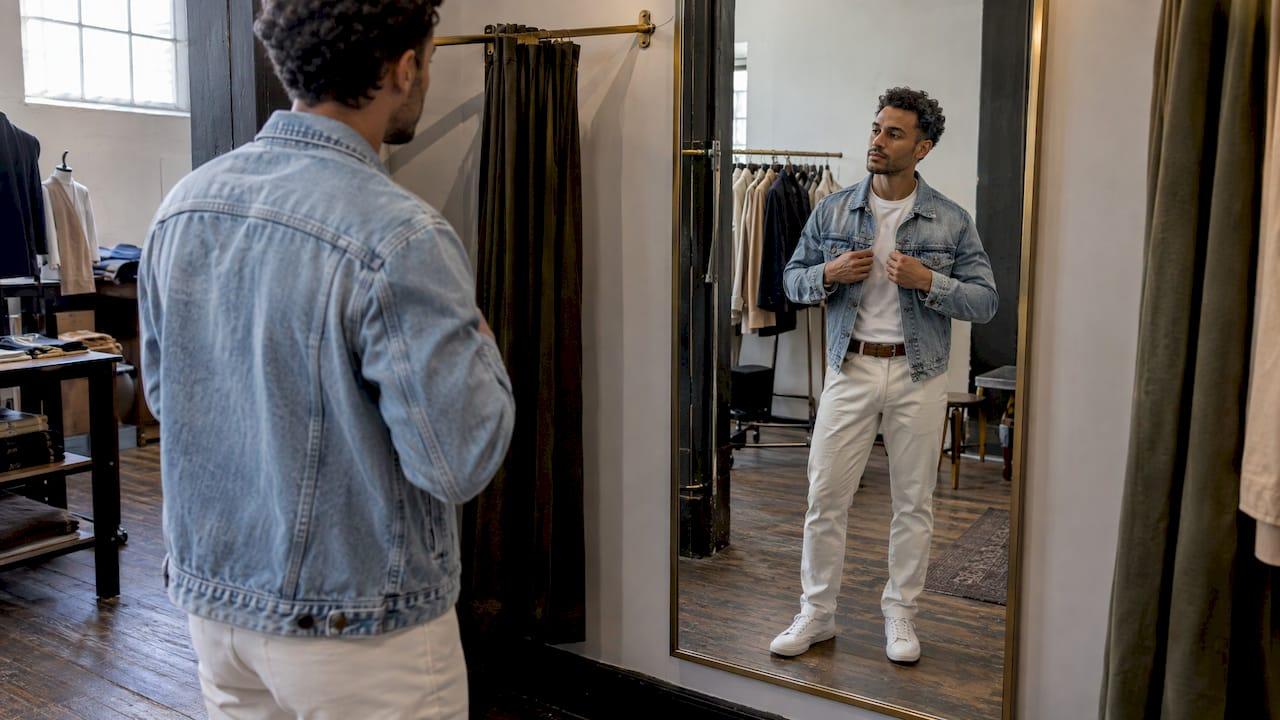
Casual weekend. White cotton tee (quiet), light-wash denim jacket (supporting), leather sneakers or belt (star accent). Three textures, one palette of blue, white and tan.
Office, cool day. Silk or satin-finish blouse (smooth), fine wool trousers (matte), structured blazer in a tweed or textured weave (star). The blouse and blazer contrast clearly. Keep colors within one family, such as cream, camel and brown.
Evening. Slip dress or satin skirt (shiny), leather jacket or chunky knit (rough). This is the leather-and-silk idea in practice: a moto jacket over a slip dress, or a wool coat over a satin skirt. Both combos appear in The Budget Fashionista's list of practical texture pairs.
In each case, the check is the same. Can you name the three textures? Are any two of them alike? If so, change one.
A note on the 3-3-3 rule
People often confuse two ideas under this name. One is a capsule: three tops, three bottoms and three pairs of shoes, from which nine outfits emerge without much effort, as Frank Walder describes. The same page says a monochrome outfit tolerates at most three color tones and three materials.
Both are handy. The capsule limits your choices. The three-material cap keeps any single outfit coherent. If you build a small wardrobe this way, choose pieces in contrasting fabrics so every combination already works. Our pages on stretching outfits on a tight budget and why layering saves money show how far a few well-chosen pieces go.
Our perspective
Most people do not struggle with fabrics because they lack taste. They struggle because they cannot see the result before they get dressed.
At MyTenue, we think the answer is a stylist that knows your own wardrobe. Our AI looks at color, fabric, style and occasion compatibility across the pieces you already own, then proposes complete looks. You see them on your personal avatar or as an editorial flat-lay, so you can judge a leather-and-knit pairing before you commit to it.
We also believe the most sustainable outfit is the one built from clothes you already have. Mixing fabrics is a perfect way to make old pieces feel new: a familiar denim jacket over a silk top is a different outfit from the same jacket over a tee. Our app is designed to help you find those combinations, plan them on a calendar, and adapt them to the day's weather.
Good fabric mixing is a skill. We built the tool to make it a quick one.
Ahmed
Try your fabric mixes before you wear them
You have the rules. Now test them on your own clothes. MyTenue is an AI stylist app for iOS and Android. Digitize your wardrobe, get outfit ideas built from your own pieces, and preview them with virtual try-on on your personal avatar.
The app offers a Free plan, plus Basic at 5.99 € per month, Premium at 9.99 € per month and Gold at 16.99 € per month. See the details and download the MyTenue app.

Want a shortcut first? Read our three-minute method to mix fabrics and preview outfits digitally. If you want dressier ideas, our 15 smart casual combinations are a good place to start.
FAQ
What fabrics look good together?
Leather with knit, suede with denim, velvet with cotton, silk with wool, and corduroy with smooth leather are reliable pairs, according to TRY. Each pairs a rougher or heavier piece with a smoother or lighter one. Add a plain neutral piece to ground the look.
What fabrics shouldn't be mixed?
Avoid two rough fabrics as main garments, such as bouclé with tweed, and two very shiny ones, such as satin with velvet, per Style Blooming. Be careful with extremes of weight too, like wool with linen. Choose one rough and one smooth fabric instead.
How many textures can I wear at once?
Two or three is the sweet spot. Relco London recommends two or three key textures, and Sahni Fabs suggests two dominant ones at most. Let one lead and keep the others quieter.
How do I mix textures without a clash?
Keep your colors tonal or neutral, and make sure fabrics contrast in feel: smooth against rough, matte against shiny. Build from the inside out, one layer at a time. Checking each new layer against the previous one catches most clashes.
What is the 3-3-3 rule for outfits?
It is a capsule idea: three tops, three bottoms and three pairs of shoes that combine into many outfits, as Frank Walder explains. The same source also limits monochrome outfits to three tones and three materials.
Sources
- How to Mix Textures in Your Outfits: A Practical Guide | TRY
- Trend to try: Texture Clash | Levi's France
- Paris Fashion Week fall street style | Vogue
- Comment mélanger les textures dans votre tenue | howtofashionedition
- A Quick Guide to Mixing and Matching Clothing Textures | South Boutique
- How to Mix and Match Fabrics for Creative Outfit Designs | Sahni Fabs
- How to Add Texture to Your Wardrobe | Relco London
- How to Layer Clothes Like a Pro | Harper's Bazaar
- How to Layer Outfits in Spring 2026 | Esquire
- The Modern Layering Guide | UNIQLO LifeWear magazine
- Texture Mixing 101 | Style Blooming
- What two fabrics are you not supposed to wear together? | Bairon Fashion
- Veston moleskine Le Laboureur | Essais-produits
- La transparence en vogue | Modemag
- Mode femme printemps-été 2026 | Femme Magazine
- Ton in Ton Outfits | Frank Walder